Failed US-Iran Talks Risk Summer Oil Shock Hitting Everyday Gas Prices
If US-Iran talks fail, depleted oil buffers could trigger sharp price spikes by July, directly raising US gas prices and consumer costs as SPR, floating storage, and IEA reserves run dry. Credible analysts from Brookings and UBS warn of non-linear surges beyond $140/bbl with real economic pain for households.
As fragile ceasefire efforts between the United States and Iran falter over control of the Strait of Hormuz and uranium stockpiles, analysts warn of a potential "generational" oil price spike by mid-summer 2026. This would rapidly translate into higher gasoline prices at the pump, a tangible hit to household budgets that could amplify inflation and reshape consumer behavior nationwide. While markets have so far been cushioned by inventory draws, floating storage depletion, and Strategic Petroleum Reserve (SPR) releases, these temporary buffers are rapidly exhausting, setting the stage for non-linear price surges that mainstream forecasters are now modeling closely.
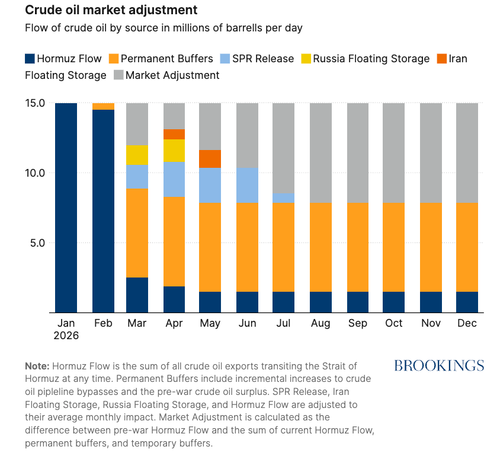
Brookings Institution analysts Robin Brooks and Ben Harris detailed the timeline in their analysis "The Timing of the Impending Crude Crisis." They note that crude prices have been held in check by trade rerouting, inventory drawdowns, and optimism for a quick resolution. However, Russian floating stocks are projected to deplete by end-April, Iranian stocks by end-May, and IEA emergency releases by July 9. The longer tanker traffic remains restricted through Hormuz — a chokepoint for roughly 20% of global oil — the greater the risk of sharp, disproportionate price spikes as buffers vanish. Their framework highlights how a sustained ~9-12% global supply shortfall could interact with declining demand elasticity to drive prices far higher than current ~$100-105/bbl levels.[1][2]
This aligns with UBS strategist Arend Kapteyn's warnings in "When The Oil Buffers Run Out." Kapteyn points to the largest-ever weekly US inventory draw (17.8 million barrels) and estimates that without SPR support, the effective disruption approaches 12%, implying prices near $123. More critically, once inventories are exhausted and "easy" demand reductions are used up, elasticity falls, leading to extreme scenarios: a 14% shortfall could push prices to $140, while worse elasticity assumptions yield $200-370 ranges. These are not abstract figures — they directly feed into refinery margins and retail gasoline, where US pump prices are already ~$1.50 above pre-conflict levels.[3]
Reuters, CNBC, and Axios reporting confirm stalled talks, with both sides entrenched on Hormuz access and Iran's nuclear program. President Trump has signaled "make a good deal or no deal," while Secretary of State Marco Rubio noted progress but persistent gaps. Oil has swung wildly on headlines: climbing on pessimism, falling on tentative breakthroughs. Yet the consensus from Goldman, JPMorgan, and others is that a no-deal outcome collides with depleted buffers precisely as summer driving season peaks.[2][4][5]
Connections often missed: This shock would not unfold in isolation. Depleted SPR limits future policy flexibility, while higher transport and petrochemical costs ripple into groceries, plastics, and manufacturing — a broad "energy tax" felt acutely by middle- and lower-income households least able to absorb it. Politically, it tests the Trump administration's energy dominance narrative at a vulnerable time. Broader context includes strained Russian supplies from sanctions and lingering global inventories from pre-war builds now exhausted. If talks collapse, the non-linear dynamics could accelerate recession fears, delay green energy transitions by making fossil alternatives costlier short-term, and reshape alliances around energy security. Consumers should prepare for $4.50-$6 gasoline in affected regions by July-August, turning routine costs into political and economic flashpoints. The window for diplomacy is narrowing, and markets are beginning to price in the worst-case timeline.
LIMINAL: Failed talks by July could spike average US gas prices toward $5/gallon, delivering immediate pocketbook pain that shifts voter sentiment and exposes over-reliance on fragile Middle East chokepoints.
Sources (5)
- [1]The timing of the impending crude crisis(https://www.brookings.edu/articles/the-timing-of-the-impending-crude-crisis/)
- [2]Oil prices settle higher on slow progress in US-Iran peace talks(https://www.reuters.com/business/energy/us-oil-prices-rise-investors-doubt-breakthrough-us-iran-peace-talks-2026-05-21/)
- [3]Oil prices post weekly loss as U.S. and Iran signal progress toward a deal(https://www.cnbc.com/2026/05/22/oil-prices-today-trump-iran-strait-of-hormuz-uranium-.html)
- [4]Oil prices sink on signs of U.S.-Iran deal(https://www.axios.com/2026/05/24/oil-prices-iran-war-hormuz-strait-trump-tehran-peace-talks)
- [5]UBS Flags Crude 'Danger Zone' as SPR Buffers Rapidly Disappear(https://m.investing.com/analysis/ubs-flags-crude-danger-zone-as-spr-buffers-rapidly-disappear-200680857)