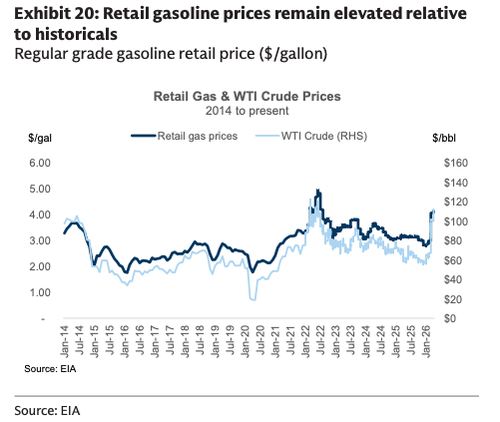
$4 Gas: The Tipping Point Where Economic Fragility Reveals Itself
When gasoline hits $4/gallon, consumer behavior shifts rapidly toward downtrading, reduced spending, and trip consolidation, exposing thin household budgets and systemic economic fragility amid ongoing inflation. Corroborated across Goldman retail surveys, Barron's spending data, WSJ sentiment analysis, PBS inflation reporting, Brookings distributional impacts, and NY Fed expectations, this threshold reveals patterns of precarity that mainstream outlets tend to downplay.
ZeroHedge's examination of Goldman's "Nicotine Nuggets" survey captured a pivotal shift: when regular gasoline crossed $4 per gallon, 58% of tobacco and convenience retailers observed immediate changes in consumer behavior, including reduced in-store purchases (32%), downtrading (47%), lower fuel volumes (37%), fewer trips, and "splash and go" pump visits that bypass inside sales. Deep-discount cigarettes gained significant share as budget-conscious buyers traded down. While the survey focused on nicotine and retail data, it serves as a proxy for broader stress. Recent reporting confirms the pattern has repeated. Barron's documented that as gasoline reached $4 amid geopolitical oil shocks, early data showed U.S. consumer spending already slowing despite prior resilience. The Wall Street Journal noted the $4 threshold's outsized psychological weight, driving shifts in sentiment even if absolute spending impacts appear modest on paper. PBS reported that soaring gas prices triggered the largest monthly inflation spike in four years, weighing on discretionary budgets and complicating Federal Reserve policy. A Brookings Institution analysis (updated in context of recurring shocks) highlights how higher fuel costs disproportionately burden lower- and moderate-income households, forcing cuts elsewhere that function like a regressive tax and slow overall growth. The New York Fed's consumer expectations survey revealed deteriorating household finances and heightened pessimism as gas and food prices climbed. Mainstream coverage often frames these as manageable trade-offs or temporary sentiment dips, yet the repeated breach of the $4 barrier—seen in 2008, 2022, and now again in 2026—exposes a deeper pattern of fragility. Persistent inflation has left households with thinner margins; energy shocks rapidly compel prioritization that cascades through retail, confidence, and demand. Connections others miss include how "splash and go" behavior and nicotine downtrading signal not just frugality but the erosion of the incidental spending that sustains small businesses and local economies. Under sustained pressure, these micro-adjustments compound into macro instability, historically preceding sharper contractions or recessions as documented in energy-price studies. This is less about literal "chaos at the pump" than the speed with which normalized economic participation frays when baseline costs rise, a vulnerability minimized in optimistic narratives but evident in retailer surveys, Fed data, and repeated historical cycles. The robustness of nicotine pouch growth amid the stress further illustrates selective value-seeking rather than broad resilience.
LIMINAL: The $4 gas threshold functions as a reliable stress test exposing how quickly budget constraints cascade into widespread behavioral contraction, signaling deeper structural fragility that repeated inflation shocks could accelerate into broader instability.
Sources (5)
- [1]Gas Prices Hit $4 a Gallon. Early Data Show Consumer Spending Is Slowing.(https://www.barrons.com/articles/gas-prices-consumer-spending-retail-impact-12ede465)
- [2]Gas Just Hit $4 a Gallon. Is That Really as Bad as It Sounds?(https://www.wsj.com/economy/consumers/gas-just-hit-4-a-gallon-is-that-really-as-bad-as-it-sounds-850545f3)
- [3]Soaring gas prices leads to biggest monthly inflation spike in four years in March(https://www.pbs.org/newshour/economy/soaring-gas-prices-leads-to-biggest-monthly-inflation-spike-in-four-years-in-march)
- [4]How Higher Gas Prices Hurt Less Affluent Consumers and the Economy(https://www.brookings.edu/articles/how-higher-gas-prices-hurt-less-affluent-consumers-and-the-economy/)
- [5]US households see their finances deteriorating amid rising gas prices(https://finance.yahoo.com/economy/article/us-households-see-their-finances-deteriorating-amid-rising-gas-prices-151638457.html)