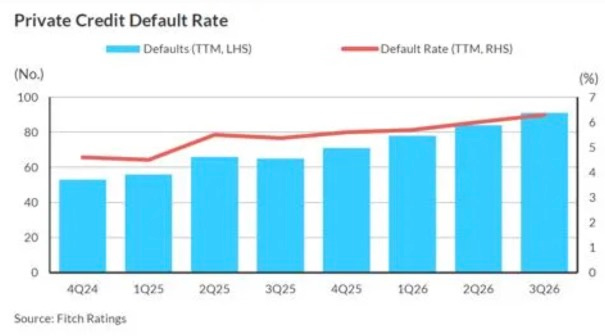
U.S. Private Credit Default Rate Hits Record 6.3% as Restructurings Mask Underlying Distress
Private credit defaults reached a record 6.3 percent trailing rate driven by 2020-2022 vintage loans. Most distress is managed through restructurings that shift repayment into 2027-2028, preserving reported stability while accumulating refinancing risk. Primary data from Fitch and Moody’s indicate the scale of speculative credits due next will test creditor willingness to absorb losses.
Fitch documented 27 default events in Q3 alone, concentrated in healthcare, industrials, and consumer sectors. Roughly half involved interest deferrals or payment-in-kind toggles while 38 percent featured maturity extensions. Moody’s middle-market analysis similarly raised its observed rate from 4 percent to 5.8 percent once distressed exchanges were counted. These figures track loans originated 2020-2022 under now-obsolete rate assumptions.
The pattern reflects coordinated creditor incentives to postpone recognition of cash-flow shortfalls. Senior facilities retain covenant protections and collateral claims, yet the volume of deeply speculative credits due in 2027-2028 exceeds 50 percent of Moody’s middle-market CLO sample. Refinancing markets have already tightened; further compression would convert deferred obligations into realized losses for non-bank lenders and their institutional investors.
Central banks and regulators have so far treated private credit as outside core banking perimeters, limiting direct oversight. Continued extension practices defer but do not eliminate the requirement for fresh capital or writedowns once maturities arrive. Absent renewed liquidity or earnings recovery, the current 6.3 percent rate functions as a lower bound rather than a ceiling.
The next observable threshold will be the share of 2025-2026 maturities that fail to refinance on market terms; any sustained rise above 10 percent would force balance-sheet recognition across pension funds and insurers holding the underlying loans.
Fitch Ratings: Trailing default rate exceeds 8 percent by Q4 2025 if more than 15 percent of 2027 maturities require additional concessions.
Sources (2)
- [1]Fitch Ratings Private Credit Report Q3(https://www.fitchratings.com/research/corporate-finance/us-private-credit-defaults-q3-2024)
- [2]Moody's Middle Market CLO Analysis(https://www.moodys.com/research/Middle-Market-CLO-Defaults-and-Distressed-Exchanges-2024)