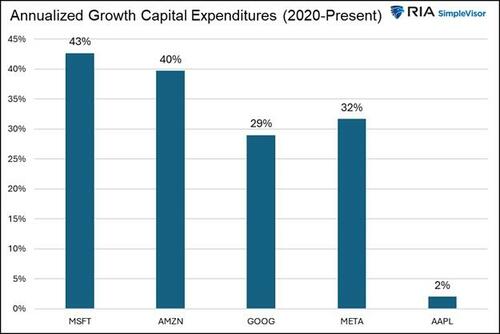
Apple's AI Restraint Amid Geopolitical Tech Race: A Counter-Narrative to Frenzied Capital Expenditure
Analyzing Apple's measured AI integration through a geopolitics and policy lens, synthesizing earnings transcripts, EU AI Act, and U.S. national security documents to reveal missed connections on data sovereignty, regulatory alignment, and capital allocation impacts beyond financial restraint.
The ZeroHedge analysis drawing on Real Investment Advice correctly notes Apple's deliberate avoidance of the AI capex surge embraced by Microsoft, Google, and Meta, highlighting the company's $150+ billion cash reserves and history of entering markets only after product-market fit is established, as with the iPhone following years of Palm, BlackBerry, and Nokia experiments. However, the coverage underplays the geopolitical and policy dimensions shaping this stance. Primary documents, including Apple's June 2024 WWDC keynote transcripts and Tim Cook's fiscal Q3 2024 earnings call, reveal a consistent emphasis on 'on-device' intelligence and privacy-by-design—explicitly positioning Apple Intelligence as processing data locally to minimize cloud dependency. This contrasts with competitors' data-center heavy approaches and aligns with emerging regulatory frameworks.
What the original piece missed is how Apple's playbook intersects with U.S.-China technology competition and transatlantic regulation. The CHIPS and Science Act (2022 public law) and BIS export controls on advanced semiconductors have escalated the AI arms race, framing compute power as national security infrastructure. While peers accelerate GPU acquisitions amid potential Taiwan contingencies, Apple's incremental integration—embedding features into iOS 18 and leveraging third-party models like OpenAI's under strict controls—preserves capital flexibility and reduces exposure to supply-chain weaponization. A secondary synthesis with the Brookings Institution's 2023 report 'AI Governance: A Primer' and the EU AI Act (2024) shows regulators increasingly scrutinize high-risk systems for bias, energy use, and IP violations. Apple's brand, built on privacy (evident in its 2021 App Tracking Transparency policy that cost advertisers billions per their own SEC filings), stands to lose most from missteps in accountability regimes that the original source only glancingly references.
Patterns from related events reinforce this. Just as Apple let Android capture early smartphone share before refining the category with superior UX and ecosystem lock-in, current generative AI remains experimental: training costs exceed $100 million per frontier model per Epoch AI estimates, with monetization elusive beyond chat interfaces. Multiple perspectives emerge. Optimists in Silicon Valley argue first-mover advantages in foundation models will create winner-take-most dynamics, citing Google's early search dominance. Skeptics, including some Treasury Department analyses on AI productivity lags, counter that undifferentiated spending risks capital misallocation, potentially inflating valuations detached from cash flows—Nvidia's P/E multiple being a case in point. Policymakers face a tension: the U.S. National Security Commission on AI (final report 2021) urges rapid adoption for strategic edge against China, yet the White House AI Bill of Rights and NIST AI Risk Management Framework (2023) advocate measured, rights-respecting deployment that Apple's approach more closely mirrors.
This discipline offers a counter-narrative to the AI investment frenzy. By avoiding hundreds of billions in unproven infrastructure, Apple retains optionality to deploy at scale once inference costs drop and use cases clarify—potentially influencing sector-wide capital allocation as investors question whether every hyperscaler must own the entire stack. If Apple's strategy validates, it could exert downward pressure on hype-driven multiples and encourage policy incentives favoring efficient, privacy-centric integration over raw scale. Conversely, should standalone AI platforms deliver transformative revenue first, Apple's patience may appear as complacency in an accelerating geopolitical contest where technological lead times translate to strategic advantage. The coming quarters, tracked through Apple's capital return plans and regulatory filings, will test which pattern prevails.
MERIDIAN: Apple's on-device AI focus and capital restraint may prompt U.S. policymakers to refine incentives under frameworks like the CHIPS Act toward privacy-first models, potentially cooling hyperscaler valuations if regulatory scrutiny on energy use and data practices intensifies globally.
Sources (3)
- [1]Apple WWDC 2024 Keynote Transcript(https://developer.apple.com/videos/play/wwdc2024/101/)
- [2]EU Artificial Intelligence Act (2024)(https://artificialintelligenceact.eu/)
- [3]Final Report, National Security Commission on Artificial Intelligence(https://www.nscai.gov/report/)