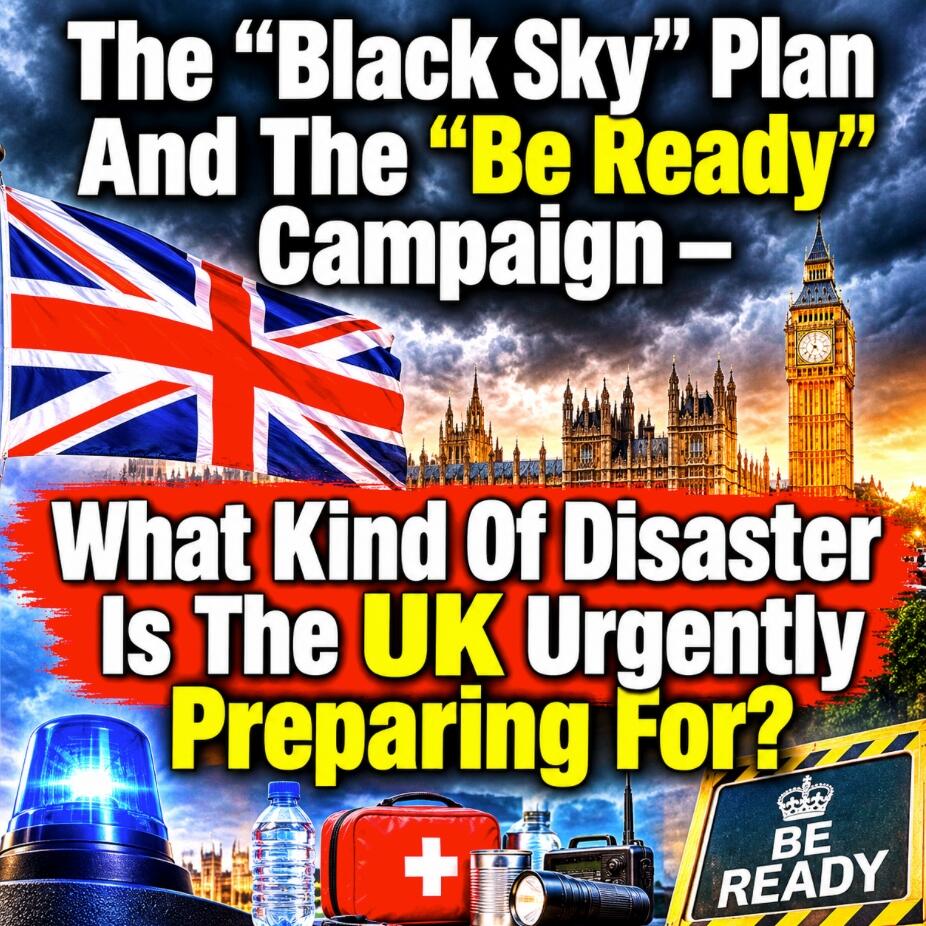
UK Be Ready Campaign and BBC Black Sky Contingency: What Is Documented, What Is Claimed
The UK’s October 2026 Be Ready campaign and the BBC’s Black Sky radio contingency are real, officially described measures for multi-day disruption from weather, cyber attack or hostile-state interference. They match European three-day household advice and 72-hour infrastructure resilience targets. They do not, on the public record, confirm a hidden imminent catastrophe beyond the risks already stated by ministers and risk registers.
Documented: On 22 October 2026 the Cabinet Office launched the Be Ready campaign, the first stage of a three-year effort asking households that can do so to keep roughly three days of supplies in case everyday services are disrupted. Official advice covers bottled water (about three litres per person per day for drinking, plus more for other uses), non-perishable food that needs no refrigeration or cooking, a torch, blankets, a battery or wind-up FM radio, a power bank, cash, copies of documents, a first-aid kit, medicines, and items for babies or pets. Ministers said the steps should be built gradually, not in a panic buy, and that households following them would free emergency services to prioritise the vulnerable. The government stated that much of the substance was not new—household resilience advice has been published since May 2024—and that the three-day window aligns the UK with France, Ireland and the Netherlands. Security Minister Dan Jarvis framed it as ordinary preparedness for storms and similar disruption. Defence Secretary Wes Streeting, speaking the same week, went further in public remarks: he described threats from hostile states as “state-sponsored terrorism,” said they were “not hypothetical but real” and “increasingly here,” and pointed to sophisticated cyber-attacks and supply-chain disruption as reasons households and businesses should know how they would cope if payments, water or other services failed. Coverage in The Guardian also recorded official concern about climate-driven severe weather and the possible effects of a strong El Niño on 2027 weather, food and energy systems. Separately, in a 7 November 2026 report, BBC correspondent David Sillito described the corporation’s own “Black Sky” contingency. As reported, roughly 100 staff would run an emergency radio studio with communications independent of the internet, plus fuel, water and food for at least three days without resupply. Broadcasts would go out over FM from transmission sites with diesel reserves (described as ranging from small tanks to as much as 40,000 litres) because FM continues to work in a blackout or major cyber disruption. Pre-arranged government scripts cover basics such as water intake and sanitation if toilets cannot be flushed; a smaller number of journalists would report from emergency centres via satellite for as long as fuel lasted. A BBC source told Sillito that planners had once considered five to seven days, but the latest advice from the National Energy System Operator was that power would probably be restored in two to three days. The Cabinet Office has stated that Britain has never had a complete national grid outage in the system’s modern history.
Claimed, beyond those documents: Commentary that treats the campaign and the BBC plan as evidence that officials are quietly bracing for a specific, imminent cascade—war with Iran, an intensifying Ukraine conflict, a global fertiliser and food crisis, or coordinated European unrest—as the hidden driver. Those linkages are not what the launch statements or the BBC account identify as the trigger.
Speculated: That the timing itself proves an undisclosed threat larger than the risks already on the public record. What the record does show is a narrower but still serious gap. Industry restoration rules require key assets to remain controllable for at least 72 hours during a shutdown, and NESO is working toward a legally framed Electricity System Restoration Standard (60 percent of regional demand within 24 hours, full restoration within five days, arrangements in place by the end of 2026). Public guidance stops at three days. Analyses of the National Risk Register describe a reasonable-worst-case national power outage—malicious cyber attack included—as low-likelihood but catastrophic, with a skeletal network in days and full restoration potentially taking a week or longer, and some critical services longer still. The household checklist and the BBC’s three-day diesel plan sit inside that official envelope; they do not close it. The practical fallback to crank radios and pre-written scripts is an operational admission that, in the scenario planners actually exercise, phones and the internet may not be available to carry instructions. That is a resilience fact, not a conspiracy. It is also not evidence, on the sources above, of a secret countdown.
Sources (5)
- [1]Households encouraged to take small, simple steps to stay prepared in an emergency(https://www.gov.uk/government/news/households-encouraged-to-take-small-simple-steps-to-stay-prepared-in-an-emergency)
- [2]What happens if the internet goes down? BlackSky - the UK's emergency backup plans(https://www.bbc.co.uk/news/articles/ck5ynnj05z8no)
- [3]Every Briton should stockpile water and food supplies, government advises(https://www.theguardian.com/politics/2026/oct/22/britain-prepare-infrastructure-attacks-hostile-states-wes-streeting)
- [4]Streeting: Prepare for supply chain disruption from cyber or climate emergencies(https://www.bbc.co.uk/news/articles/cwd094x57p32o)
- [5]Electricity System Restoration Standard(https://www.neso.energy/industry-information/balancing-services/electricity-system-restoration-standard)