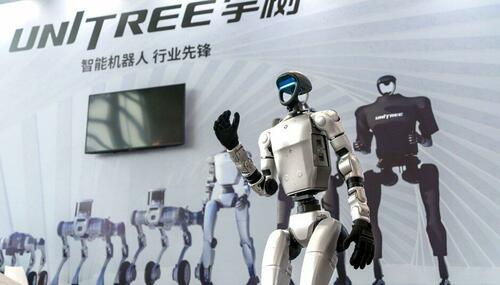
Unitree's 10m/s Humanoid Sprint Signals China's Strategic Robotics Edge in Labor, Defense, and Tech Supremacy
Unitree's H1 humanoid hitting near-world-record sprint speeds of 10m/s in a human-scale body highlights China's accelerating robotics program. Corroborated by engineering and state media reports, this advance ties directly to national strategies addressing labor shortages, enhancing manufacturing, and building dual-use military capabilities amid intensifying U.S.-China tech rivalry. Mainstream coverage underplays the systemic competitive risks to global labor markets and technological hegemony.
China's Unitree Robotics has demonstrated its H1 humanoid robot achieving a peak sprint speed of 10 meters per second (approximately 22.4 mph), with a human-like physique of roughly 1.78 meters tall and 62 kg, including leg lengths of 0.4m per segment. The test, conducted on a standard athletics track, recorded a momentary 10.1 m/s reading, positioning it near elite human performance levels such as Usain Bolt's record paces. Unitree described it as a new world record for humanoid robots, building on the company's prior speed milestones.[1][2][3]
This achievement is more than a viral engineering stunt. It underscores Beijing's deliberate, state-backed push into embodied AI and agile bipedal systems at a moment when China's working-age population is contracting by millions annually. Humanoid robots are explicitly framed in official strategies as a solution to sustain manufacturing dominance, offset demographic decline, and maintain economic output without relying on an shrinking labor pool. Companies like Unitree, UBTECH, and others are scaling production of affordable platforms, with China accounting for the overwhelming majority of recent global humanoid installations.[4][5]
Mainstream coverage has noted the speed record but often frames it in isolation as an incremental curiosity rather than a strategic inflection point. Yet the convergence of speed, human-compatible form factor, and advancing AI 'brains' carries profound implications. In labor markets, widespread deployment could accelerate automation of repetitive, hazardous, or physically demanding roles across factories, logistics, and services—potentially displacing or transforming millions of positions while boosting productivity. Chinese officials emphasize robots will handle undesirable tasks and complement human workers rather than cause mass unemployment, yet analysts warn of broader economic disruption amid already intense automation efforts.[6][7]
Militarily, agile humanoids open pathways for battlefield applications: rapid pursuit, reconnaissance in complex terrain, logistics under fire, or operating in environments too dangerous for soldiers. U.S. assessments highlight that success in China's humanoid goals could yield transformative dual-use capabilities across manufacturing, healthcare, agriculture, and defense, intensifying U.S.-China technological competition. While American firms like Tesla and Boston Dynamics lead in certain AI and software domains, China's supply chain scale, lower costs, and government coordination enable faster iteration and deployment.[5][8]
The Unitree H1's performance—untethered, outdoor, human-proportioned sprinting—illustrates how China is compressing timelines for practical, high-mobility robots. Combined with parallel advances in perception and decision-making AI, this trajectory points toward systems that could one day 'chase down' humans or integrate into autonomous formations. Western observers risk underestimating the pace; the competitive threat is not distant sci-fi but measurable progress in 2026 that could reshape global supply chains, workforce structures, and strategic balances by the early 2030s. Deeper connections emerge when viewed through China's history of rapid scaling in EVs, solar, and high-speed rail: targeted policy, massive investment, and iterative hardware refinement create self-reinforcing leads that are difficult to dislodge once momentum builds.
LIMINAL: China's fusion of human-like speed, scalable hardware, and state strategy in humanoids positions it to dominate embodied AI, displacing labor at scale while gaining asymmetric military options that could erode Western technological parity within a decade.
Sources (5)
- [1]China's humanoid robot inches closer to Usain Bolt-like speeds(https://interestingengineering.com/ai-robotics/china-humanoid-robot-reaches-record-sprint)
- [2]Humanoid robot reaches 10 m/s in test, company says(https://news.cgtn.com/news/2026-04-13/Humanoid-robot-reaches-10-m-s-in-test-company-says-1Mj0fO3i5MI/p.html)
- [3]Unitree's H1 robot runs 10 meters per second(https://www.chinadaily.com.cn/a/202604/13/WS69dcc9caa310d6866eb4321c.html)
- [4]Humanoid Robots(https://www.uscc.gov/research/humanoid-robots)
- [5]Xi's AI ambitions collide with China's fragile employment landscape(https://www.japantimes.co.jp/business/2026/02/28/tech/xi-ai-china-employment/)