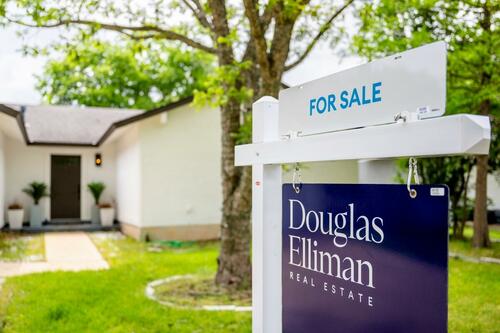
Inflection Point in US Housing: Record Price Cuts Reveal Deeper Shifts with Fed and Consumer Implications
Record share of US home sellers cutting prices in February signals potential market inflection after pandemic boom, with under-explored effects on household net worth, regional supply imbalances, and Federal Reserve rate path decisions amid locked-in low-rate mortgages.
Redfin's April 2024 analysis of MLS data, as reported by ZeroHedge, documents a record 34.2% of home sellers cutting asking prices in February—the highest February figure since tracking began in 2012—with average reductions of 7.3% or $40,915. The report correctly identifies a buyer's market driven by elevated mortgage rates near 7%, elevated prices, and economic uncertainty, with pronounced effects in overbuilt Sun Belt markets like San Antonio (nearly 60% of sellers cutting) and Austin (over 55%). However, the coverage remains largely descriptive and misses critical macro linkages to consumer balance sheets, the "rate lock" effect, and Federal Reserve policy transmission.
National Association of Realtors data for the same period shows existing-home sales rose 1.7% month-over-month to 4.09 million but fell 1.4% year-over-year, confirming subdued demand. Synthesizing this with the Federal Reserve's Q4 2023 Financial Accounts of the United States (Z.1 release), which shows residential real estate comprising roughly 29% of household net worth, reveals the stakes: sustained price softening risks eroding equity for pandemic-era buyers who remain underwater in adjusted markets. Redfin notes longer-tenured owners with equity are less likely to cut, underscoring a bifurcated market where mobility is constrained by the gap between 3% mortgage rates secured in 2020-2021 and current rates—a dynamic the original piece under-emphasizes.
This pattern connects to post-2020 dynamics: unprecedented fiscal stimulus and Fed balance-sheet expansion fueled a 40%+ national price surge (per Case-Shiller Index), creating the current inventory shortage as owners refuse to trade up or down. What original coverage overlooked is regional overbuilding signals from NAR's 2024 housing supply reports in Texas and Florida, compounded by Florida-specific insurance premia spikes and condo safety regulations post-Surfside collapse. These supply gluts contrast with supply-constrained coastal markets like San Francisco (only 7% price cuts), highlighting uneven transmission of monetary policy.
Multiple perspectives emerge. Optimistic voices from the National Association of Home Builders argue current price adjustments represent healthy normalization without 2008-style lax underwriting. More cautious analyses in the Fed's biannual Financial Stability Report flag rising commercial real estate parallels and potential spillovers to consumer confidence. Neither extreme fully captures the policy tension: persistent shelter inflation has kept the Fed on hold, yet accelerating price cuts could signal demand collapse, complicating the soft-landing narrative and pressuring policymakers ahead of rate decisions. If household wealth contracts materially, the 70% consumption-driven economy faces headwinds, as seen in 2007-2009 precedent documents.
Ultimately, February's data may mark an early inflection after a decade-plus inflation cycle in housing, with sellers capitulating as buyers await clarity on rates. This carries under-appreciated risks to local fiscal bases, bank mortgage portfolios, and Fed credibility on its dual mandate.
MERIDIAN: Rising seller price cuts, especially in overbuilt Sun Belt regions, suggest housing may have reached a post-pandemic peak; this could ease inflationary pressures on shelter costs but erode household equity enough to influence Fed timing on rate cuts later in 2024.
Sources (4)
- [1]Record Share Of Home Sellers Cut Listing Prices In February: Report(https://www.zerohedge.com/personal-finance/record-share-home-sellers-cut-listing-prices-february-report)
- [2]Existing-Home Sales Rose in February but Remained Below Year-Ago Level(https://www.nar.realtor/newsroom/existing-home-sales-rose-in-february-but-remained-below-year-ago-level)
- [3]Financial Accounts of the United States - Z.1(https://www.federalreserve.gov/releases/z1/)
- [4]Redfin Data Center: Housing Market February 2024(https://www.redfin.com/news/data-center/)