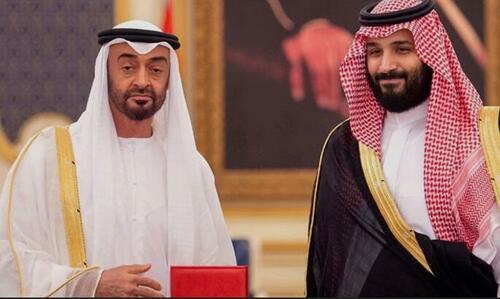
Gulf Rejection of UAE's Iran Escalation Bid Reveals Fractured Regional Order Beyond US-Iran Binary
Bloomberg, FT, and Reuters reporting confirms Persian Gulf states rebuffed UAE efforts to forge a joint anti-Iran military bloc, accelerating OPEC fractures and Saudi diplomatic initiatives for a Helsinki-style non-aggression pact. This exposes multipolar hedging and regional autonomy often overlooked in US-centric coverage.
Recent reporting exposes significant divisions within the Gulf Cooperation Council as the United Arab Emirates failed to rally Saudi Arabia, Qatar, and other neighbors into a unified military front against Iran amid the ongoing US-Israeli conflict that began on February 28, 2026. According to Bloomberg, UAE President Mohammed bin Zayed personally lobbied counterparts including Saudi Crown Prince Mohammed bin Salman, invoking the GCC's founding purpose as a bulwark against Iranian influence following the 1979 revolution. Yet leaders uniformly responded that this was "not their war," prioritizing de-escalation over joining offensive operations alongside Washington and Tel Aviv.[1][2]
This refusal has deepened preexisting rifts, contributing to the UAE's surprise exit from OPEC and OPEC+ in late April 2026, a move Reuters and The New York Times link to strategic divergences with Riyadh over oil policy and Iran strategy during wartime energy market chaos. The Emirates proceeded with limited independent strikes on Iran in March and April, while Saudi Arabia emphasized defense, deterrence, and Pakistani-mediated talks between the US and Tehran. Qatar initially weighed involvement after Iranian missiles struck its Ras Laffan LNG facility but ultimately aligned with de-escalation. Bahrain, Kuwait, and Oman similarly declined participation.[3][4]
Western narratives frequently reduce the conflict to a straightforward US-Iran confrontation, yet these developments highlight deeper regional fractures: Gulf states' reluctance to escalate stems not from weakness but from calculated hedging in a multipolar landscape. Saudi Arabia has floated a postwar "non-aggression pact" with Iran and neighbors, modeled explicitly on the 1975 Helsinki Accords that stabilized Cold War Europe. The Financial Times reports this initiative enjoys quiet backing from several European capitals, which see it as the optimal path to prevent future flare-ups by allowing regional actors to manage their own security without perpetual great-power intervention. This Saudi-led diplomacy connects to broader BRICS discussions, where differing views on the Iran war prevented a joint statement, underscoring how traditional US allies are exploring alternatives to escalation.[5]
The pattern reveals Gulf pragmatism: protecting vital oil infrastructure and LNG exports from retaliatory disruption, maintaining economic ties with China and Russia, and avoiding entanglement in what many view as an Israeli-American project with uncertain endgames. UAE's deepening Israel alignment, while tactically bold, has isolated it within the GCC, accelerating its pivot toward independent energy policy and unilateral action. In contrast, Riyadh's Helsinki-inspired framework signals a vision for inclusive regional architecture that could accommodate a post-war Iran, reducing incentives for proxy conflicts and creating breathing room from external binaries.
These dynamics suggest the conflict's resolution may hinge less on battlefield outcomes than on whether Gulf states can forge mechanisms that outlast US drawdowns, challenging assumptions of monolithic Sunni alignment against Tehran. The episode underscores how local actors are rewriting the script on escalation, prioritizing long-term stability and economic resilience over short-term military solidarity.
Liminal Analyst: Gulf states' de-escalatory stance and Saudi pact proposal will accelerate a regional security realignment favoring BRICS-adjacent mediation, marginalizing UAE-Israel alignment and forcing US policy toward negotiated settlements by late 2026.
Sources (4)
- [1]UAE Tried in Vain to Get Saudis to Partner on Iran Response(https://www.bloomberg.com/news/articles/2026-05-15/uae-tried-in-vain-to-get-saudis-to-coordinate-on-iran-response)
- [2]Saudi Arabia floats Middle Eastern non-aggression pact with Iran(https://www.ft.com/content/ab78e60e-7a41-4943-a1a5-bd60b4ca31b9)
- [3]UAE Says It Will Leave OPEC as Iran War Strains Oil Markets(https://www.reuters.com/markets/commodities/uae-says-it-quits-opec-opec-statement-2026-04-28/)
- [4]United Arab Emirates Says It Will Leave OPEC in Blow to Oil Cartel(https://www.nytimes.com/2026/04/28/world/middleeast/uae-opec.html)