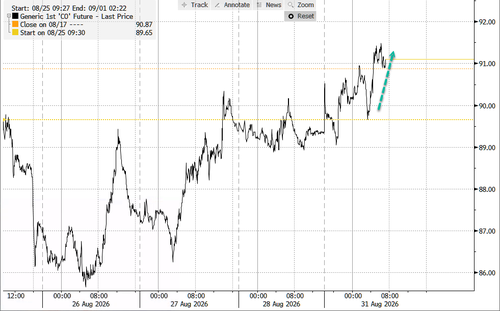
US-Iran Strikes Resume Over Strait of Hormuz: Oil Surges Past $90 Amid Retaliatory Escalation
Corroborated reports confirm U.S. strikes on Iranian launchers in Hormuz and Iranian missile retaliation in Jordan, pushing oil prices above $90 and highlighting supply chain vulnerabilities.
Fresh military exchanges between the United States and Iran have reignited tensions in the Strait of Hormuz, driving global oil prices higher and underscoring the waterway's critical role in energy markets. On August 30, 2026, U.S. Central Command forces struck Iranian rocket launchers on Larak Island after detecting preparations to deploy sea mines into the strait, marking the first direct U.S. action against Iranian targets in roughly a month.[1][2]
Iran's Islamic Revolutionary Guard Corps (IRGC) responded by launching ballistic missiles and drones targeting U.S. air bases in Jordan, including King Hussein and Al Azraq. Jordanian forces intercepted eight missiles with no reported damage or injuries. Iranian state media reported casualties on Larak Island from the U.S. strike, while the IRGC vowed further retaliation.[3][4]
Brent crude futures climbed above $90 per barrel, reaching intraday highs near $91, while WTI topped $86 amid heightened geopolitical risk premiums tied to potential disruptions in the strait, through which a significant portion of global oil transits.[5][6] Refined product markets, including diesel crack spreads, showed signs of strain consistent with ongoing supply concerns. President Trump signaled a firm U.S. response, describing Iran as a "failed nation" and hinting at further action.
The escalation centers on control of shipping lanes, with prior U.S. efforts to clear mines and restore traffic now challenged by renewed Iranian activity. While traffic through alternative Omani corridors has continued, the tit-for-tat raises risks of prolonged volatility in energy prices, with potential knock-on effects for global inflation, transportation costs, and economic stability over the coming months.
Oil markets: Renewed Hormuz volatility likely sustains $5-10/bbl risk premium through Q4 2026, pressuring diesel and transport costs globally while accelerating shifts to alternative supply routes.
Sources (5)
- [1]US hits Larak Island, first strike on Iran in weeks(https://www.usatoday.com/story/news/world/2026/08/30/us-iran-war-larak-island-iran-war/91539747007/)
- [2]Iran attacks US bases in Jordan after US strikes Larak Island(https://www.aljazeera.com/news/2026/8/30/us-strikes-irans-lark-island-in-first-attack-in-weeks)
- [3]Oil Prices Surge as U.S. and Iran Exchange Strikes(https://oilprice.com/Energy/Oil-Prices/Oil-Prices-Surge-as-US-and-Iran-Exchange-Strikes.html)
- [4]Global oil prices top $91 a barrel after U.S. and Iran exchange fire(https://www.morningstar.com/news/marketwatch/2026083139/global-oil-prices-top-91-a-barrel-after-us-and-iran-exchange-fire-for-the-first-time-in-a-month)
- [5]US strikes Iran's Larak Island, Iran fires missiles at bases in Jordan(https://www.intellinews.com/us-strikes-iran-s-larak-island-iran-fires-missiles-at-bases-in-jordan-464529/)