Huawei's Tau Scaling Law: Sanctions Backfire as China Forges Post-Moore Paradigm
Huawei's announcement of the Tau Scaling Law and LogicFolding at IEEE ISCAS 2026 outlines a sanctions-resistant path to 1.4nm-equivalent chip density by 2031 via time-based scaling rather than pure geometry, highlighting the limits of U.S. export controls and accelerating tech decoupling.
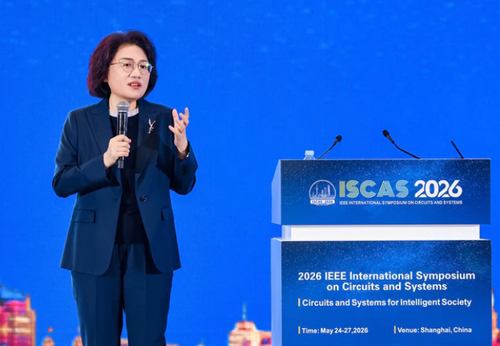
At the 2026 IEEE International Symposium on Circuits and Systems in Shanghai, Huawei Semiconductor President He Tingbo unveiled the Tau (τ) Scaling Law, a fundamental shift from geometric transistor shrinking under Moore's Law to 'time scaling' focused on minimizing signal propagation delays across devices, circuits, chips, and entire systems. Central to this is LogicFolding architecture, which reconfigures circuit layouts to shorten critical-path wiring, reduce resistive and capacitive loads, boost transistor density, and improve performance without requiring the most advanced Western fabrication tools. Huawei stated that high-end chips based on this approach will achieve transistor densities equivalent to 1.4nm processes by 2031, with the first Kirin mobile processors implementing LogicFolding set for release this fall.
This development, confirmed in Huawei's official announcement and covered by Reuters, Global Times, and technology outlets, directly undercuts the core premise of U.S. export controls imposed since 2019. Those sanctions aimed to block China's access to EUV lithography and sub-5nm production, slowing military and AI ambitions. Yet by pioneering an alternative optimization framework after six years of redesigning over 150 chips, Huawei reveals how sanctions can accelerate domestic innovation in electronic design automation, system-level co-optimization, and architectural leaps that mainstream analysis often reduces to 'catch-up' narratives.
Connections missed by typical reporting include the direct lineage to the 2023 Mate 60 surprise featuring a domestically produced 7nm Kirin, proving iterative progress with SMIC despite restrictions. The immediate market reaction—SMIC shares jumping over 7-18%—signals investor conviction that this Tau framework reduces dependence on ASML and Applied Materials equipment. Deeper still, it accelerates great-power decoupling: as Washington layers ever stricter controls, Beijing is establishing parallel standards that could influence global roadmaps, fragment supply chains, and reshape competition in AI accelerators, 5G infrastructure, and defense semiconductors. While 'equivalent density' is not identical to bleeding-edge process nodes, presenting at a premier IEEE conference alongside concrete deployment timelines exposes the diminishing returns of sanctions in an era where system-level time constants matter as much as feature size. This technological leap doesn't just bypass controls; it redefines the metrics of progress, forcing a reevaluation of containment strategies that mainstream outlets have downplayed as mere rhetoric.
LIMINAL: Huawei's Tau breakthrough shows U.S. sanctions are catalyzing creative architectural workarounds that erode containment timelines, hastening a bifurcated global semiconductor ecosystem where China sets independent performance standards.
Sources (5)
- [1]HUAWEI Presents the Tau (τ) Scaling Law, Enabling Breakthroughs in Transistor Density and System Performance(https://www.huawei.com/en/news/2026/5/ieee-iscas-tau-scaling)
- [2]Huawei unveils new semiconductor law, charting fresh path for industry development(https://www.globaltimes.cn/page/202605/1361841.shtml)
- [3]Huawei unveils 'Tau Scaling Law' as China's workaround to chip sanctions(https://thenextweb.com/news/huawei-tau-scaling-law-chip-sanctions)
- [4]Huawei proposes new path for chips as Moore's Law runs out of road(https://www.siliconrepublic.com/machines/huawei-proposes-new-path-for-chips-as-moores-law-runs-out-of-road)
- [5]Huawei proposes new path for chip development amid US sanctions(https://www.investing.com/news/economy-news/huawei-proposes-new-path-for-chip-development-amid-us-sanctions-4708270)