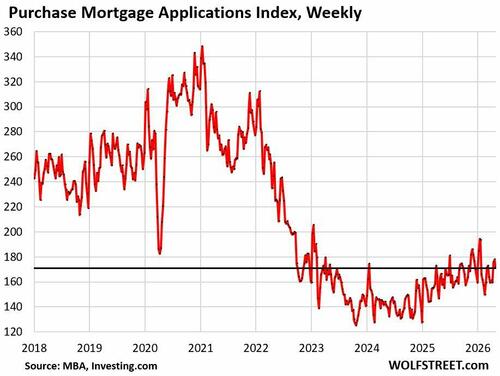
Housing Market Stagnation Signals Broader Economic Risks Amid High Rates and Inflation
The U.S. housing market’s failed spring selling season, marked by a 34% drop in mortgage applications and stagnant sales, reflects deeper economic challenges from high interest rates and inflation. Beyond real estate, this stagnation signals risks to consumer confidence, broader economic activity, and financial markets, with regional disparities and Fed policy constraints adding complexity.
The spring selling season, traditionally a pivotal period for the U.S. housing market, has once again failed to ignite, as highlighted in recent data from the Mortgage Bankers Association (MBA) showing a 34% decline in mortgage purchase applications compared to 2019 levels. This stagnation, detailed in Wolf Richter’s analysis on ZeroHedge, reflects a market frozen by high mortgage rates—currently hovering at 6.45% for a 30-year fixed mortgage—and persistent inflation. However, the narrative of a 'dud' spring season misses deeper systemic issues and broader economic implications that extend beyond real estate.
First, the expectation of Federal Reserve rate cuts driving a housing recovery ignored the Fed's constrained policy space. The Fed’s minutes from the March 2023 Federal Open Market Committee (FOMC) meeting indicate a cautious stance, with officials prioritizing inflation control over stimulating growth, even hinting at potential rate hikes if price pressures persist. This policy rigidity, combined with Treasury yields climbing in response to inflation fears, has kept mortgage rates elevated, effectively pricing out potential buyers. Historical context shows that while 6-7% rates are not unprecedented, they are a sharp departure from the sub-3% rates during the Fed’s quantitative easing (QE) era, which fueled a home price explosion from 2020-2022. The resulting affordability crisis—where median home prices remain near record highs—has not been adequately addressed in mainstream coverage.
Second, the housing market’s malaise is a bellwether for broader economic risks. Stagnant pending home sales, down 30% from 2019 as reported by the National Association of Realtors (NAR), correlate with declining consumer confidence. The Conference Board’s Consumer Confidence Index for April 2023 noted a drop to its lowest level in nine months, driven by concerns over inflation and job security. Housing, as a key driver of household wealth, influences consumer spending, which accounts for nearly 70% of U.S. GDP. A prolonged freeze in transactions could dampen economic activity, potentially tipping the economy toward recession—a connection underexplored in the original ZeroHedge piece.
Third, the regional disparities and financial market ripple effects deserve scrutiny. While national data paints a grim picture, markets in high-growth areas like Texas and Florida have seen relative resilience due to population inflows, per NAR’s regional reports. Conversely, high-cost coastal markets like California face steeper declines, exacerbating inequality in housing access. Additionally, the housing slowdown impacts financial markets through mortgage-backed securities (MBS), a significant asset class for institutional investors. With the Fed unwinding its MBS holdings as part of quantitative tightening, per its 2023 balance sheet reports, market liquidity for housing finance is further strained, a dynamic overlooked in most analyses.
In synthesizing these perspectives, it becomes clear that the housing market’s struggles are not merely a seasonal disappointment but a symptom of deeper economic pressures—high interest rates, inflation, and policy uncertainty—that could cascade into consumer behavior and financial stability. The original coverage, while detailed on mortgage application trends, missed these interconnections, framing the issue as a standalone real estate problem rather than a potential precursor to recessionary risks.
MERIDIAN: The housing market’s persistent stagnation suggests a higher likelihood of recessionary pressures by late 2023 if consumer confidence continues to erode and Fed policy remains hawkish.
Sources (3)
- [1]Mortgage Bankers Association Weekly Mortgage Applications Survey(https://www.mba.org/news-and-research/newsroom)
- [2]Federal Reserve FOMC Meeting Minutes, March 2023(https://www.federalreserve.gov/monetarypolicy/fomcminutes20230322.htm)
- [3]National Association of Realtors Pending Home Sales Index(https://www.nar.realtor/research-and-statistics/housing-statistics/pending-home-sales)