Manufacturing ISM Miss Signals Persistent Inflation and Labor Weakness Amid Economic Fragility
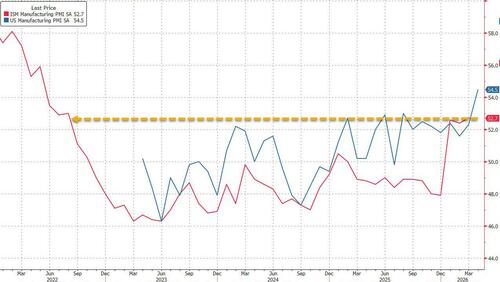
The April Manufacturing ISM report, missing expectations at 52.7, reveals surging prices (84.6, highest since April 2022) and declining employment (46.4, weakest since 2020), signaling stagflation risks. Beyond the headline, these trends reflect persistent inflation, labor market fragility, and potential challenges for Federal Reserve policy and stock valuations, amid broader economic uncertainty.
The latest Manufacturing ISM report for April, registering at 52.7, missed expectations of a rise to 53.2, revealing deeper economic undercurrents that point to persistent inflation pressures and labor market fragility. While the headline figure suggests continued expansion, a granular examination of the subindices—particularly Prices Paid surging to 84.6 (the highest since April 2022) and Employment dropping to 46.4 (the weakest since 2020)—paints a more troubling picture of stagflation risks. This combination of rising input costs and declining employment echoes patterns seen in prior economic slowdowns, such as during the 1970s stagflation crisis and the pre-recession signals of 2007-2008, where cost pressures outpaced demand growth.
Beyond the numbers reported by ZeroHedge, the surge in Prices Paid (up 6.3 points from March) reflects not just supply chain disruptions but also the lingering effects of geopolitical tensions, including the Ukraine conflict’s impact on energy and raw material costs. The ISM’s own commentary notes that 62% of manufacturing industries reported paying higher prices, a trend that aligns with the Federal Reserve’s ongoing concerns over sticky inflation, as highlighted in their April 2023 FOMC minutes. Meanwhile, the Employment Index’s contraction signals hesitancy among manufacturers to commit to labor expansion amid cost pressures and uncertain demand—a dynamic missed in the original coverage, which downplayed the potential long-term implications for wage growth and consumer spending.
Contextually, this report connects to broader economic patterns, including the Federal Reserve’s delicate balancing act between curbing inflation and avoiding a recession. The Fed’s recent rate hikes, with the federal funds rate at 5.25-5.50% as of May 2023, have yet to fully cool input price inflation, as evidenced by the ISM data. This raises questions about whether further tightening could exacerbate employment declines without addressing supply-side cost drivers. Additionally, the contrast between the ISM’s stagnation and S&P Global’s more optimistic PMI of 54.5 suggests divergent interpretations of manufacturing health, potentially influenced by differing survey methodologies or sector focus—an angle underexplored in initial reporting.
Stock valuations, particularly in industrial and consumer discretionary sectors, may face downward pressure as investors reassess growth expectations against this backdrop of rising costs and weakening labor metrics. Historical parallels, such as the 2000 dot-com bust prelude, show that sustained input price spikes often precede margin compression for manufacturers, a risk not adequately flagged in the original source. Furthermore, the ISM’s Backlog of Orders drop to 51.4 hints at a potential softening of future demand, challenging the narrative of a robust recovery.
Synthesizing additional sources, the Federal Reserve’s Beige Book (April 2023) corroborates the ISM’s findings of uneven manufacturing activity, noting ‘mixed’ regional performance and persistent cost pressures. Similarly, the Bureau of Labor Statistics’ Producer Price Index (PPI) data for March 2023 showed a year-over-year increase of 2.1%, aligning with the ISM’s price surge and underscoring inflation’s persistence. These primary documents provide a more systemic view than secondary analyses, grounding the stagflation concern in hard data.
What the original coverage missed is the interplay between these metrics and broader policy implications. If inflation remains sticky while employment weakens, the Fed may face a no-win scenario: further rate hikes risk deepening labor market pain, while pausing could entrench inflation expectations. This dilemma, combined with geopolitical wildcards like energy price volatility, suggests that the manufacturing sector’s struggles are a microcosm of larger economic fragility—a perspective absent from the initial report’s focus on short-term misses and gains.
MERIDIAN: The persistent rise in input prices alongside employment contraction suggests the Federal Reserve may face tougher choices ahead, potentially delaying rate cuts into late 2023 or early 2024 as stagflation risks grow.
Sources (3)
- [1]ISM Manufacturing Report on Business - April 2023(https://www.ismworld.org/supply-management-news-and-reports/reports/ismreportonbusiness/pmi/april/)
- [2]Federal Reserve Beige Book - April 2023(https://www.federalreserve.gov/monetarypolicy/beigebook202304.htm)
- [3]Bureau of Labor Statistics - Producer Price Index, March 2023(https://www.bls.gov/news.release/ppi.nr0.htm)