US Destroyers in Hormuz Test Fragile Iran Ceasefire as Proxy Dynamics and Factional Splits Signal Broader Energy War Risks
US Navy destroyers successfully transited the Strait of Hormuz despite Iranian actions targeting UAE with missiles and drones, prompting Pentagon assurances that the ceasefire holds as operations stay below major combat thresholds. Internal Iranian divisions and diplomatic outreach to China highlight fragile proxy war dynamics with risks of global energy market disruption.
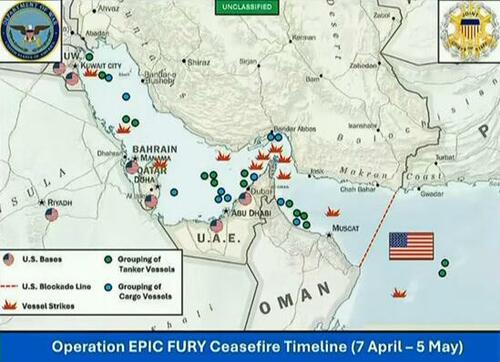
The transit of two US Navy destroyers through the Strait of Hormuz on May 4-5, 2026, amid reported Iranian missile and drone attacks on the UAE, underscores the precarious nature of the US-Iran ceasefire established in early April. While the Pentagon, in a briefing led by Defense Secretary Pete Hegseth and Joint Chiefs Chairman Gen. Dan Caine, insisted that recent actions remain 'below the threshold' for restarting major combat and that 'the ceasefire is not over,' the events reveal deeper patterns of managed escalation typical in proxy-involved conflicts.[1][2]
UAE authorities reported intercepting multiple ballistic missiles, cruise missiles, and drones originating from Iran, with explosions reported and an oil facility impacted in Fujairah. This marks the first such direct strike on a Gulf state since the ceasefire. Contradictory statements from Tehran suggest internal divisions, with IRGC elements potentially operating independently of civilian leadership—a fracture that complicates diplomatic efforts. Iranian Foreign Minister Abbas Araghchi's immediate travel to Beijing for talks with Chinese officials further hints at efforts to internationalize the crisis beyond US-centric channels, potentially leveraging China's economic leverage in the region.[3]
What others miss in the headlines is the structural reality: US involvement in securing the Hormuz chokepoint—through 'Project Freedom' to escort commercial vessels—exemplifies a recurring pattern where American forces are drawn into proxy entanglements to safeguard global energy arteries. This is not isolated but reflective of longstanding dynamics seen in support for regional partners, where 'harassing' fire from Iranian-linked forces tests resolve without crossing into full-scale war. Reuters reporting notes unchanged timelines for Iran's nuclear breakout despite prior strikes, suggesting that sustained low-level pressure aims to constrain enrichment without the politically costly need for wholesale destruction of stockpiles.[4]
The fragility is evident. CBS News and Fortune detailed how the destroyers navigated Iranian barrages with air support, while US forces sank several Iranian small boats. Yet Hegseth framed the naval operation as 'temporary' and 'separate' from broader combat, emphasizing restraint as strength. This rhetorical tightrope highlights how ceasefires in such theaters often function less as resolutions and more as pauses that allow repositioning—risking miscalculation that could spike WTI crude beyond $100 per barrel and trigger global supply shocks.[5][6]
Axios and Al Jazeera coverage connects the UAE strikes to stalled nuclear negotiations, with Tehran maintaining its regional proxy posture. Deeper analysis reveals this as part of a multipolar contest: Iran's outreach to China coincides with US efforts to reopen shipping lanes, exposing how Gulf tensions serve as proxies for great-power competition. Should factional clashes in Iran escalate or hardliners prevail, the 'below threshold' paradigm could collapse into disruptions affecting 20% of global oil transit. The Pentagon's slide presentations and statements reveal awareness of this, yet the insistence on ceasefire continuity suggests a strategy of calibrated response aimed at avoiding congressional escalation while preserving strategic gains. Ultimately, these incidents lay bare the illusion of easy off-ramps in proxy-driven Middle East conflicts, where energy security, nuclear ambitions, and internal regime dynamics intersect to threaten far wider economic contagion.
LIMINAL: Apparent IRGC-civilian splits in Iran combined with Beijing diplomacy suggest a calibrated proxy pressure campaign that keeps the ceasefire technically intact while testing US red lines; persistent Hormuz harassment risks sharp oil spikes to $110+ and broader economic fallout by amplifying global energy chokepoint vulnerabilities.
Sources (5)
- [1]2 U.S. Navy destroyers transit Strait of Hormuz after dodging Iranian onslaught(https://www.cbsnews.com/news/2-us-navy-destroyers-transit-strait-of-hormuz-after-dodging-iranian-onslaught/)
- [2]Ceasefire with Iran is not over, Pentagon's Hegseth says(https://www.reuters.com/world/middle-east/us-not-looking-fight-with-temporary-operation-protect-ships-iran-pentagon-chief-2026-05-05/)
- [3]Iran ceasefire in peril as UAE says it's under attack(https://www.axios.com/2026/05/04/iran-attack-uae-missiles-ceasefire-hormuz)
- [4]UAE accuses Iran of attacks as 'large fire' breaks out at oil facility(https://www.aljazeera.com/news/2026/5/4/uae-reports-missile-and-drone-strikes-incoming-from-iran)
- [5]Battle for Hormuz begins as U.S. military fights off Iranian attacks(https://fortune.com/2026/05/04/strait-of-hormuz-showdown-us-navy-warships-persian-gulf-commercial-ships-project-freedom/)