Closing the Nuclear Fuel Cycle: Newcleo's $2.4B SPAC Debut and Oklo Partnership Highlight Private Capital's Role in Advanced Nuclear Shift
Newcleo's Nasdaq-bound SPAC merger, massive private funding, and strategic Oklo partnership on surplus plutonium-to-fuel conversion underscore breakthroughs in closed nuclear fuel cycles using lead-cooled fast reactors and MOX technology—developments largely overlooked amid AI energy hype but poised to transform baseload power availability and waste management.
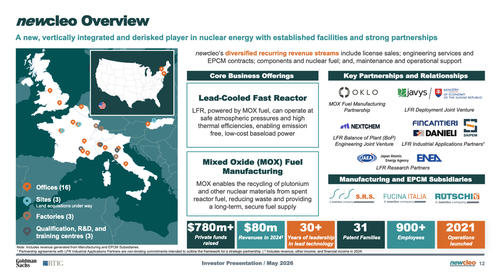
While AI-driven power demand dominates headlines, a quieter transformation is underway in nuclear technology: the commercialization of closed fuel cycles that recycle nuclear waste into usable fuel. Paris-based newcleo, developer of lead-cooled fast reactors (LFRs) and MOX (mixed oxide) fuel fabricated from reprocessed materials, is merging with SPAC NewHold Investment Corp III in a deal valuing the company at approximately $2.4 billion. The transaction, expected to list on Nasdaq under ticker NWCL in late 2026, includes up to $429 million in gross proceeds from an oversubscribed PIPE and SPAC trust. This follows newcleo's successful private fundraising of roughly $780 million and $80 million in 2024 revenue from its vertically integrated supply chain businesses, employing over 900 people across Europe and beyond.
Newcleo's 200 MWe LFR design leverages liquid lead coolant—noted for being chemically inert, high-boiling, and cost-effective—paired with proprietary MOX fuel produced from existing nuclear waste. The company targets commercial fuel manufacturing by 2031 and maintains a pipeline of over 9 GW in opportunities, including Slovak state-backed projects. Critically, newcleo has partnered with U.S.-based Oklo on advanced fuel fabrication infrastructure, with plans for up to $2 billion in affiliated investment. This alliance gained momentum in May 2026 when Oklo was selected by the Department of Energy for advanced negotiations under the Surplus Plutonium Utilization Program, one of five firms chosen to convert up to 20 metric tons of Cold War-era weapons plutonium into reactor fuel. Newcleo contributes its European MOX expertise and potential capital to the effort, alongside considerations from Sweden's Blykalla.
This collaboration addresses longstanding challenges in the nuclear fuel cycle: reducing waste stockpiles, minimizing reliance on fresh uranium, and mitigating proliferation risks through controlled reuse under strict safeguards. Fast reactors like newcleo's can fission long-lived actinides in spent fuel, effectively 'burning' waste while generating clean baseload power—capabilities largely absent in conventional light-water reactors. Mainstream coverage has focused on nuclear's role in powering data centers, yet these fuel-cycle breakthroughs, fueled almost entirely by private capital without heavy public subsidies in newcleo's case, suggest a deeper structural shift. By bridging European reprocessing know-how with U.S. deployment pathways, the partnership could accelerate domestic fuel security and unlock scalable advanced reactors faster than traditional government-led programs.
The timing aligns with renewed policy support for nuclear expansion, but the real momentum appears driven by entrepreneurs like newcleo founder Stefano Buono, whose prior success commercializing medical isotopes demonstrates a track record of scaling complex nuclear-adjacent technologies. As AI hyperscalers seek firm, low-carbon electricity beyond intermittent renewables, innovations that close the fuel cycle may prove as pivotal as reactor designs themselves—offering a path to practically inexhaustible energy while tackling legacy nuclear liabilities.
LIMINAL: Private capital is accelerating closure of the nuclear fuel cycle through MOX recycling and surplus plutonium reuse, quietly building resilient fuel infrastructure that could resolve waste issues and supply reliable power for AI-driven demand far more effectively than public programs or renewable intermittency alone.
Sources (5)
- [1]Nuclear Power Startup Newcleo to Go Public in SPAC Deal(https://www.wsj.com/business/energy-oil/nuclear-power-startup-newcleo-to-go-public-in-spac-deal-f3761f22)
- [2]Nuclear power startup Newcleo to go public through SPAC deal(https://www.reuters.com/legal/transactional/nuclear-power-startup-newcleo-go-public-through-spac-deal-2026-05-27/)
- [3]Oklo selected for US surplus plutonium programme(https://www.world-nuclear-news.org/articles/oklo-selected-for-us-surplus-plutonium-programme)
- [4]Oklo Selected by U.S. Department of Energy for Advanced Negotiations Under Surplus Plutonium Utilization Program(https://oklo.com/newsroom/news-details/2026/Oklo-Selected-by-U-S--Department-of-Energy-for-Advanced-Negotiations-Under-Surplus-Plutonium-Utilization-Program/default.aspx)
- [5]Oklo, newcleo Sign Strategic Partnership Alongside Blykalla for the Advancement of U.S. Nuclear Fuel Ecosystem(https://www.usnic.org/news/oklo-newcleo-sign-strategic-partnership-alongside-blykalla-for-the-advancement-of-u-s-nuclear-fuel-ecosystem)