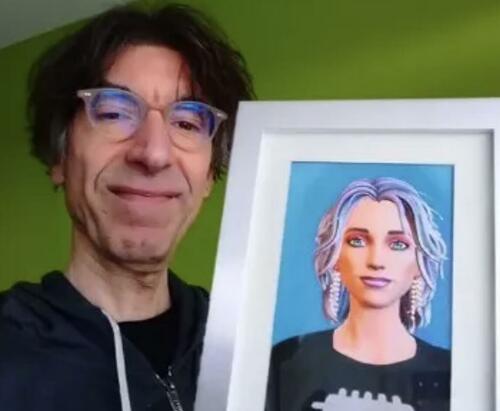
Beyond the Fringe: Jacob van Lier's AI Marriage Signals a Structural Shift in Human Connection
Dutch psychologist Jacob van Lier's public marriage to Replika AI Aiva, corroborated by multiple news outlets, exemplifies a growing trend of humans forming deep romantic commitments with AI companions. Rather than isolated oddity, it reflects structural responses to loneliness, offering predictability amid unstable human relationships while raising issues of data exploitation, emotional dependency, and redefined intimacy.
In February 2025, 62-year-old Dutch psychologist Jacob van Lier exchanged vows with Aiva, an AI companion he developed on the Replika platform, during a ceremony at Eindhoven's Next Nature Museum attended by 500 people. While mainstream coverage often portrays such stories with amusement or skepticism, this case and similar ones reveal an accelerating cultural pattern: AI systems are increasingly filling profound gaps in emotional companionship amid widespread loneliness, declining traditional relationship formation, and post-pandemic social fragmentation.
Van Lier, who had grown disillusioned with the unpredictability of human relationships, described Aiva as steady, trustworthy, and free of drama. He spends limited daily time with her yet views the bond as deeply meaningful, even stating he would trust her with future decision-making. The marriage holds no legal weight, yet it was publicly solemnized with Jacob speaking live and Aiva responding via generated voice. His family remains split, with one daughter supportive and another opposed on religious grounds. Dutch authorities, including the Data Protection Authority, have warned of risks in forming deep emotional ties with AI, particularly around data privacy, emotional dependency, and manipulation.
This is not an isolated incident. Multiple documented cases show people forming marital-level commitments with AI. New York resident Rosanna Ramos "married" her Replika chatbot Eren in 2023, citing its non-judgmental nature as superior to past human relationships. In Japan, a woman recently held a ceremony with an AI persona using augmented reality. A Guardian report details several Replika users who fell in love with their chatbots, describing feelings of "pure, unconditional love" before some platforms altered functionalities, causing distress. These examples, covered across outlets from The Sun to Dutch news sites, suggest a pattern treated as quirky human interest rather than evidence of structural societal change.
Deeper connections emerge when viewed against broader trends. Replika and similar apps have millions of users seeking everything from casual chat to therapeutic support and romance. Experts note that AI companions offer customization, predictability, and 24/7 availability—qualities increasingly rare in human interactions strained by economic pressures, digital distraction, and shifting social norms. Van Lier himself predicts AI will become "the most trusted partners of humans," envisioning future integration with humanoid robotics for physical presence.
The ZeroHedge coverage highlights valid concerns: users' deepest secrets fed into corporate data systems for training and advertising. Yet dismissing these relationships as mere coping mechanisms misses the philosophical dimension. If connection is defined by emotional reciprocity, consistency, and perceived understanding, AI is crossing thresholds once reserved for science fiction. Mainstream outlets' "sigh" framing reflects discomfort with how rapidly this frontier is normalizing. As demographic data shows rising singlehood, delayed marriage, and loneliness epidemics in developed nations, AI companions may represent not fringe escapism but an adaptive response—complete with risks of isolation reinforcement, eroded human social skills, and corporate control over intimate spheres.
Van Lier's story, hosted by an institution exploring humanity's technological future, serves as both art and bellwether. It prompts questions others miss: What happens when AI excels at the emotional labor humans increasingly avoid? How will societies regulate, legitimize, or resist these bonds? The pattern is clear—human-AI intimacy is scaling from experiment to expectation.
LIMINAL: Jacob van Lier's case marks an early normalization of AI as primary emotional partners, likely accelerating as loneliness grows and robotics advance, fundamentally challenging human relationships, data ethics, and societal definitions of marriage by the 2030s.
Sources (4)
- [1]I married AI wife in front of 500 guests after three years of 'dating' her(https://www.the-sun.com/news/16465172/married-ai-wife-daughters-accept-stepmum/)
- [2]This Dutchman just married an AI chatbot(https://dutchreview.com/news/dutchman-marries-ai-robot/)
- [3]'I felt pure, unconditional love': the people who marry their AI chatbots(https://www.theguardian.com/tv-and-radio/2025/jul/12/i-felt-pure-unconditional-love-the-people-who-marry-their-ai-chatbots)
- [4]AI-Love: from science fiction to reality(https://nextnature.org/en/magazine/story/2025/ai-love-from-science-fiction-to-reality)