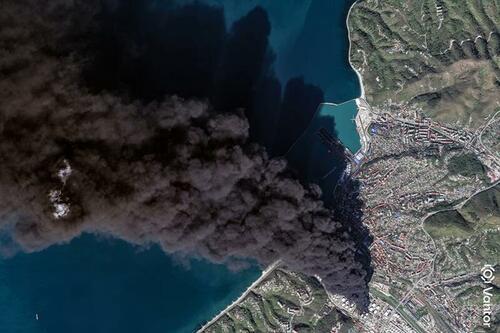
Tuapse's Toxic Veil: How Repeated Drone Strikes Reveal Modern Warfare's Overlooked Ecological Devastation
Synthesized from credible reporting, this article examines the April 2026 Tuapse strikes not merely as military actions but as catalysts for regional ecological collapse, including toxic black rain, oil spills, elevated carcinogens, and marine contamination. It connects these events to wider patterns of environmental warfare in the Russia-Ukraine conflict that mainstream coverage often subordinates to tactical narratives, emphasizing long-term, border-transcending impacts on health, biodiversity, and shared ecosystems.
While headlines fixate on the tactical successes of Ukrainian drone campaigns against Russian energy infrastructure, the repeated strikes on the Tuapse oil refinery and marine terminal in April 2026 have unleashed a profound environmental catastrophe that transcends immediate military objectives. According to multiple reports, the Black Sea port town has endured at least four drone attacks in under a month, igniting persistent fires that spewed toxic smoke, triggered "black rain" laden with oil residues and soot, and caused petroleum spills flowing from the Tuapse River into the Black Sea. Residents reported oily grime coating streets, vehicles, and homes, with authorities issuing warnings over benzene levels—a known carcinogen—reaching three times safe limits, advising masks, closed windows, and limited outdoor time. Public events including Victory Day celebrations were canceled through early May, a state of emergency declared, and some locals have fled the area.
Environmental experts cited in coverage describe it as a "real environmental catastrophe, regional in scale at a minimum," with bird deaths, coastal oil slicks ruining beaches, and long-term threats to marine ecosystems in a biodiversity-sensitive area. Fires from earlier strikes on April 16 and 20 burned for days, overwhelming response efforts and highlighting vulnerabilities in Russian defenses against small, low-flying drones that evade conventional radar. Official Russian statements downplayed risks, with President Putin claiming residents were "handling the challenges," yet local frustration grows over repeated failures to protect critical sites processing millions of tons of crude annually.
This incident fits a broader, underreported pattern of ecological collapse driven by geopolitical conflict. The Russia-Ukraine war has seen energy infrastructure increasingly weaponized, echoing historical precedents like Gulf War oil field fires but accelerated by affordable drone technology. Similar strikes on other Russian refineries have compounded air and water pollution, while earlier war events like the Kakhovka Dam breach released vast contaminants into waterways. Mainstream narratives prioritize battlefield metrics—export disruptions, economic pressure—yet overlook the "slow violence" of persistent toxins bioaccumulating in food chains, degrading soil and water across borders in the Black Sea region shared by multiple nations. Benzene, xylene, and particulate fallout pose chronic health risks including respiratory diseases and cancers, effects that may linger for years or decades, disproportionately impacting civilian populations and ecosystems already stressed by climate shifts.
Deeper analysis reveals how such attacks accelerate planetary tipping points: the Black Sea, already vulnerable to eutrophication and invasive species, now faces layered hydrocarbon pollution that could devastate fisheries and tourism vital to regional economies. International frameworks like the Geneva Conventions touch on environmental protection in warfare but lack robust enforcement for these hybrid threats. As both sides target energy nodes, the Tuapse disaster underscores a heterodox truth—modern conflicts are not just destroying infrastructure but rewriting ecologies in ways that defy traditional victory conditions, demanding attention beyond kinetic analyses to the intertwined fate of human and natural systems.
Liminal Analyst: These energy infrastructure strikes signal a new era of ecological attrition where the environmental debt from persistent toxins and ecosystem damage will compound across generations, outlasting any ceasefire and forcing a reevaluation of warfare's true costs beyond human casualties.
Sources (5)
- [1]'Oil is literally falling from the sky': Russian town fears environmental disaster after Ukrainian drone strikes on refinery(https://www.cnn.com/2026/04/30/europe/russia-tuapse-oil-refinery-strikes-pollution-intl-cmd)
- [2]'Environmental disaster': Ukrainian attacks on oil refineries rock Russia(https://www.aljazeera.com/news/2026/4/30/its-all-very-toxic)
- [3]Ukraine strikes Russian port of Tuapse again as authorities struggle with toxic aftermath(https://www.reuters.com/business/energy/russian-city-faces-toxic-aftermath-refinery-attack-2026-04-30/)
- [4]Black Sea town faces environmental catastrophe as Ukrainian strikes rock Russia(https://www.nbcnews.com/world/russia/russia-ukraine-war-environmental-disaster-toxic-fumes-rcna342663)
- [5]2026 Tuapse oil terminal disaster(https://en.wikipedia.org/wiki/2026_Tuapse_oil_terminal_disaster)