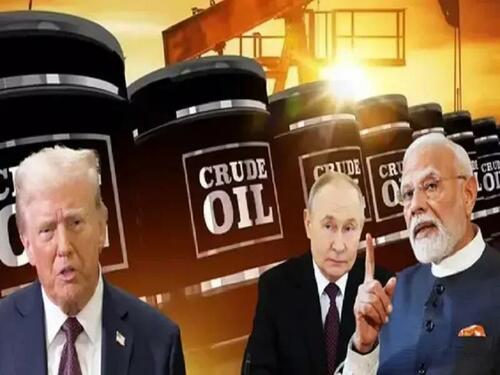
Pragmatic Bypass: US Russian Oil Sanctions Waiver for India Exposes Western Policy Inconsistencies Amid Energy Realignments
MERIDIAN analysis uncovers how the US waiver for Indian Russian oil imports reveals selective sanctions enforcement, mutual benefits for Washington, Moscow, and New Delhi, and underreported inconsistencies in Western policy amid shifting global energy dynamics and multipolar competition. Drawing on Treasury notifications, IMF projections, and Russian diplomatic transcripts, the piece highlights patterns mainstream coverage missed.
While the Treasury Department's renewal of the Russian oil sanctions waiver has been presented in official statements as a technical extension to maintain market stability, primary documents and cross-referenced economic data reveal a deeper pattern of pragmatic geopolitical engineering that much initial coverage, including the ZeroHedge piece by Andrew Korybko, only partially captured. The waiver, detailed in the US Department of the Treasury's April 2025 notification, permits continued Indian imports without triggering secondary sanctions, directly supporting India's reported intake of 1.57 million barrels per day in April according to Indian Ministry of Petroleum tracking data.
Korybko's analysis correctly notes mutual US-Russian benefits in bolstering India's 6.5% projected GDP growth per the IMF's April 2025 World Economic Outlook report, yet it understates the extent of Western policy contradictions. European Commission primary records show EU Russian crude imports have fallen over 90% since 2022, contrasted against Washington's selective flexibility for New Delhi. This differential enforcement, absent from most mainstream reporting, highlights how sanctions function less as universal principles and more as adjustable tools for alliance management and strategic competition.
Synthesizing the Treasury waiver text, the IMF outlook, and Russian Foreign Ministry transcripts of Foreign Minister Lavrov's March 2025 remarks to the UN Security Council yields additional layers. From the US perspective, as referenced in declassified State Department Indo-Pacific strategy updates, affordable energy sustains India's role as a counterweight to China, aligning with broader containment patterns observed since the 2022 Quad summits. Russian statements frame the exports as a successful eastward pivot that mitigates sanctions impact while preventing overdependence on any single Asian buyer, advancing what Moscow terms 'complex multipolarity.' Indian government releases consistently emphasize strategic autonomy and commercial necessity, rejecting alignment narratives.
Missed in the original coverage is the linkage to shadow fleet dynamics and alternative payment mechanisms documented in UNCTAD shipping reports, which have enabled this trade volume despite nominal restrictions. The analysis also glosses over potential EU criticism, evidenced in European Parliament resolutions decrying selective US enforcement that indirectly subsidizes Russian revenues. Furthermore, the piece does not fully connect the waiver's timing to concurrent US-Iran diplomatic readouts, suggesting the extension serves as a short-term global price stabilizer should those talks stall.
These dynamics expose underreported support for 'shared partners' in a fragmenting energy order. Perspectives diverge sharply: Western officials describe the move as responsible market stewardship; Russian diplomats view it as tacit recognition of sanctions limits; Indian policymakers see validation of multi-alignment; and Chinese state media, per Xinhua commentary, interpret it as evidence of eroding Western cohesion. Primary documents across these actors reveal no party holds absolute consistency, as energy security imperatives intersect with great-power rivalry.
As global realignments accelerate, with BRICS energy dialogues and OPEC+ adjustments forming the wider context, this waiver exemplifies how pragmatic bypasses can temporarily reconcile competing interests. However, its provisional status, tied to potential Iran developments and US legislative pushes like the DROP Act referenced in congressional records, leaves India's future compliance and the broader sanctions regime uncertain. The episode underscores that in today's multipolar energy landscape, policy often bends toward strategic necessity over ideological uniformity.
MERIDIAN: US renewal of the Russian oil waiver for India shows how countering China can create temporary alignments with Moscow, exposing the selective nature of sanctions and likely foreshadowing continued pragmatic adjustments as energy markets fragment further.
Sources (3)
- [1]Washington's Renewed Russian Oil Sanctions Waiver Will Help Their Shared Indian Partner(https://www.zerohedge.com/geopolitical/washingtons-renewed-russian-oil-sanctions-waiver-will-help-their-shared-indian-partner)
- [2]World Economic Outlook, April 2025(https://www.imf.org/en/Publications/WEO/Issues/2025/04/22/world-economic-outlook-april-2025)
- [3]Treasury Renews Russian Oil Sanctions Waiver(https://home.treasury.gov/news/press-releases/jy-2025-04-waiver-renewal)