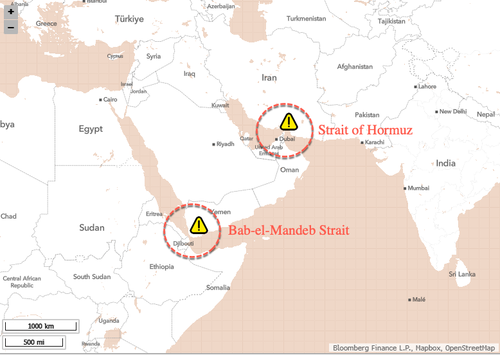
Dual Maritime Chokepoints Test Global Trade Resilience as Red Sea and Hormuz Pressures Converge
Houthis' ban on Israeli shipping intersects with Hormuz dynamics to expose persistent chokepoint risks to trade and energy, drawing from primary statements and institutional records.
The Houthi declaration of a total ban on Israeli-linked vessels through the Bab al-Mandab Strait, issued via their armed forces statement on 8 June 2026, explicitly frames operations as responses to regional escalations involving Gaza, Lebanon, and Iran. Primary texts from the group emphasize escalation symmetry rather than isolated retaliation. This occurs alongside documented Iranian positions on Strait of Hormuz transit rights, as outlined in official Iranian statements to the UN Security Council in prior years asserting sovereign control over energy outflows. Multiple perspectives emerge: Houthi and aligned actors view restrictions as legitimate countermeasures to sieges, while shipping registries and flag states stress impacts on neutral commerce under international maritime conventions. The International Maritime Organization's periodic reports on chokepoint vulnerabilities, cross-referenced with IMF assessments of 2024 Suez rerouting effects that halved canal traffic, reveal patterns of sustained cost elevation through Cape of Good Hope diversions rather than one-off spikes. Analysis of these documents shows that simultaneous pressures on Bab al-Mandab and Hormuz extend beyond episodic coverage by linking energy price transmission to containerized goods flows, with insurance and fuel surcharges propagating across Asia-Europe lanes. Primary data from energy agencies further indicate that Hormuz handles roughly one-fifth of global oil trade, creating compounding exposure when paired with Red Sea constraints on both crude and manufactured exports.
MERIDIAN: Sustained dual-chokepoint friction will likely sustain elevated baseline shipping costs even without full closure, as operators embed permanent rerouting premiums into contracts.
Sources (3)
- [1]Houthi Armed Forces Statement on Red Sea Navigation Ban(https://english.almayadeen.net/news/politics/houthis-declare-total-ban-on-israeli-ships-in-red-sea)
- [2]IMF World Economic Outlook Chapter on Trade Disruptions(https://www.imf.org/en/Publications/WEO)
- [3]IMO Reports on Critical Maritime Chokepoints(https://www.imo.org/en/OurWork/Security/Pages/Maritime-Security.aspx)