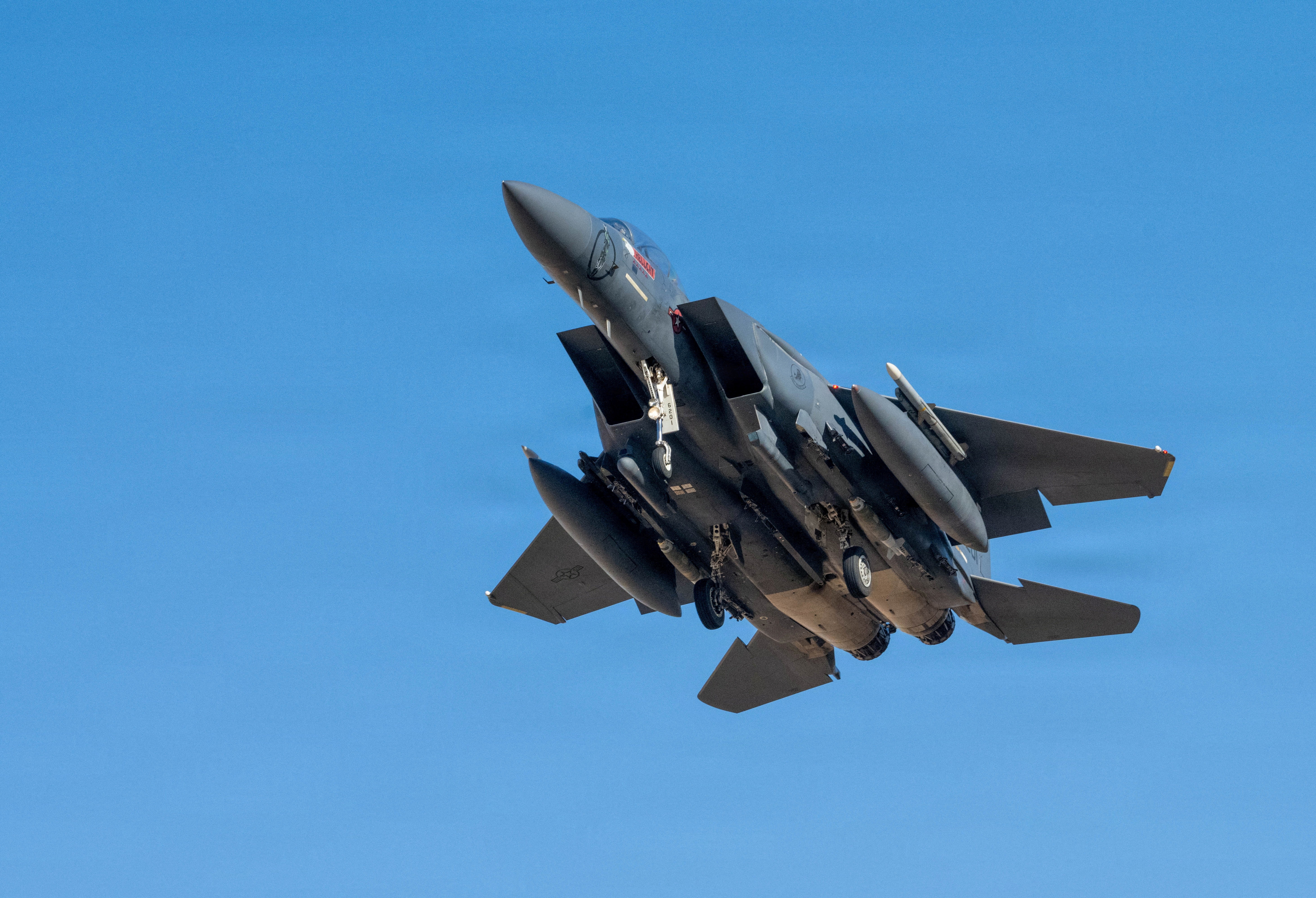
F-15E Loss Over Iran: Threshold Crossed in Direct Nuclear-Power Confrontation
The first confirmed U.S. manned aircraft loss over Iran during Operation Epic Fury reveals matured Iranian air defenses likely enhanced by Russian and Chinese technology. This event, beyond the tactical loss, compresses escalation ladders between nuclear powers and exposes prior U.S. intelligence and planning shortfalls regarding Iran's IADS capabilities.
The confirmed shoot-down of a U.S. Air Force F-15E Strike Eagle over Iran during Operation Epic Fury is not merely the first manned aircraft loss in this campaign. It represents a qualitative shift from episodic strikes and proxy conflict to sustained, direct kinetic engagement between the United States and a state that, while not yet nuclear-armed itself, operates within a patronage network of nuclear powers. The original Defense News dispatch accurately reports the rescue of one crew member, the ongoing search, and Iranian propaganda claiming an F-35 kill before being contradicted by tailfin markings of the 494th Fighter Squadron. However, it treats the event as an isolated tactical incident rather than a systemic failure of prior U.S. assumptions about Iranian air-defense penetration.
What existing coverage missed is the maturation timeline of Iran's integrated air-defense system. Russian S-300PMU-2 and suspected S-400 components, supplemented by Chinese JY-27 radars and indigenous upgrades accelerated after the 2022 Ukraine invasion, have created overlapping kill zones that challenge low-altitude ingress routes previously considered relatively safe. This mirrors the 1999 Serbian downing of an F-117 using upgraded SA-3s and obsolete radars through clever emission control and networked sensors, a pattern the Pentagon has studied for two decades yet apparently failed to fully neutralize in Iranian conditions.
Synthesizing the primary Defense News report with a 2025 CSIS assessment on Iranian IADS modernization and a RAND study on air superiority in contested littorals reveals a consistent underestimation. CENTCOM's repeated denials of prior IRGC claims now appear as information operations that have backfired, eroding credibility at the moment when verifiable evidence has emerged. The article also underplays the significance of the HC-130/Pave Hawk SAR package operating inside Iranian airspace, an extremely high-risk insertion that signals Washington is willing to accept further losses to recover personnel, thereby giving Tehran leverage in the information domain.
This event occurs against a backdrop of 13 U.S. fatalities and 348 wounded in just weeks of major combat, including the March friendly-fire episode involving Kuwaiti F/A-18s that exposed coalition deconfliction fragility. The broader pattern is clear: U.S. air dominance, taken for granted since 1991, is being contested by relatively inexpensive, layered systems in the hands of a determined adversary. For nuclear powers, the danger lies in the compression of decision timelines. Each additional U.S. loss increases domestic pressure for escalation against Iranian leadership targets, raising the probability of striking sites that could trigger Russian or Chinese red lines.
The downing therefore functions as both a tactical data point and a strategic warning. It demonstrates that Iran has successfully imposed costs on the world's premier air force inside its own territory, altering the perceived correlation of forces in the Gulf. Future U.S. planning must now assume higher attrition rates for fourth-generation platforms and accelerate fifth-generation tasking, with all the maintenance and logistical strain that entails. Most importantly, it forces a reckoning with the reality that direct confrontation with Iran is no longer a low-risk punitive campaign but a grinding conflict carrying horizontal escalation risks to nuclear-armed patrons.
SENTINEL: This verified F-15E loss proves Iranian IADS have crossed a capability threshold, likely forcing the U.S. into higher-risk SEAD missions and raising the probability of strikes on Iranian leadership targets that could trigger Russian or Chinese involvement.
Sources (3)
- [1]US F-15E fighter jet shot down over Iran(https://www.defensenews.com/news/your-military/2026/04/03/us-fighter-jet-shot-down-over-iran/)
- [2]Iranian Air Defense Modernization and Implications for U.S. Operations(https://www.csis.org/analysis/iranian-air-defense-modernization)
- [3]Contested Skies: Air Superiority in the Persian Gulf(https://www.rand.org/pubs/research_reports/RRA1897-1.html)