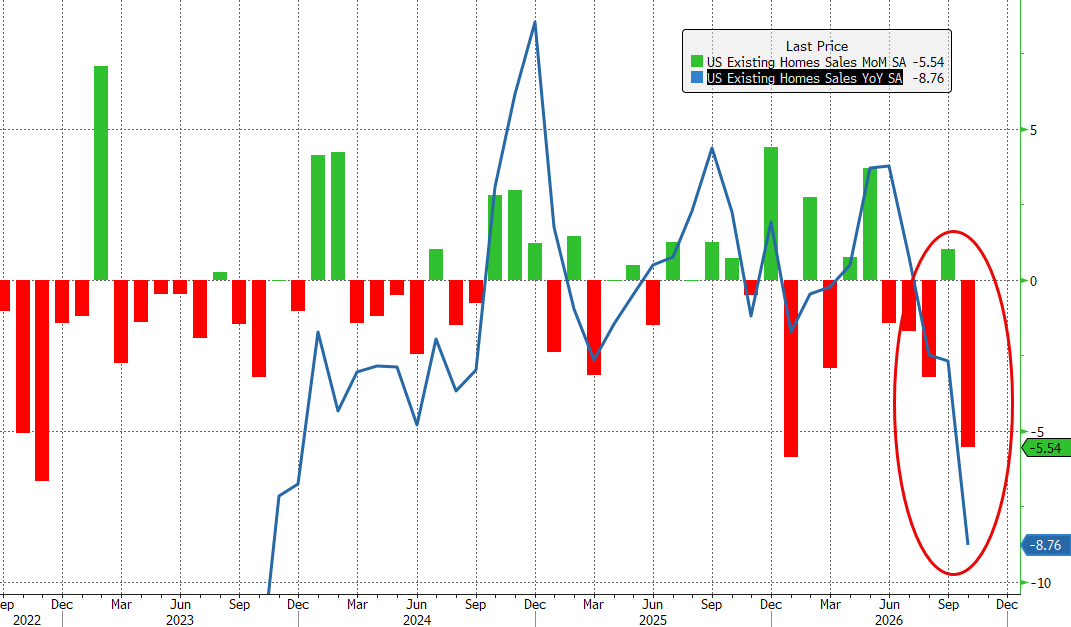
US existing home sales fall to 3.75 million annual rate, lowest since 2010
US existing home sales fell to a 3.75 million seasonally adjusted annual rate in October, the lowest since August 2010, while the median price rose 0.4% year-over-year to $416,700. The combination of high mortgage rates, elevated prices and weak first-time-buyer participation points to a structural affordability squeeze. It affects labor mobility and wealth distribution by favoring existing owners over new entrants.
The National Association of Realtors said October sales of previously occupied homes fell 5.5% from September and 8.76% from a year earlier, leaving the seasonally adjusted annual rate at 3.75 million units, below consensus expectations of 3.86 million. Single-family sales declined to 3.41 million, with lower activity in the Midwest, South and West and flat sales in the Northeast. Every region was below year-ago levels.
Inventory rose to 1.59 million units, a 5.1-month supply, slightly expanding buyer choice, but the median existing-home price rose 0.4% year-over-year to $416,700, marking a 40th consecutive annual increase. The average 30-year mortgage rate was about 7.3% in October, near multi-decade highs. NAR Chief Economist Lawrence Yun said buying has been difficult because rates are at their highest levels since 2000, aside from one month in 2023.
The data point to a market constrained by rate lock-in: many owners hold low mortgage rates and accumulated equity, reducing willingness to sell and move, while buyers face high borrowing costs and elevated prices. First-time buyers fell to 29% of sales, narrowing the entry point for households that need mobility for jobs, schooling or family formation. The pattern is national, not merely local, with all regions below year-ago sales.
The stakes are distributional. Low transaction volume protects equity for existing owners but raises barriers for younger and lower-income buyers, and can slow labor reallocation and concentrate wealth in households already positioned in homeownership. Because prices have not fallen despite weak sales, affordability pressure persists even as inventory improves modestly. The October figures mark the weakest sales pace in more than 14 years.
High rates and rising prices make it harder for first-time buyers to enter the market, while existing owners are shielded by low legacy rates and equity. That can slow household moves for work or family and make homeownership wealth harder to reach.
Sources (2)
- [1]Existing Home Sales Crash To 16 Year Lows In October(https://www.zerohedge.com/personal-finance/existing-home-sales-crash-16-year-lows-october)
- [2]National Association of Realtors existing home sales statistics(https://www.nar.realtor/research-and-statistics/housing-statistics/existing-home-sales)