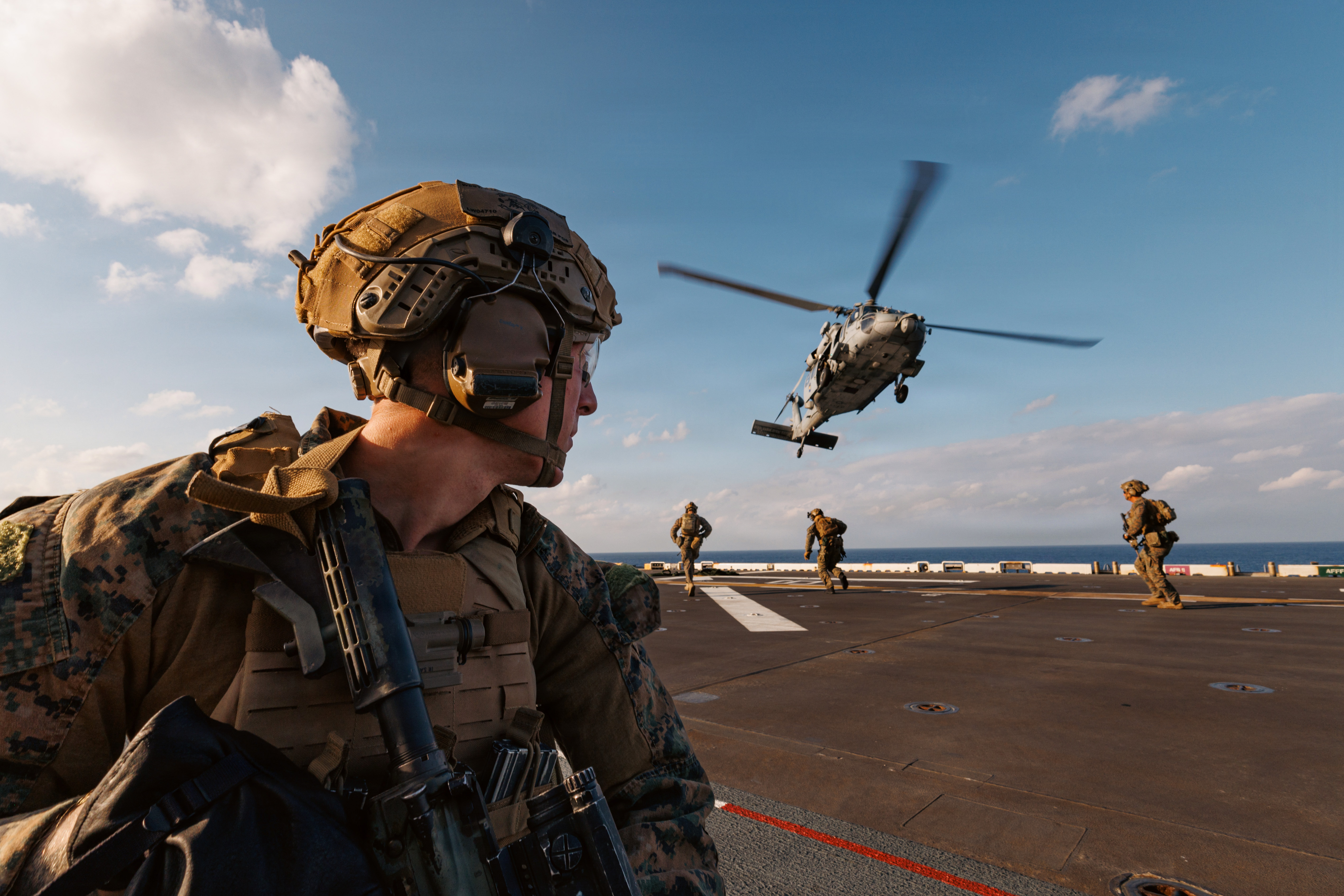
USS Tripoli Deployment Signals US Escalation as Iran Tensions Threaten Direct Conflict
The arrival of the USS Tripoli with the 31st MEU in CENTCOM represents a significant escalation of US military posture amid Iranian proxy aggression and nuclear advances, signaling preparation for possible direct involvement beyond routine presence.
The Defense News report on the USS Tripoli Amphibious Ready Group and embarked 31st Marine Expeditionary Unit entering CENTCOM waters provides only surface-level logistics. What it misses is the deeper strategic repositioning: the diversion of a Pacific-based MEU to the Middle East at a time when Iranian proxy networks are activating across Iraq, Syria, Lebanon, and Yemen. This mirrors the 2019 Abraham Lincoln carrier deployment and the rapid Marine surges following the January 2020 Soleimani strike, yet occurs under even more complex multi-theater pressure.
Synthesizing reporting from Reuters on Iran's March 2026 naval exercises near the Strait of Hormuz and a recent CSIS assessment of Iranian missile and drone proliferation, the arrival of the Tripoli ARG is not routine relief. The 31st MEU brings specialized crisis-response capabilities including rapid amphibious insertion, maritime security teams, and aviation combat elements that can operate independently from carriers. These assets are particularly suited for securing energy infrastructure, conducting non-combatant evacuations, or supporting limited strikes against proxy targets.
Original coverage failed to contextualize this within Iran's pattern of incremental gray-zone aggression: Houthi attacks on Red Sea shipping, militia rocket campaigns against US outposts in Iraq, and Tehran's nuclear enrichment advances past 60%. By reallocating forces from the Indo-Pacific, Washington is signaling that the Persian Gulf remains the priority theater despite public emphasis on China. This posture risks miscalculation. Tehran has historically responded to visible US buildups with asymmetric actions targeting commercial vessels or Gulf allies, potentially drawing American forces into direct kinetic exchanges.
The deployment reveals an uncomfortable truth: despite years of 'de-escalation' rhetoric, the US finds itself once again building the military infrastructure for potential direct involvement to deter a nuclear threshold state and its network of militant proxies.
SENTINEL: The movement of the 31st MEU from the Pacific to CENTCOM indicates Washington now views Iranian proxy escalation and nuclear progress as the immediate priority threat, positioning forces for rapid response that could quickly transition from deterrence to direct engagement if shipping or US personnel come under sustained attack.
Sources (3)
- [1]USS Tripoli, embarked 31st Marine Expeditionary Unit arrive in Middle East(https://www.defensenews.com/news/your-military/2026/03/28/uss-tripoli-embarked-31st-marine-expeditionary-unit-arrive-in-middle-east/)
- [2]Iran steps up military drills as US boosts presence in Gulf(https://www.reuters.com/world/middle-east/iran-steps-up-military-drills-us-boosts-presence-gulf-2026-03-20/)
- [3]Maintaining Deterrence in the Gulf: US Posture and Iranian Responses(https://www.csis.org/analysis/maintaining-deterrence-gulf-us-posture-and-iranian-responses)