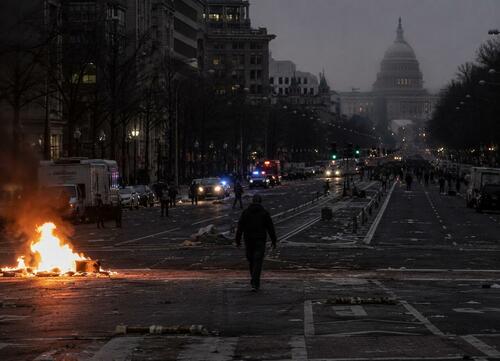
Cascading Darkness: Grid Fragility and the Underestimated Risk of Systemic Societal Collapse
Official reports from the EMP Commission, DOE, NERC, FERC, and NIAC document how prolonged US grid failure would trigger rapid cascading collapse across water, fuel, food, healthcare, finance, and governance systems. Recent load growth, generation retirements, weather, and cyber risks amplify vulnerabilities long known from the 2003 blackout and other events. This undercovered fragility reveals tight coupling in modern supply chains and institutions, where recovery timelines exceed societal buffers.
Modern civilization's dependence on continuous electricity creates a single point of failure whose consequences are chronically underreported despite extensive documentation in official assessments. The ZeroHedge dramatization of a nationwide blackout, while narrative-driven, accurately reflects mechanisms identified in federal studies: electricity underpins water purification, fuel distribution, healthcare, communications, financial transactions, transportation signaling, and supply chain logistics. A prolonged outage does not simply inconvenience; it initiates interlocking failures across interdependent systems.
Real-world precedents and expert analyses confirm the pathway. The 2003 Northeast Blackout, which affected 50 million people across the US and Canada, demonstrated how a single transmission failure can cascade uncontrollably, causing economic losses exceeding $6 billion and exposing coordination weaknesses. Scaled nationally and extended beyond days, the dynamics shift from disruption to existential risk. The Commission to Assess the Threat to the United States from Electromagnetic Pulse (EMP) Attack documented in its 2004 and 2008 reports that prolonged grid collapse could lead to the breakdown of all critical infrastructures, with recovery timelines for large transformers measured in months or years due to specialized manufacturing and global supply constraints. Testimony referenced in peer-reviewed assessments has warned that secondary effects—starvation, disease, and exposure—could result in catastrophic population impacts in a year-long nationwide outage.
Recent analyses deepen these concerns. The Department of Energy's 2025 Report on Evaluating U.S. Grid Reliability and Security states that the status quo is unsustainable: with 104 GW of firm generation slated for retirement by 2030 amid explosive load growth from AI data centers and reindustrialization, the risk of annual outages could increase by a factor of 100 in many regions. NERC's Long-Term Reliability Assessments and 2025 State of Reliability reports highlight emerging stressors including extreme weather (responsible for 100% of the worst Central US outage days between 2014-2024 per Union of Concerned Scientists analysis), cybersecurity threats, inverter-based resource instability, and the unprecedented speed of large computational loads that can destabilize the system in seconds.
What conventional coverage misses is the rapidity of cross-sector cascade and institutional limits. Just-in-time supply chains maintain grocery stocks measured in days, not weeks; electric pumps at pipelines and refineries halt fuel movement, immobilizing resupply. Municipal water systems lose pressure within hours as pumps fail, collapsing sanitation and triggering public health emergencies. Hospitals exhaust generator fuel in 72-96 hours without resupply chains. Financial infrastructure—ATMs, credit networks, trading systems—freezes, halting commerce. Communication networks overload and fail as cellular towers exhaust backups, blinding emergency coordination and public information.
The President's National Infrastructure Advisory Council (NIAC) has explicitly studied "catastrophic power outages beyond modern experience," concluding that federal, state, and private sector preparedness remains inadequate for events lasting weeks or longer. FERC-NERC joint reports on grid restoration emphasize that loss of SCADA systems, data communications, and interdependent fuel supplies would dramatically delay black-start procedures and system recovery. Unlike contained events such as Hurricane Maria in Puerto Rico or the 2015 Ukraine cyber attack on the grid, a continental-scale failure would overwhelm mutual aid agreements and federal continuity protocols, which themselves depend on functional infrastructure.
These patterns connect to broader heterodox observations about civilizational fragility: modernity's complexity and tight coupling of systems—energy, logistics, information, governance—create brittleness where small triggers produce outsized, nonlinear failures. Institutional responses assume partial functionality that may not exist, echoing historical precedents where infrastructure collapse accelerated social fragmentation. Despite repeated warnings from NERC, FERC, DOE, and congressional commissions, policy discourse prioritizes incremental renewables integration and short-term demand management over comprehensive hardening, redundancy, and decentralized resilience measures.
The undercoverage stems from psychological and political factors: acknowledging the grid's role as civilization's bloodstream challenges narratives of perpetual progress and institutional competence. Yet the evidence is unambiguous. Without urgent focus on transformer stockpiles, microgrid islands for critical facilities, fuel reserves, and reduced systemic interdependencies, the next major trigger—solar storm, coordinated cyber-physical attack, or cascading weather/generator failure—risks transitioning technical outage into irreversible societal unraveling.
[LIMINAL]: A sustained national grid failure would expose just-in-time systems and institutional assumptions as brittle illusions, with cascading supply chain and governance breakdowns likely becoming irreversible within days to weeks.
Sources (6)
- [1]Report of the Commission to Assess the Threat to the United States from Electromagnetic Pulse (EMP) Attack(https://www.empcommission.org/docs/empc_exec_rpt.pdf)
- [2]An assessment of threats to the American power grid(https://link.springer.com/article/10.1186/s13705-019-0199-y)
- [3]DOE Report on Evaluating U.S. Grid Reliability and Security (2025)(https://www.energy.gov/sites/default/files/2025-11/DOE%20Final%20EO%20Report%20%28REVISED%20OCT%2027%29.pdf)
- [4]NERC 2025 Long-Term Reliability Assessment(https://www.nerc.com/globalassets/our-work/assessments/nerc_ltra_2025.pdf)
- [5]FERC-NERC Report on Restoration and Recovery Plans(https://www.ferc.gov/sites/default/files/2020-05/06-09-17-FERC-NERC-Report_0.pdf)
- [6]Strengthening the Reliability and Security of the United States Electric Grid (Executive Order)(https://www.whitehouse.gov/presidential-actions/2025/04/strengthening-the-reliability-and-security-of-the-united-states-electric-grid/)