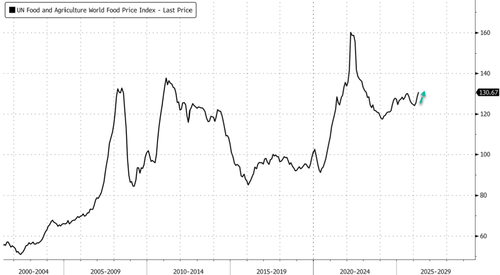
Super El Niño Convergence with Geopolitical Shocks to Spike Asian Food Prices and Strain Household Budgets
High-probability 2026-27 El Niño, combined with fertilizer disruptions from conflict, is forecasted to intensify food inflation across Asia—particularly rice—directly raising grocery costs and pressuring household budgets through 2027.
A potent combination of an emerging super El Niño and disruptions from Middle East conflicts is poised to drive significant food inflation across Asia, with direct impacts on household grocery bills expected within months. NOAA's latest ENSO outlook confirms high probabilities: an 82% chance of El Niño emerging in May-July 2026, rising to 96% persistence through the Northern Hemisphere winter of 2026-27. This weather pattern typically brings hotter, drier conditions to South and Southeast Asia, reducing rainfall critical for rice, palm oil, and other staples.
UBS analysts and Reuters reporting highlight how this overlays existing pressures from fertilizer price volatility tied to the Iran conflict, which has restricted nitrogen supplies and elevated input costs for farmers. Rice—a cornerstone of diets feeding half the world's population—has already seen sharp gains, with Thai benchmark prices surging and regional yields at risk of dropping by millions of metric tons in the Philippines alone. Reuters scenarios project price shocks of 10-50% across core commodities, with rice, palm oil, and sugar potentially surging 50-100% in severe cases, prompting export bans from India, Vietnam, and Thailand that would further tighten global supplies.
The connections run deeper than surface-level weather alerts: El Niño's effects on power demand, disease vectors, and weakened monsoons compound climate-amplified vulnerabilities in irrigation-dependent systems. CNBC notes that while fertilizer shortages from energy-intensive production matter, drought impacts may dominate in 2026, especially as Australia faces wheat shortfalls that ripple through Asian imports. Unlike transient spikes, this convergence risks embedding higher baseline food costs into 2027, disproportionately burdening lower-income households already facing rising inflation in most major Asian economies.
Historical El Niño events have consistently pressured yields by 4-11% in affected Asian rice belts. Current forecasts suggest limited buffers from global stockpiles, with policy responses like subsidies offering only partial relief. The concrete outcome is one consumers will feel immediately: elevated prices for rice, cooking oils, and staples at local markets, turning abstract climate risks into weekly budget squeezes.
LIMINAL: El Niño will turn abstract weather risks into immediate, tangible increases in everyday rice and staple prices across Asia, squeezing household budgets starting late 2026 and persisting into 2027.
Sources (5)
- [1]Super El Nino could trigger a global food price shock, Reuters(https://www.reuters.com/sustainability/land-use-biodiversity/super-el-nino-could-trigger-global-food-price-shock-heres-how-companies-can--ecmii-2026-06-03/)
- [2]Iran war: Why a super El Niño event poses fresh risks to food prices, CNBC(https://www.cnbc.com/2026/04/09/el-nino-food-risks-iran-war-fertilizer-weather.html)
- [3]Official NOAA CPC ENSO Strength Probabilities(https://cpc.ncep.noaa.gov/products/analysis_monitoring/enso/roni/strengths.php)
- [4]El Nino is Coming! - What it Means for Commodity Prices in Asia(https://commodityreport.substack.com/p/el-nino-is-coming-what-it-means-for)
- [5]El Nino, Iran war impact seen slashing PH, Asia rice yields(https://business.inquirer.net/591655/el-nino-iran-war-impact-seen-slashing-ph-asia-rice-yields)