S&P 500 Index Outperformance Stats Ignore Buybacks, Survivorship Bias and Zero Costs
The piece exposes how benchmark mechanics and career-risk incentives lock investors into relative-performance chases that erode absolute wealth. Structural index advantages plus behavioral feedback loops sustain the myth that beating the S&P 500 is both necessary and feasible for most portfolios.
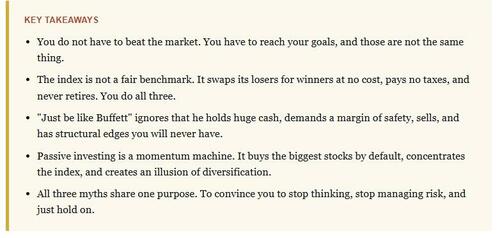
Roberts dismantles the requirement to beat the index by documenting how share buybacks, index substitutions, zero trading costs and no tax drag inflate benchmark returns. Real portfolios sized for income or volatility control cannot replicate these conditions, turning relative-performance mandates into an apples-to-oranges contest that encourages repeated buying high and selling low. Data from fund-flow records confirm that investors who fire managers after one year of underperformance lock in the cycle.
The comparison trap is reinforced by industry incentives that favor assets under management over absolute returns. When benchmarks become the sole scorecard, allocators shift capital toward recent winners just before mean reversion, a pattern visible in mutual-fund persistence studies spanning 2000-2023. Roberts notes that any deviation for capital preservation automatically produces reported underperformance regardless of long-term client outcomes.
Next steps hinge on whether rising volatility and higher real yields force plan sponsors to adopt absolute-return benchmarks. If drawdown limits tighten in 2025-2026, flows into rules-based strategies that cap downside should accelerate, reducing the weight of pure index-chasing mandates.
Roberts: Absolute-return mandates will capture over 25 percent of new 401(k) flows by end-2026 if trailing 10-year S&P 500 real returns fall below 4 percent.
Sources (2)
- [1]Primary Source(https://www.zerohedge.com/markets/more-investing-myths-dismantled)
- [2]Supporting Source(https://www.realinvestmentadvice.com/investing-myths-dismantled/)