Trump's 'Largely Negotiated' Iran Deal and Hormuz Reopening Signal Potential Middle East Realignment
Multiple outlets confirm Trump's claims of a near-complete U.S.-Iran peace framework centered on reopening the Strait of Hormuz as part of a 60-day ceasefire extension, sanctions relief, and nuclear talks groundwork. This points to a broader realignment in Middle East power dynamics, energy security, and pragmatic dealmaking amid recent conflict.
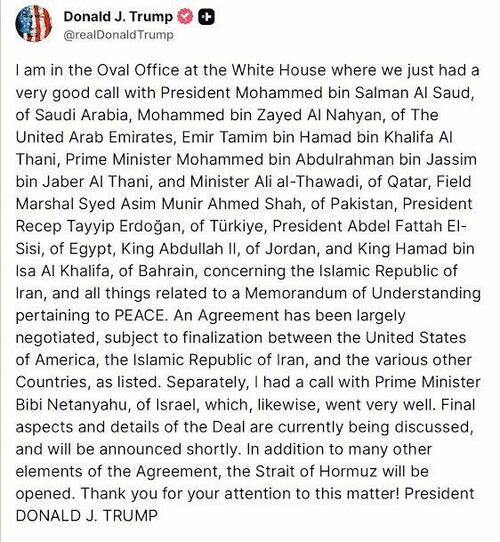
President Donald Trump stated on May 23, 2026, that a peace agreement with Iran has been 'largely negotiated' and is subject to finalization, with the reopening of the Strait of Hormuz as a central element. In a Truth Social post and follow-up remarks, Trump detailed productive calls with leaders from Saudi Arabia, the UAE, Qatar, Pakistan, Turkey, Egypt, Jordan, and Bahrain on a Memorandum of Understanding for peace, alongside a positive conversation with Israeli Prime Minister Benjamin Netanyahu. He indicated final details would be announced shortly, framing the Strait's reopening as key to restoring global energy flows.[1][2]
This development builds on weeks of intensive mediation, primarily facilitated by Pakistan, following a period of direct conflict that saw U.S.-Israeli strikes on Iran, Iranian closure of the Hormuz Strait to most international shipping, and reciprocal U.S. blockades of Iranian ports. Mediators are now advancing a 60-day ceasefire extension that would include phased sanctions relief, unfreezing of some Iranian assets, and commitments regarding Iran's highly enriched uranium stockpile, while laying groundwork for broader nuclear discussions. Secretary of State Marco Rubio, speaking from India, confirmed 'progress has been made' and that the conflict would be resolved 'one way or the other.' Iranian officials described narrowing differences and a focus on finalizing the MOU, which incorporates 30- and 60-day timeframes.[3][4]
While legacy media has covered the tactical back-and-forth and Trump's '50/50' odds of striking a deal versus escalating, deeper analysis reveals a potential geopolitical realignment. The emphasis on Hormuz—through which roughly 20% of global oil trade passes—prioritizes immediate energy security and economic stabilization over complete Iranian capitulation on its nuclear program or proxy networks. This pragmatic framework could ease pressure on global oil markets strained since early 2026 disruptions, benefit Gulf states eager for de-escalation, and allow Iran an off-ramp that preserves regime stability in exchange for verifiable limits on enrichment and openness to international maritime traffic.[5][6]
Connections often missed in coverage include the shifting roles of regional actors: Pakistan's army chief acting as a key intermediary highlights South Asian diplomacy's rising influence in Persian Gulf affairs; Saudi Arabia and UAE's participation suggests a move beyond Abraham Accords-style normalization toward inclusive security architecture that sidelines maximalist demands from all sides. For China and Russia, major buyers of discounted Iranian oil during the blockade, a reopened strait under monitored terms could reduce their leverage while integrating Iran into a U.S.-brokered economic reality. Long-term, success hinges on enforcement mechanisms for uranium dilution and port access—issues that have repeatedly stalled prior talks—but Trump's framing signals confidence in a breakthrough by late May 2026. CBS reporting on Pentagon preparations for potential renewed strikes underscores the high stakes and 'wait and see' posture in Tehran. This is no minor ceasefire but a possible pivot from confrontation to managed coexistence, with Hormuz as the linchpin.[7]
LIMINAL: If finalized, the Hormuz reopening and phased relief could trigger rapid de-escalation, lower global energy prices, and force a realignment where Iran trades nuclear leverage for economic reintegration while Gulf states and Israel gain security guarantees, reshaping alliances away from confrontation toward transactional stability.
Sources (5)
- [1]Trump says Iran deal 'largely negotiated' including reopening Strait of Hormuz(https://www.bbc.com/news/articles/crmp121z3z8o)
- [2]Trump: Iran deal to reopen Strait of Hormuz 'largely negotiated'(https://www.cnbc.com/2026/05/23/us-iran-war-talks.html)
- [3]US and Iran move closer to extending ceasefire by 60 days, say mediators(https://www.ft.com/content/0f6f9962-c6c4-4c75-bba2-8b103edfbc85)
- [4]Live Updates: Peace deal with Iran has been 'largely negotiated' and will include reopening Strait of Hormuz, Trump says(https://www.cbsnews.com/live-updates/iran-war-trump-us-peace-talks-strait-of-hormuz-control/)
- [5]Trump says willing to wait for a few days to get 'right answer' on Iran peace deal(https://www.reuters.com/world/asia-pacific/tankers-exit-hormuz-trump-vance-talk-up-iran-deal-prospects-2026-05-20/)