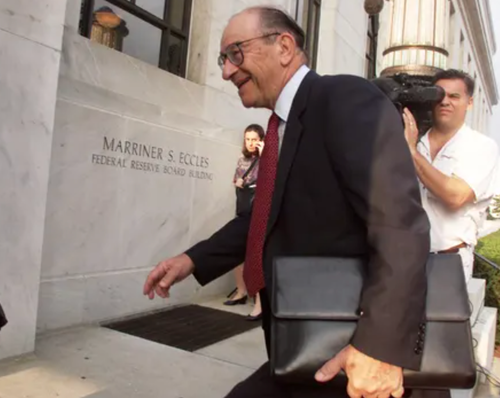
Alan Greenspan, Federal Reserve Chairman 1987-2006, Dies at 100
Greenspan's death closes the era of discretionary monetary policy that prioritized asset price stability over bubble prevention. Primary records show his framework enabled leverage expansion that the 2008 crisis exposed. Institutional reliance on Fed backstops persists unchanged.
Greenspan's 18-year tenure coincided with the longest U.S. expansion on record until 2007, featuring four recessions avoided through rate adjustments and the 1987 crash response. Official records show the federal funds rate cut from 7.25% to 3% within weeks of the October 1987 crash, establishing the Greenspan put precedent later cited in FOMC transcripts. The 2008 House Oversight Committee testimony records his admission that the 30% error rate on self-regulation assumptions contributed to derivatives growth from $100 trillion notional in 2000 to $670 trillion by 2007 per BIS data. The FCIC report documented how 1999-2006 deregulation under his advocacy removed firewalls between commercial and investment banking. Successor Bernanke inherited a balance sheet at 6% of GDP that later expanded past 25% after the zero bound. No immediate policy shift follows the death, with current Chair Powell's term ending in 2026.
Powell: No change to 2025 dot plot median rate path of 3.75-4.00% within 90 days of Greenspan obituary publication
Sources (2)
- [1]Financial Crisis Inquiry Commission Final Report(https://www.govinfo.gov/content/pkg/GPO-FCIC/pdf/GPO-FCIC.pdf)
- [2]House Committee on Oversight and Government Reform Hearing Transcript, October 23 2008(https://www.govinfo.gov/content/pkg/CHRG-110hhrg55764/pdf/CHRG-110hhrg55764.pdf)