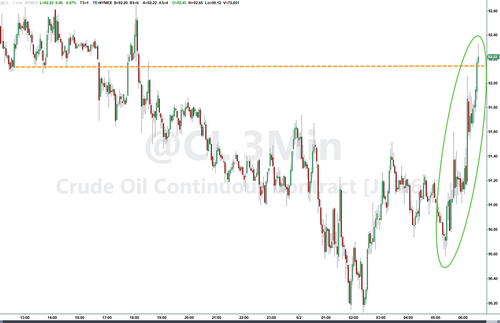
Shaky Lebanon Truce and Halted US-Iran Talks Propel Oil Higher, Foretelling Sharp Consumer Energy Pain
Stalled US-Iran diplomacy linked to persistent Lebanon violence is driving sustained oil price spikes, with credible reporting from multiple outlets confirming halted talks, ceasefire violations, and direct upward pressure on consumer fuel and energy costs in the coming months.
Despite declarations of progress from the Trump administration, Iranian officials have confirmed that exchanges with the US on an initial memorandum of understanding have halted for at least several days, directly contradicting claims of an imminent broader deal. This reversal, tied to ongoing Israeli operations in Lebanon, has sent oil prices spiking as markets price in renewed supply risks, particularly around the Strait of Hormuz. Forbes reported that Iran's decision to cut off talks, blaming Israeli strikes on Lebanon, triggered immediate jumps with WTI futures rising nearly 8% to $94.27. CNBC similarly noted oil rallying as Trump stated he does not care if talks end, renewing fears over the fragile April ceasefire between the US and Iran.
The Lebanon front remains especially volatile. Multiple outlets document that while a nominal ceasefire was announced, exchanges of fire continue. BBC reporting aligns with the original material, confirming further violence overnight including Hezbollah missile attacks on Israeli positions in southern Lebanon and Israeli strikes plus demolitions in areas like Debbine. Reuters and AP News detail proposals for phased Israeli withdrawal, Lebanese army and UNIFIL deployment in the south, and political resolution of Hezbollah's weapons — yet Israeli officials insist operations against threats will persist, and Hezbollah has rejected aspects of the US-brokered framework. This disconnect creates a feedback loop missed in headline coverage: localized Lebanon skirmishes are being leveraged by Iran as a precondition for any nuclear or Hormuz-related concessions, preventing de-escalation and sustaining a geopolitical risk premium in energy markets.
Deeper connections reveal why this matters beyond the Middle East. The war that began 95 days prior has already disrupted shipping and raised global energy costs; a failure to lock in the ceasefire extension by early June (as floated in some proposals) risks renewed closures or threats to the Strait of Hormuz, through which roughly 20% of global oil transits. Reuters coverage of earlier price action showed oil settling 3% higher on Trump's 'life support' comments about the ceasefire. Unlike temporary disruptions, the current dynamic compounds with post-conflict reconstruction demand and reduced OPEC+ spare capacity, embedding higher baseline prices. Consumers will feel this at the pump and in household energy bills within months — analysts project gasoline increases of 20-50 cents per gallon as refiners pass through costs, with knock-on effects for heating oil, natural gas, and broader inflation. Mainstream dismissal of these tensions as 'contained' overlooks how fragile ceasefires in Lebanon act as the linchpin for any larger US-Iran understanding.
Trump has publicly maintained that a deal could arrive 'over the next week' and that shooting would stop, yet Iranian state media and sources like Tasnim push back, demanding Israeli withdrawals from Lebanon as a prerequisite. This gap between rhetoric and reality keeps markets on edge, as seen in BBC and NPR reports tracking oscillating oil prices on conflicting signals. The overlooked angle is the domestic US impact: higher energy costs will hit working households hardest, amplifying political pressure on the administration just as it seeks to claim foreign policy wins.
Energy Markets Analyst: Expect gasoline prices to climb 25-45 cents per gallon by August as the risk premium from unresolved Lebanon-Iran linkages keeps crude elevated above $90, directly increasing household fuel and utility costs amid already strained post-war supply dynamics.
Sources (5)
- [1]Oil rises after Trump says he doesn't care if Iran talks are over(https://www.cnbc.com/2026/06/01/oil-prices-wti-brent-crude-israel-lebanon-hezbollah-iran-trump-us.html)
- [2]Iran Halts Talks With U.S.—Driving Up Oil Prices(https://www.forbes.com/sites/saradorn/2026/06/01/iran-cuts-off-all-talks-with-us-blames-israeli-strikes-on-lebanon/)
- [3]Oil prices settle higher after Trump says Iran ceasefire 'on life support'(https://www.reuters.com/business/energy/oil-jumps-us-iran-fail-reach-agreement-peace-proposal-2026-05-10/)
- [4]Are the US and Iran close to reaching a peace deal… again?(https://www.bbc.com/news/videos/crep48831p8o)
- [5]Trump says U.S. in talks with Iran to end war. Iran denies it(https://www.npr.org/2026/03/23/nx-s1-5757172/iran-defiant-trump-hormuz)