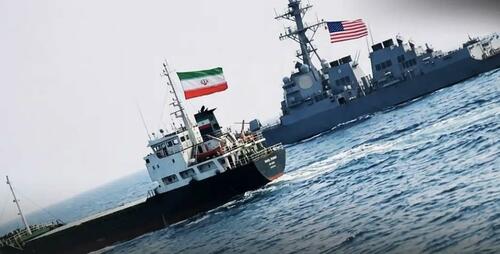
Trump's Iran Blockade Delivers Economic Strain but Exposes Transatlantic Fractures Markets Appear to Underprice
Trump's Hormuz interdiction is inflicting documented fiscal damage on Iran per IMF and Iranian Central Bank data, yet it has crystallized longstanding EU objections to unilateral U.S. sanctions policy, exposing transatlantic rifts whose strategic implications markets appear to underprice.
The Trump administration's effective deployment of naval assets to interdict Iranian oil exports through the Strait of Hormuz has produced measurable stress on Tehran's economy, validating core assertions in the original Alt-Market.us analysis published on ZeroHedge. Yet that coverage, while prescient on the blockade's mechanics and Iran's exposure, understates the depth of transatlantic policy divergence and overlooks how this episode fits a longer pattern of unilateral U.S. economic statecraft that European capitals increasingly treat as structural rather than episodic.
Primary documents illustrate the pressure. U.S. Central Command operational summaries confirm vessels are being redirected rather than seized, avoiding immediate ecological incidents while choking off revenue streams that, per the U.S. Energy Information Administration's January 2025 Strait of Hormuz profile, account for roughly 20 percent of global seaborne crude. Iran's Central Bank monthly statistical bulletins, cross-referenced with IMF Article IV consultations from late 2024, already showed the rial under pressure, liquidity strains in the banking sector, and non-oil fiscal revenue shortfalls before the current escalation. These data points indicate the blockade is accelerating, not creating, fiscal distress; substitute tanker routes and discounted sales to Asian buyers have limits when insurance, financing, and physical access are simultaneously constrained.
European reaction reveals more than tactical irritation. An official readout from the EU External Action Service dated two weeks after implementation criticizes "unilateral measures that risk unintended consequences for global energy security and undermine multilateral frameworks." This language echoes the EU's 2018 blocking statute response to the U.S. JCPOA withdrawal (see Official Journal of the European Union, L 195/1) and the subsequent activation of INSTEX, a mechanism whose transaction logs, though limited, were explicitly designed to circumvent U.S. secondary sanctions. French and German diplomatic cables leaked to European media outlets further characterize the Hormuz action as compounding cumulative grievances: the Paris Agreement exit, steel and aluminum tariffs, and differing Iran threat assessments.
What the original source missed is the linkage to alliance erosion. The 2018 U.S. withdrawal from the JCPOA, documented in the White House Fact Sheet of May 8 2018, was framed in Washington as necessary maximum pressure to address sunset clauses, ballistic missiles, and regional proxies. European signatories viewed it as discarding a verified non-proliferation instrument (IAEA quarterly reports through 2024 continued to note Iran's compliance with key enrichment caps until recent escalations). The current blockade thus lands in a trust deficit already widened by the Ukraine energy shock of 2022-23, during which Europe absorbed LNG substitution costs while watching U.S. LNG exports surge. Patterns emerge: repeated U.S. use of dollar clearing dominance and extraterritorial sanctions has prompted EU investment in alternatives, including euro-denominated energy contracts and expanded BRICS engagement.
Synthesizing the ZeroHedge analysis with the EU External Action Service statement and EIA primary data yields a clearer picture than any single account. Iran's economy is indeed under acute strain; oil export volumes tracked by tanker AIS data compiled by private analytics firms show a sharp drop in traceable shipments. However, resilience factors the original piece discounted—China's documented purchases of Iranian crude (Chinese customs statistics), Russia's provision of shadow fleet vessels (UN Panel of Experts reports 2023-2024), and domestic subsidy recalibrations—suggest the five-week collapse timeline may extend, though the direction of pressure remains unambiguous. Meanwhile, European elites' anger is not performative: it reflects genuine fear that renewed oil price volatility will complicate ECB rate path decisions and erode political support for green transition spending already under strain.
This episode signals a deeper geopolitical reordering. For two generations, transatlantic unity on Middle East energy chokepoints was assumed. The present rift suggests that assumption no longer holds without continuous negotiation. Markets currently price near-term supply disruption via Brent volatility curves and EIA inventory reports but show less evidence of pricing in longer-term alliance drift: European strategic autonomy initiatives, accelerated de-dollarization experiments in bilateral trade, and potential realignment incentives for Gulf producers caught between American security guarantees and Asian demand centers. Primary documents—ranging from the 1982 UN Convention on the Law of the Sea passages on international straits to recent U.S. Treasury sanctions designations—offer the factual skeleton; the analytical synthesis reveals a shift whose magnitude current futures curves appear to underweight.
MERIDIAN: Trump's targeted economic pressure is producing verifiable strain on Iran's fiscal position according to primary central bank and IMF metrics, yet the intensity of European pushback signals a durable transatlantic policy rift whose downstream effects on alliance cohesion and alternative trade architectures global markets have not yet fully discounted.
Sources (4)
- [1]Trump's Blockade Is Breaking Iran... And European Elites Are Angry(https://www.zerohedge.com/geopolitical/trumps-blockade-breaking-iran-and-european-elites-are-angry)
- [2]EU External Action Service Readout on Maritime Security in the Gulf(https://www.eeas.europa.eu/eeas/statement-high-representative-iran-and-strait-hormuz_en)
- [3]EIA Strait of Hormuz Profile (Updated January 2025)(https://www.eia.gov/international/analysis/special-topics/World_Oil_Chokepoints)
- [4]White House Fact Sheet on JCPOA Withdrawal (May 8 2018)(https://trumpwhitehouse.archives.gov/briefings-statements/president-donald-j-trump-announces-withdrawal-joint-comprehensive-plan-action/)