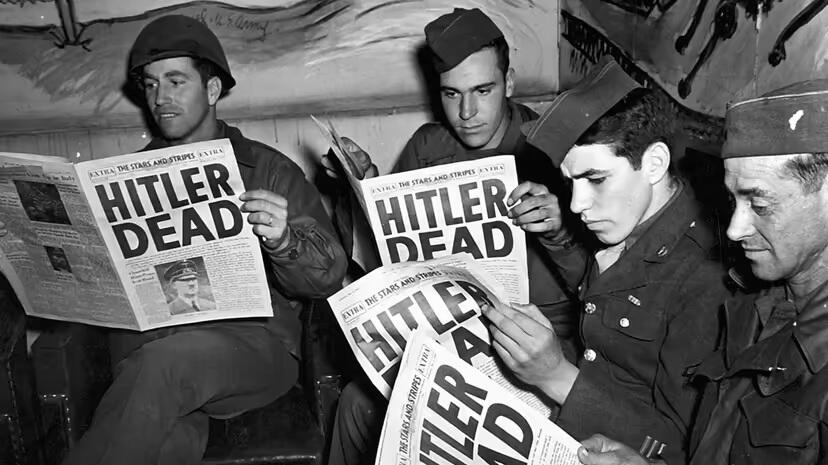
The Hitler Analogy Overload: How 'Everybody's Hitler' Fuels Endless War Advocacy
Politicians routinely compare foreign leaders to Hitler to advocate intervention, a tactic documented across decades with examples from Gaddafi to Putin, often leading to questionable outcomes.
A recent ZeroHedge piece by Jack Hunter highlights a recurring rhetorical tactic in U.S. foreign policy debates: equating adversarial leaders with Adolf Hitler to build support for military intervention. The article cites Libertarian Institute Director Scott Horton responding to Piers Morgan's claim that Russian President Vladimir Putin is 'the nearest thing to a modern day Hitler.' Horton retorted that Noriega, Saddam Hussein, Milosevic, and others were similarly labeled, suggesting the comparison dilutes its meaning and justifies aggression.
This pattern has deep roots. In 2011, Sen. Lindsey Graham (R-SC) warned that Libyan leader Muammar Gaddafi was 'serious' about attacking European cities, stating, 'He actually means it. Hitler meant it. He means it.' Contemporary reporting from The Atlantic and Salon documented the remarks amid debates over NATO intervention in Libya. Graham later applied similar rhetoric to Syrian President Bashar al-Assad and Iranian leaders, whom he has called 'religious Nazis.'
Secretary of State John Kerry in 2013 placed Assad in the company of Hitler and Saddam Hussein regarding chemical weapons use, as covered by The New York Times and Washington Post fact-checks. Sen. Ted Cruz (R-TX) described the Iran nuclear negotiations as 'a moment like Munich in 1938,' echoing Neville Chamberlain's appeasement of Hitler, per reports in The Washington Times and The Hill.
Critics argue these analogies often precede or rationalize interventions with mixed or negative results, such as the post-Gaddafi instability in Libya that Obama later called his 'worst mistake.' The piece also notes documented neo-Nazi elements within some Ukrainian units, a point raised in discussions of Western support for Kyiv. While the original Hitler represented unique evil, the frequent invocation risks turning the term into a generic justification rather than a precise historical warning.
Documented claims include specific politician statements verified across mainstream outlets; broader speculation on 'war drooling' motives remains interpretive.
[Analyst]: Overuse of the Hitler trope may erode public trust in foreign policy justifications, contributing to skepticism toward future interventions amid documented past failures.
Sources (6)
- [1]Piers Morgan urges Trump to side with Ukraine against 'modern-day Hitler' Putin(https://www.thelondoneconomic.com/news/piers-morgan-urges-trump-to-side-with-ukraine-against-modern-day-hitler-putin-410652/)
- [2]Is Qaddafi the New Hitler?(https://www.theatlantic.com/international/archive/2011/07/is-qaddafi-the-new-hitler/241502/)
- [3]Lindsey Graham: Gadhafi is like Hitler(https://www.salon.com/2011/07/06/lindsey_graham_gadhafi_hitler/)
- [4]Kerry’s claim that only three ‘tyrants’ have used chemical weapons(https://www.washingtonpost.com/news/fact-checker/wp/2013/09/05/kerrys-claim-that-only-three-tyrants-have-used-chemical-weapons/)
- [5]Ted Cruz on Iran: ‘I believe we’re at a moment like Munich’(https://www.washingtontimes.com/news/2015/mar/12/ted-cruz-iran-i-believe-were-moment-munich/)
- [6]Lindsey Graham compares Iranians to Nazis(https://www.cnn.com/2015/09/08/politics/lindsey-graham-iranians-nazis)