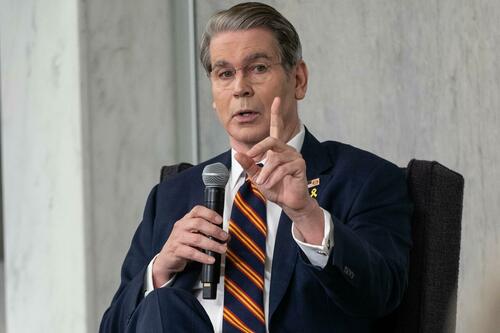
Bessent's Tally of Chinese Unreliability Signals Deeper US Strategic Reorientation Toward Supply Chain Realignment
Bessent's third designation of China as an unreliable partner amid oil hoarding reveals a maturing US policy of strategic competition, connecting COVID, critical minerals, and energy crises while risking escalated trade measures and supply chain fragmentation. Multiple viewpoints highlight sovereignty versus collective stability tensions.
Treasury Secretary Scott Bessent's characterization of China as an 'unreliable global partner' for the third time in five years—citing COVID-era hoarding of medical supplies, 2024 rare earth export restrictions that temporarily idled Ford production lines, and current panic accumulation of crude and refined products amid Iran's Strait of Hormuz closure—extends well beyond a simple ledger of grievances. While the ZeroHedge report accurately captures Bessent's running tally and notes China's strategic petroleum reserve now rivals the entire IEA membership's holdings, it underplays the extent to which this rhetoric reflects institutionalized US policy evolution rather than episodic frustration.
Primary documents illustrate the pattern. The 2022 US National Security Strategy explicitly frames the PRC as the only competitor capable of combining economic, diplomatic, military, and technological power to challenge the international order. Bessent's comments align with this by cataloging instances where Beijing's resource nationalism disrupted allied supply chains. The IEA's Fatih Birol, in his Financial Times interview, warned against export bans and hoarding without naming China directly, stating such moves would cause 'trade partners, allies and neighbors' to suffer—echoing earlier IEA reports on emergency response measures that emphasize coordinated stock releases.
Multiple perspectives emerge. The US view, articulated in Treasury readouts and Bessent's direct engagements with Chinese counterparts, holds that Beijing's actions undermine global public goods during crises, whether PPE in 2020, critical minerals in 2024, or energy stability in the current Gulf shock. Chinese official statements, including Ministry of Foreign Affairs briefings, counter that sovereign states must prioritize domestic needs for a 1.4-billion population, accuse Washington of selective enforcement via military blockades on Iranian oil routes while permitting others, and note US export controls on semiconductors and energy equipment as parallel forms of weaponization.
What much coverage misses is the linkage to systemic de-risking initiatives already codified in law: the CHIPS and Science Act, Inflation Reduction Act incentives for non-Chinese critical materials, and Quad-led mineral security partnerships. The rare earth restrictions Bessent referenced parallel Beijing's 2010 actions against Japan, which catalyzed global diversification investments still underway. Current oil hoarding, occurring against a US-enforced blockade preventing Chinese tankers from accessing Iranian crude, risks accelerating fragmentation of energy markets—potentially elevating prices in Asia while boosting US LNG and shale exports to Europe.
Synthesizing the ZeroHedge reporting, Birol's IEA warnings, and the US Treasury's emphasis on 'stability from the top' ahead of the mid-May Trump-Xi meeting, the episode points to preparatory positioning. Rather than derailing talks, the public tally may establish leverage on issues from reciprocal market access to transparent SPR management. This approach could trigger broader trade measures, including targeted tariffs or technology controls, prompting market realignment: accelerated friend-shoring, higher commodity volatility, and new bilateral energy pacts bypassing traditional chokepoints.
The original coverage correctly flags communication as key but underestimates how Bessent's comments normalize a competitive baseline that treats economic security as inseparable from national security—potentially reshaping alliances, investment flows, and reserve management norms for years ahead.
MERIDIAN: Bessent's systematic tally frames China’s resource actions as a pattern justifying accelerated US de-risking, likely producing higher tariffs, diversified critical supply chains, and increased volatility in global energy and commodity markets regardless of Trump-Xi meeting outcomes.
Sources (3)
- [1]Bessent Keeps Running Tally Of China As "Unreliable Global Partner" - Count Now Stands At Three(https://www.zerohedge.com/energy/bessent-keeps-running-tally-china-unreliable-global-partner-count-now-stands-three)
- [2]IEA chief urges countries not to impose fuel export bans as Gulf crisis deepens(https://www.ft.com/content/3f1e8c4a-2b5d-4e8f-b7c2-1a5e9f3d8b2e)
- [3]National Security Strategy of the United States(https://www.whitehouse.gov/wp-content/uploads/2022/10/Biden-Harris-Administrations-National-Security-Strategy-10.2022.pdf)