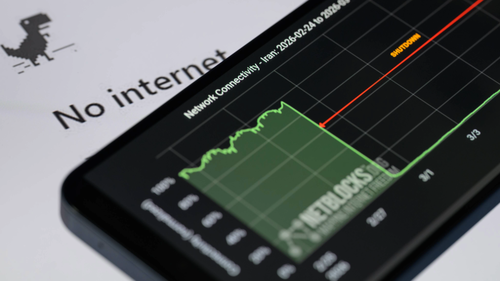
Iran's 57-Day Internet Blackout Exposes Fog of War and Regime Narrative Control Amid US-Israel Conflict
Credible reporting from NetBlocks, NYT, DW, Al Jazeera, and Iran International confirms Iran's unprecedented 57-day near-total internet blackout since Feb 28, 2026, following US-Israeli strikes. It has isolated citizens from war news, devastated the economy, and created a tiered system favoring elites, exposing the conflict's information opacity beyond official narratives.
As of April 25, 2026, Iran has endured a near-total internet blackout for exactly eight weeks—57 days and over 1,344 hours—since February 28, when the regime severed global connectivity shortly after US and Israeli strikes on the country. Internet monitoring organization NetBlocks has consistently documented connectivity plummeting to as low as 2-4% of normal levels, marking this as the longest nationwide internet shutdown on record.
This digital isolation did not emerge in a vacuum. It intensified following anti-government protests in January 2026, during which authorities first imposed severe restrictions, and was fully enacted amid escalating military conflict. According to The New York Times, the blackout has left most of Iran's 90+ million citizens reliant almost exclusively on state-controlled media and intranet services, cutting them off from independent reporting on war developments, stalled negotiations, Israeli threats, and family abroad. Critics argue this creates a "tiered internet" where limited access is selectively restored for university professors and elites while the broader population remains in the dark.
The human and economic costs are staggering. NetBlocks estimates economic losses approaching or exceeding $1.8 billion by mid-April, with daily losses continuing to mount as businesses dependent on online operations remain paralyzed. Deutsche Welle (DW) highlights how ordinary Iranians face daily reminders of state control, struggling to run enterprises or maintain contact with relatives. Reports detail citizens undertaking arduous border crossings into Turkey solely for Wi-Fi access to make video calls, while black markets for Starlink terminals, VPNs, and smuggled SIM cards have proliferated despite their unreliability and high cost.
Al Jazeera and Iran International note that while a limited domestic network persists for basic services, international connectivity remains severed, preventing verification of conflicting claims from all sides in the conflict. This aligns with the editorial lens: the blackout reveals the profound opacity and chaos underlying official narratives. In an era of information warfare, depriving citizens of real-time war updates, protest coordination, or foreign diplomatic developments fosters rumor-driven uncertainty. It not only suppresses potential domestic opposition but obscures the conflict's true trajectory from global observers, as independent voices are silenced.
Wikipedia's entry on the 2026 Internet blackout in Iran, drawing from multiple monitors including NetBlocks and the Georgia Institute of Technology's outage database, confirms the measures followed patterns from prior crises but exceed them in scale and duration. Dawn and other outlets echo that this is a deliberate strategy seen in past protests, now scaled to wartime conditions. The regime's move hinders public awareness at a "critical moment," as NetBlocks stated, potentially enabling unverified escalation or collapse scenarios while external powers pursue regime change objectives.
Connections often missed include how this digital iron curtain accelerates innovation in circumvention technologies and underground networks, even as it damages Iran's already strained economy and isolates its people further on the international stage. Rather than pure security, it functions as information dominance, revealing how modern conflicts are fought as much through bandwidth as ballistic missiles. As the shutdown enters its third month with only minor easing for select groups, the long-term impact on Iranian society—erosion of trust, heightened desperation, and fragmented resistance—may outlast the immediate military phase.
LIMINAL: The blackout doesn't merely hide war facts from Iranians—it manufactures a perfect information vacuum where regime propaganda fills the void, likely hastening societal fractures, black market tech adoption, and long-term erosion of state legitimacy even after connectivity returns.
Sources (6)
- [1]Iran Eases Some Internet Restrictions, as Wider Blackout Passes 50th Day(https://www.nytimes.com/2026/04/19/world/middleeast/iran-internet-blackout-50th-day.html)
- [2]Iran internet blackout hits 8 weeks, NetBlocks says(https://www.iranintl.com/en/202604259473)
- [3]Iran: Internet blackout highlights real toll of censorship(https://www.dw.com/en/iran-internet-blackout-highlights-real-toll-of-censorship/a-76832488)
- [4]Iran expands limited internet access but restrictions remain for most(https://www.aljazeera.com/news/2026/4/20/iran-expands-limited-internet-access-but-restrictions-remain-for-most)
- [5]2026 Internet blackout in Iran(https://en.wikipedia.org/wiki/2026_Internet_blackout_in_Iran)
- [6]NetBlocks Official Reports on Iran Blackout(https://netblocks.org/)