US Defense Spending Dwarfs Global Peers, Revealing Deep Fiscal and Strategic Priorities Amid Rising Global Tensions
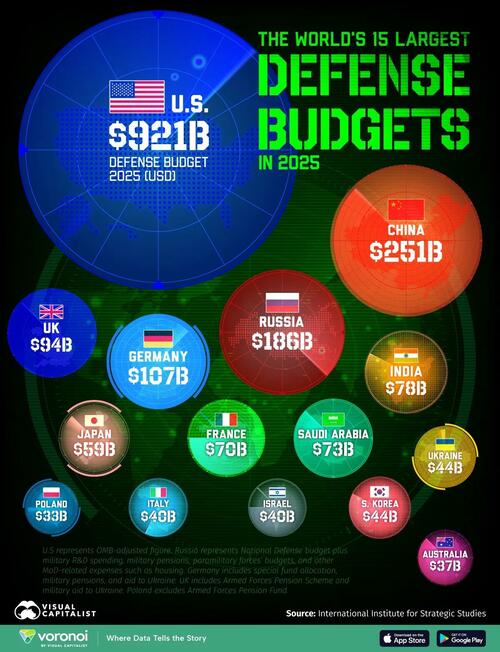
The US defense budget of $921 billion in 2025 exceeds the next eight countries combined, highlighting a persistent prioritization of military power over domestic needs amid a $1.9 trillion federal deficit. This analysis explores overlooked fiscal trade-offs, geopolitical drivers, European NATO dependencies, and the destabilizing global arms race, revealing patterns of US policy that risk long-term economic and strategic vulnerabilities.
The United States’ defense budget for 2025, pegged at $921 billion, surpasses the combined military expenditures of the next eight countries, including China ($251.3 billion) and Russia ($186.2 billion), according to data from the International Institute for Strategic Studies (IISS). This figure, reported by ZeroHedge, underscores a persistent American policy of prioritizing military dominance, a trend that has intensified since the Cold War. However, the original coverage misses critical nuances about the domestic trade-offs and geopolitical ripple effects of this spending, as well as the historical patterns driving it. This article delves into these gaps, examining the fiscal implications for the US, the strategic motivations behind the numbers, and the broader context of global military escalation.
First, the scale of US defense spending must be understood in the context of national debt and domestic priorities. The 2025 budget represents approximately 3.5% of GDP, a figure that, while lower than Cold War peaks, contributes significantly to a federal deficit projected to exceed $1.9 trillion for the fiscal year, per the Congressional Budget Office (CBO). This allocation diverts resources from pressing domestic needs like infrastructure, healthcare, and education—sectors that have seen stagnant or declining real investment over the past two decades. For instance, the American Society of Civil Engineers (ASCE) estimates a $2.6 trillion infrastructure funding gap through 2029, a sum eerily close to the global defense spending total of $2.6 trillion for 2025. The ZeroHedge piece glosses over this tension, focusing instead on raw numbers without addressing what is sacrificed. Historically, this mirrors post-9/11 spending surges, where defense budgets ballooned under the guise of national security while social programs faced cuts, suggesting a entrenched pattern of fiscal prioritization that may exacerbate long-term economic vulnerabilities.
Second, the geopolitical drivers of this spending reveal a complex interplay of deterrence and domestic politics, often underexplored in initial reports. The US justification for such expenditure frequently centers on countering China’s rising military influence in Asia (44% of regional spending) and Russia’s aggression in Ukraine. Yet, the proposed $1.5 trillion defense budget by 2027 under a potential Trump administration, as noted in the source, signals not just a response to external threats but also a domestic political tool. Defense spending historically garners bipartisan support, serving as a visible marker of national strength—a pattern evident during Reagan-era budgets that peaked at 6.2% of GDP in the 1980s. Moreover, the US maintains over 750 overseas military bases (per the Department of Defense’s 2023 Base Structure Report), a network costing upwards of $100 billion annually, which sustains global power projection but also fuels regional tensions, as seen in Middle Eastern flashpoints. The original article fails to connect this spending to the broader strategy of maintaining a unipolar world order, a goal increasingly challenged by multipolar dynamics.
Third, Europe’s accelerating defense budgets—projected to reach $1.2 trillion by 2035 among NATO members—reflect a shift the source underanalyzes. While ZeroHedge notes the 3.5% GDP target, it misses how this buildup is less about autonomous European strategy and more a reaction to US pressure to share NATO burdens, a dynamic evident in Trump-era criticisms of allied contributions. Data from NATO’s 2023 annual report shows only 11 of 31 members met the 2% GDP defense spending goal in 2022, a figure now climbing under geopolitical duress. This suggests a transatlantic dependency that could strain European economies already grappling with energy crises and post-COVID recovery, potentially deepening reliance on US military leadership rather than fostering independent capabilities.
Finally, the global arms race, with total spending at $2.6 trillion, signals a destabilizing trend the original piece only superficially addresses. Beyond the top 15 spenders, smaller nations are also militarizing, often fueled by US and Chinese arms exports. The Stockholm International Peace Research Institute (SIPRI) reports that global arms transfers rose 5% between 2018-2022, with the US accounting for 40% of the market. This proliferation risks escalating proxy conflicts in regions like Sub-Saharan Africa and the Middle East, a consequence of great power competition that the source overlooks. The US’s outsized spending, while a deterrent, may paradoxically incentivize adversaries to innovate asymmetrically—think cyber warfare or hybrid tactics—rather than match conventional budgets.
In sum, while the ZeroHedge article highlights stark spending disparities, it misses the domestic opportunity costs, the political underpinnings of US military budgets, and the cascading effects on global stability. The US’s fiscal priorities, rooted in a historical preference for defense over social investment, reflect a strategic choice to project power at the expense of internal resilience—a decision that could prove unsustainable as global challenges grow more complex.
MERIDIAN: The trajectory of US defense spending suggests sustained growth, potentially reaching $1.5 trillion by 2027, but rising national debt and global multipolarity may force a reckoning on fiscal priorities within the next decade.
Sources (3)
- [1]International Institute for Strategic Studies (IISS) - The Military Balance 2025(https://www.iiss.org/en/publications/the-military-balance/)
- [2]Congressional Budget Office (CBO) - Budget and Economic Outlook 2023-2033(https://www.cbo.gov/publication/58954)
- [3]Stockholm International Peace Research Institute (SIPRI) - Trends in International Arms Transfers 2022(https://www.sipri.org/publications/2023/sipri-fact-sheets/trends-international-arms-transfers-2022)