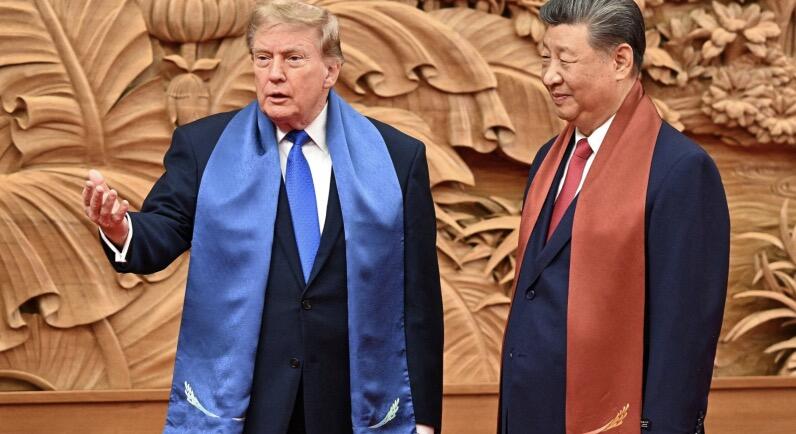
Trump says US will match China on rare earths within 10 months; production data and analysts say the gap is far larger
Trump told reporters in Manila that the US would catch China on rare earths within 10 months. USGS data show US mine output at about 51,000 tons of rare-earth oxide in 2025 versus about 270,000 in China, with refining and magnets far more concentrated in China. Analysts and project forecasts treat the timeline as political, not industrial.
Documented: On 17 November 2026 in Manila, ahead of a Quad leaders’ meeting with the prime ministers of India, Japan, and Australia, US President Donald Trump told reporters the United States was “making rare earths at a level that we’ve never made before” and that “we’re going to catch them within 10 months, they say.” He added that “everything that we need we’ll have in 10 months.” Multiple outlets, including Reuters partners, Al Jazeera, the Washington Examiner, Nikkei Asia, and the South China Morning Post, reported the remarks. The same day the Quad said the four countries had reached new critical-minerals arrangements aimed at preventing “coercion by any single foreign supplier,” and a joint statement expressed “grave concerns” about economic coercion, including arbitrary export restrictions, without naming China.
Documented production gap: The US Geological Survey’s Mineral Commodity Summaries estimate US mine output of rare-earth oxide in concentrates at about 51,000 metric tons in 2025, up from 45,500 tons in 2024, against about 270,000 tons for China. That leaves US mine production at roughly one-fifth of China’s and, on USGS figures, around 13 percent of world mine output. Almost all current US primary production comes from MP Materials’ Mountain Pass mine in California. USGS also estimates US production of rare-earth compounds and metals at only about 8,900 tons in 2025, with net import reliance for those refined products around 67 percent. Over 2021–24, about 71 percent of US imports of rare-earth compounds and metals came from China.
Documented processing choke point: Mining is not the binding constraint. The International Energy Agency has put China’s share of magnet rare-earth mining near 60 percent and of refining near 91 percent in 2024; later IEA commentary cited in Indian reporting put China’s refining share near 85 percent in 2025 as non-Chinese plants, including in the United States and Malaysia, came online. Industry reporting puts US NdFeB magnet manufacturing capacity in the low thousands of tons a year against Chinese output on the order of hundreds of thousands of tons. China also separates the large majority of heavy rare earths such as dysprosium and terbium, which magnets need for high-temperature performance in defense systems and electric motors. S&P Global analysis of producing and committed US separation projects forecasts those projects meeting roughly half of projected US rare-earth oxide demand by 2030—not parity with China, and not within a year.
Claimed versus assessed: Trump’s “10 months” line is a presidential claim, attributed in part to unnamed others (“they say”). It is not a published industrial plan with named plants, capacities, or offtake that would close a fivefold mine gap and a much wider refining and magnet gap. Jack Lifton of the Critical Minerals Institute, quoted by the South China Morning Post, called the timeline unrealistic “diplomatic bluster” and said the United States would not match China in production, processing, or rare-earth-enabled manufacturing in 10 months or 10 years. Reuters, citing Benchmark Mineral Intelligence in September 2026, reported that even with rapid build-out the United States is expected to need Chinese rare-earth imports well into the 2030s. A separate November 2026 Reuters report, ahead of Trump’s planned meeting with Xi Jinping, said many US mining projects remain years from production despite billions in federal investment.
Documented policy context, not a solved supply chain: The administration has put public capital into firms including MP Materials (a Department of Defense preferred-stock investment reported at about $400 million in July 2025, plus price-floor support for NdPr). Allied coordination is real but incomplete: Australian government statements and trade coverage describe Quad partners intending to mobilize up to about $20 billion in public and private support for critical minerals. CSIS, reviewing the year after the Busan understanding between Trump and Xi, found US imports of covered rare-earth compounds and metals still far below pre-restriction levels, with heavy rare earths such as yttrium especially constrained. Export licensing has been applied unevenly: China’s total covered exports barely fell while shipments to the United States and Japan dropped sharply.
What is speculated, and should stay labeled as such: That a 10-month political timetable is industrial strategy capable of breaking a Chinese processing monopoly; that Quad deal announcements, whose mineral volumes and company counterparties were not fully disclosed in Manila, equal near-term supply security; or that higher US mine output alone stabilizes prices, defense stockpiles, or EV and wind supply chains. None of those inferences is supported by USGS, IEA, or the project timelines analysts cite. The documented pattern is slower: more concentrate at Mountain Pass, early separation and magnet lines, allied capital, and continued dependence on Chinese refining for the materials that actually enter motors, missiles, and turbines.
Rare earths feed magnets in weapons, electric vehicles, wind turbines, and electronics, and China still refines most of the material the United States uses. A presidential claim of parity in 10 months does not match published mine, separation, or magnet figures, so manufacturers and defense buyers remain exposed to Chinese export licensing.
Sources (9)
- [1]Trump claims US will have enough rare earths in 10 months; experts call it unrealistic(https://www.scmp.com/news/china/diplomacy/article/3374808/trump-claims-us-will-have-enough-rare-earths-10-months-experts-call-it-unrealistic)
- [2]Trump says US could catch China on rare earths in 10 months(https://mining.com.au/trump-says-us-could-catch-china-on-rare-earths-in-10-months/)
- [3]Trump announces critical minerals agreements at Quad meeting in Manila(https://www.aljazeera.com/news/2026/11/17/trump-announces-critical-minerals-agreements-at-quad-meeting-in-manila)
- [4]Trump meets key US regional allies in Manila ahead of China visit(https://www.reuters.com/world/china/trump-kick-off-asia-trip-with-quad-talks-manila-ahead-china-visit-2026-11-17/)
- [5]USGS Mineral Commodity Summaries, Rare Earths (2025 estimates)(https://www.globenewswire.com/Tracker?data=gyLz0zx42eBNiQ2EBWd5mvL23BlV991TamVkBD4rIkkVVXC5OC8MY45hIiujAF1ut1CvZiFMUkEWoAq-2o6qwyMmsFQWIk33_3jmjCqwHmlUsi3QJWzCRJu0sqlCPVNtcKtSa8daT6oyZOc9eL_ndNykJmU5XWS-vTqUHDDXHGo=)
- [6]China’s rare earths dominance to overshadow Trump’s talks with Xi(https://www.reuters.com/world/china/chinas-rare-earths-dominance-overshadow-trumps-talks-with-xi-2026-09-24/)
- [7]Trump’s minerals push has yet to loosen China’s grip ahead of Xi talks(https://www.reuters.com/business/autos-transportation/trumps-minerals-push-has-yet-loosen-chinas-grip-ahead-xi-talks-2026-11-15/)
- [8]US rare-earth oxide production set to meet half of demand by 2030(https://www.spglobal.com/energy/en/news-research/latest-news/metals/111726-us-rare-earth-oxide-production-set-to-meet-half-of-demand-by-2030)
- [9]One Year After Busan: Has China Kept Its Rare Earth Promises?(https://www.csis.org/analysis/one-year-after-busan-has-china-kept-its-rare-earth-promises)