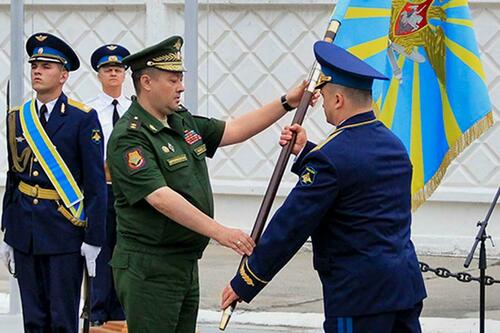
Putin's Purge of Aerospace Commander Signals Deepening Vulnerabilities as Ukrainian Drones Expose Regime Cracks
Credible reports confirm Putin replaced Aerospace Forces head Viktor Afzalov with Alexander Chaiko (linked to Bucha sanctions) after Ukrainian drones caused repeated strikes on Tuapse and Perm oil sites, triggering environmental crises and exposing Russian air defense failures. This reflects a pattern of military purges signaling regime pressure and the disruptive power of asymmetric drone tactics overlooked in conventional analyses.
In a move that underscores the escalating pressure on Russian air defenses, President Vladimir Putin has replaced Colonel-General Viktor Afzalov with Colonel-General Alexander Chaiko as commander of Russia's Aerospace Forces. This leadership shake-up, reported on May 4, 2026, comes amid a barrage of Ukrainian drone strikes that have repeatedly penetrated deep into Russian territory, striking critical oil infrastructure in Tuapse and Perm. Multiple independent reports confirm the change, citing sources close to the Russian Defense Ministry, with RBC and subsequent corroboration from outlets across the spectrum.[1][2]
While surface-level coverage frames this as a routine personnel adjustment, the deeper pattern reveals systemic fragility in Putin's military apparatus. Afzalov, appointed in 2023 following the ouster of Sergei Surovikin, oversaw a branch tasked with air and missile defense yet failed to intercept low-cost Ukrainian UAVs targeting the Tuapse oil refinery and terminal on at least four occasions since mid-April 2026. These strikes have triggered a significant environmental disaster, with toxic smoke, oil spills into the Black Sea, and reports of 'black rain' affecting local populations—issues that have sparked local anger and exposed gaps in both kinetic defenses and crisis management. Similar attacks reached the Lukoil refinery in Perm near the Ural Mountains, demonstrating Ukraine's growing reach and the limitations of Russia's layered air defense systems against attritional, inexpensive drone swarms.[3][4]
Chaiko's appointment is particularly noteworthy and potentially destabilizing. A ground forces veteran with experience commanding the Eastern Military District and Russian forces in Syria, he lacks direct aerospace expertise—a departure from tradition that suggests desperation rather than strategic optimization. More critically, Chaiko has been sanctioned by the European Union for his alleged role commanding forces during the 2022 Bucha occupation, where widespread civilian killings occurred (accusations Moscow denies). His elevation amid battlefield setbacks fits a recurring pattern of purges: when failures mount, Putin rotates commanders to deflect blame and maintain control, yet this risks further demoralization and institutional memory loss within the armed forces.[5][6]
This episode highlights what mainstream reporting often glosses over: the transformative impact of asymmetric drone warfare in eroding conventional power advantages. Ukraine, facing territorial pressure in the east, has leveraged cheap, long-range UAVs as its primary lever—bypassing Russia's air superiority claims and striking economic chokepoints like oil exports. The inability to halt these incursions not only damages Russia's war economy but signals broader regime vulnerabilities. Authoritarian systems reliant on projected strength appear brittle when challenged by innovative, low-barrier technologies. Connections to other global flashpoints are hard to ignore; if drones can neutralize advanced air defenses here, similar tactics could destabilize energy security, embolden non-state actors, or reshape deterrence calculations in conflicts involving China, Iran, or beyond. Zelensky's recent announcement of a 'new stage' in weapon use against Russian military potential only amplifies this shift. As Chaiko assumes command under intense scrutiny, the question looms: how many more firings before deeper instability surfaces within Putin's inner circle?
LIMINAL: This high-level firing amid unstoppable drone strikes reveals Putin's military leadership is increasingly reactive and fragile, likely accelerating internal purges while proving cheap autonomous systems can destabilize even nuclear powers and reshape global conflict beyond Ukraine.
Sources (5)
- [1]Putin Replaces Aerospace Commander With EU-Sanctioned General Amid Drone Surge, Reports Say(https://www.themoscowtimes.com/2026/05/04/putin-replaces-aerospace-commander-with-eu-sanctioned-general-amid-drone-surge-reports-say-a92675)
- [2]Putin Replaces Russia’s Air Defense Commander After Drone Attacks Expose Failures(https://english.nv.ua/nation/putin-replaces-russia-s-air-defense-commander-after-drone-attacks-expose-failures-50605247.html)
- [3]Russian Aerospace Forces Reportedly Get New Commander(https://www.longwarjournal.org/archives/2026/05/russian-aerospace-forces-reportedly-get-new-commander.php)
- [4]Russia Names General Sanctioned Over Bucha Killings as New Aerospace Forces Commander(https://meduza.io/en/news/2026/05/04/russia-names-general-sanctioned-over-bucha-killings-as-new-aerospace-forces-commander)
- [5]Poisonous Black Rain Falls in Russia as Ukraine Strikes Oil Facilities(https://www.washingtonpost.com/world/2026/05/04/russia-ukraine-strikes-oil-disaster/)