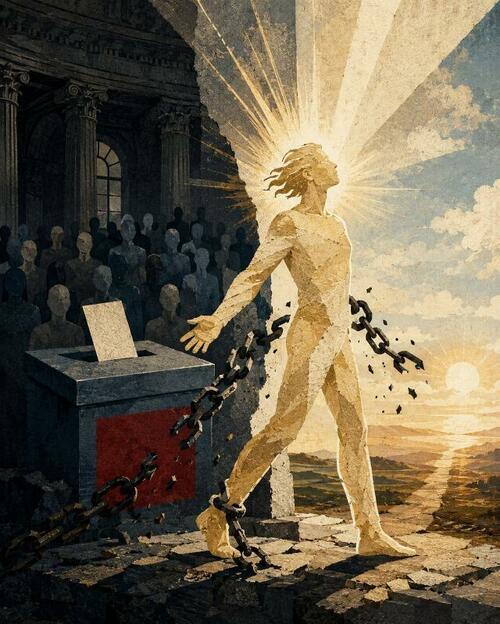
Liberty First: Why Natural Rights Outrank Pure Democracy in Enduring Political Thought
Synthesized exploration of the philosophical priority of natural liberty over pure democracy, corroborated by historical and contemporary sources from Madison and Locke to modern analyses at AEI, Mises, Hoover, and others.
The argument that freedom—understood as inviolable natural rights—holds greater importance than unchecked democracy echoes through centuries of political philosophy and finds fresh expression in contemporary discourse. A recent piece by J.B. Shurk in American Thinker contends that democracy, when reduced to majority rule without moral or constitutional restraints, risks descending into despotism, citing examples like North Korea's official name and warnings from Hobbes, Locke, and the American Founders. Shurk emphasizes that rights to speech, religion, self-defense, and property exist independently of majority vote, rooted instead in the Declaration of Independence's assertion of unalienable rights endowed by a Creator.[1]
This view aligns with longstanding critiques. In 2004, political scientist James Q. Wilson argued in AEI that freedom can be far more vital than democracy alone, noting that liberal regimes protect personal liberty even without full democratic structures, while pure majoritarianism can enable the 'tyranny of the majority.' Wilson stressed that the goal should be expanding freedom, not merely installing elections.[2] Similarly, the Mises Institute has published on how unlimited democracy threatens individual sovereignty, advocating instead for limited, liberal democracy that prioritizes personal rights over collective majorities, drawing directly from the Declaration and Lockean natural rights.[3]
Founding-era concerns reinforce the point. James Madison, in Federalist No. 10, warned against pure democracies' vulnerability to factions and mob rule, favoring a republic with checks to protect minority rights and long-term interests over fleeting popular passions. The Atlantic has revisited Madison's fears in light of modern polarization.[4] Hoover Institution scholar Tibor Machan has insisted that individual rights to life, liberty, and property must come first as the highest political value, with government serving to secure them rather than expand through democratic processes.[5]
More recent analyses, including from the Pacific Legal Foundation and FEE, highlight how the Founders viewed liberty as primary and democracy as instrumental—valuable only insofar as it safeguards natural rights. Unlimited majoritarianism, they argue, conflicts with the social contract and risks eroding the very freedoms it claims to uphold.[6][7] These threads connect Shurk's critique to a broader tradition challenging 'democracy' as an end in itself, especially when invoked without reference to constitutional guardrails or cultural virtues.
The distinction carries implications for debates over rights, majoritarianism, and institutional limits, appearing across conservative, libertarian, and classical liberal outlets without requiring endorsement of any single partisan narrative.
LIMINAL: Persistent emphasis on this liberty-democracy tension could sharpen scrutiny of majoritarian policies and reinforce calls for stronger constitutional protections in polarized societies.
Sources (6)
- [1]Freedom Is Much More Important Than Democracy(https://www.americanthinker.com/articles/2026/09/freedom-is-much-more-important-than-democracy/)
- [2]Why Freedom Can Be a Lot More Important Than Democracy(https://www.aei.org/articles/why-freedom-can-be-a-lot-more-important-than-democracy/)
- [3]Liberty Is More Important than Democracy(https://mises.org/mises-daily/liberty-more-important-democracy)
- [4]Why Freedom Must Be First(https://www.hoover.org/research/why-freedom-must-be-first)
- [5]The founders and the primacy of liberty(https://pacificlegal.org/the-founders-and-the-primacy-of-liberty/)
- [6]James Madison’s Mob-Rule Fears Have Been Realized(https://www.theatlantic.com/magazine/archive/2018/10/james-madison-mob-rule/568351/)