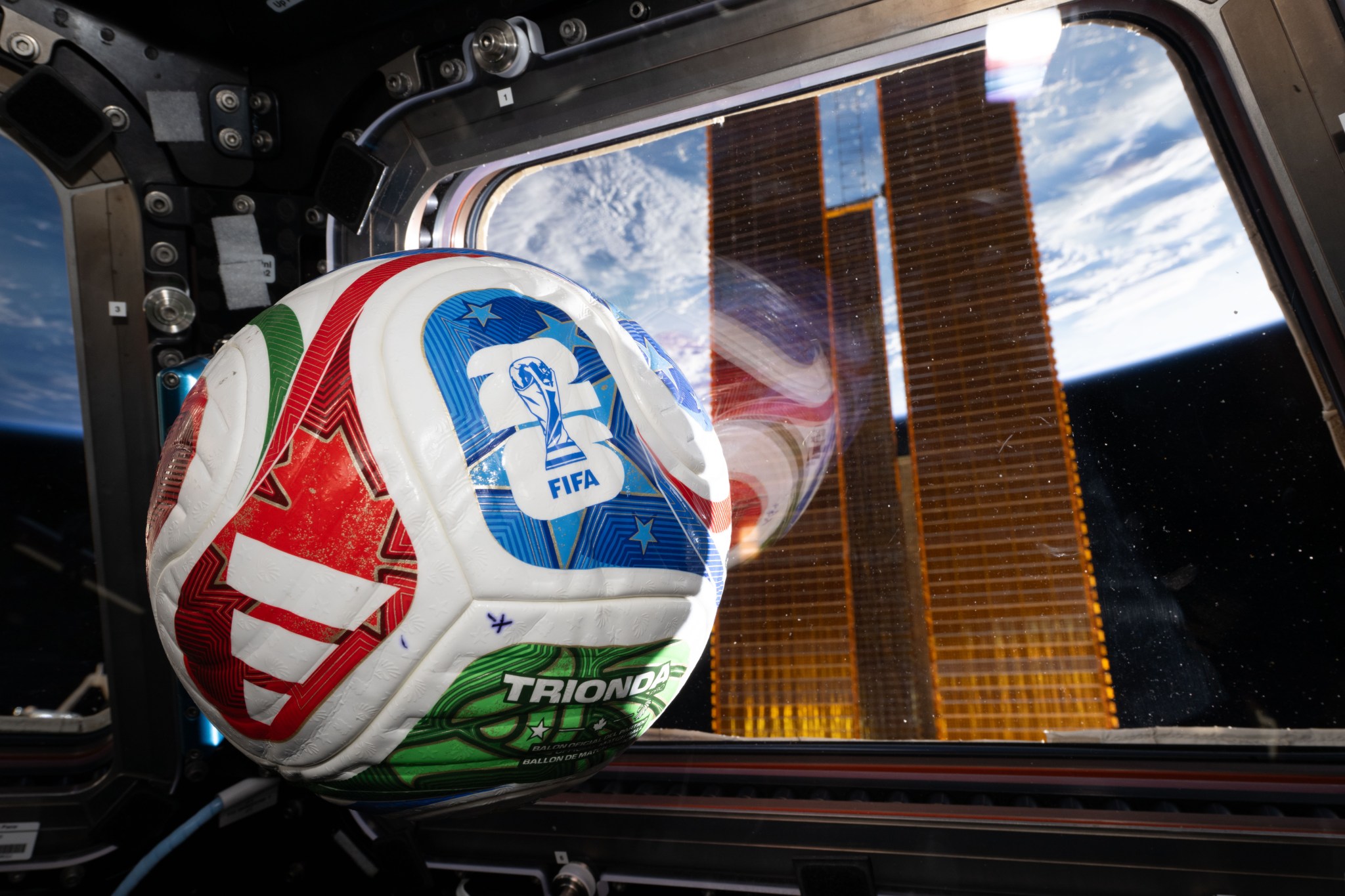
From Lunar Orbits to Penalty Kicks: How Artemis Physics and ISS Microgravity Research Quietly Reshape the 2026 World Cup Experience
NASA's ISS microgravity soccer studies and Artemis mass-distribution tech are enabling smarter World Cup balls, exposing overlooked pathways from space research to global sports infrastructure.
The NASA Johnson Space Center announcement frames its Fan Festival exhibit as a straightforward outreach effort during the 2026 FIFA World Cup in Houston, highlighting Artemis II crew appearances and ISS spinoffs. Yet this understates a deeper pattern of tech transfer: fundamental aerodynamics research conducted in microgravity is directly informing the embedded-sensor match balls that will officiate every game. The 2019 ISS National Lab experiment, conducted via parabolic flight analogs and station-based rotation tests on weighted spheres, isolated how off-center mass alters torque and precession—methodology relying on repeated microgravity sessions rather than large statistical samples, with inherent limitations from short-duration orbits and controlled lab conditions. This work, absent from most mainstream sports coverage, underpins Adidas' 2022 sensor integration by predicting stability deviations that ground wind-tunnel tests at Ames (used on the 2014 Brazuca) could not fully capture. Synthesizing this with Artemis program data on spacecraft center-of-mass dynamics reveals an under-covered feedback loop: lunar navigation algorithms refined for Artemis I are mirrored in real-time ball-tracking software, turning elite athletic officiating into a public demonstration of orbital mechanics. Mainstream reporting misses how such transfers normalize space-derived precision in everyday spectacles, fostering cultural acceptance of Artemis-scale engineering without explicit linkage. Limitations persist in scaling lab findings to variable tournament weather, where seam turbulence effects remain partially unmodeled.
Helix: Microgravity-derived mass modeling will standardize sensor balls across future tournaments, accelerating public intuition for spacecraft dynamics by 2030.
Sources (3)
- [1]Primary Source(https://www.nasa.gov/centers-and-facilities/johnson/how-nasa-science-and-artemis-are-shaping-the-2026-fifa-world-cup/)
- [2]ISS National Lab Soccer Ball Study Summary(https://www.issnationallab.org/research/soccer-ball-microgravity-2019/)
- [3]NASA Ames Fluid Mechanics Lab Wind Tunnel Report on Brazuca(https://www.nasa.gov/ames/fluid-mechanics/soccer-ball-aerodynamics-2014)