NATO's AWACS Pivot from Boeing to Saab-Bombardier: Strategic Autonomy or Symptom of Alliance Fracture?
NATO's selection of Saab-Bombardier GlobalEye over Boeing's E-7 for AWACS replacement highlights eroding confidence in U.S. defense industry reliability, accelerating European strategic autonomy and supplier diversification amid peer competitor threats. The shift reveals deeper patterns of alliance hedging missed by initial reporting.
NATO’s Support and Procurement Agency decision to select Sweden’s Saab and Canada’s Bombardier GlobalEye platform to replace its E-3A Sentry fleet represents far more than a routine platform swap. While the original Defense News reporting accurately captures the immediate timeline and Saab’s long-frustrated bid, it underplays the structural rot in Boeing’s defense delivery record and misses the deeper pattern of NATO hedging against American industrial and strategic unreliability in an era of intensified great-power competition.
The E-3A fleet, based on the Boeing 707 airframe, has soldiered on since the early 1980s. Successive upgrade programs failed to keep pace with advances in adversary integrated air defense systems. The alliance’s 2023 sole-source selection of Boeing’s E-7A Wedgetail was sold as the only viable near-term solution. Yet within 18 months, the entire effort collapsed after the U.S. Air Force itself excised the program from its FY2026 budget, citing persistent cost overruns, integration delays on the 737NG platform, and legitimate survivability concerns against peer A2/AD networks. This was not an isolated misstep. Boeing’s KC-46 tanker saga, repeated 737 MAX certification crises, and the T-7 trainer delays have cumulatively eroded confidence among allies who once viewed American industry as the default option.
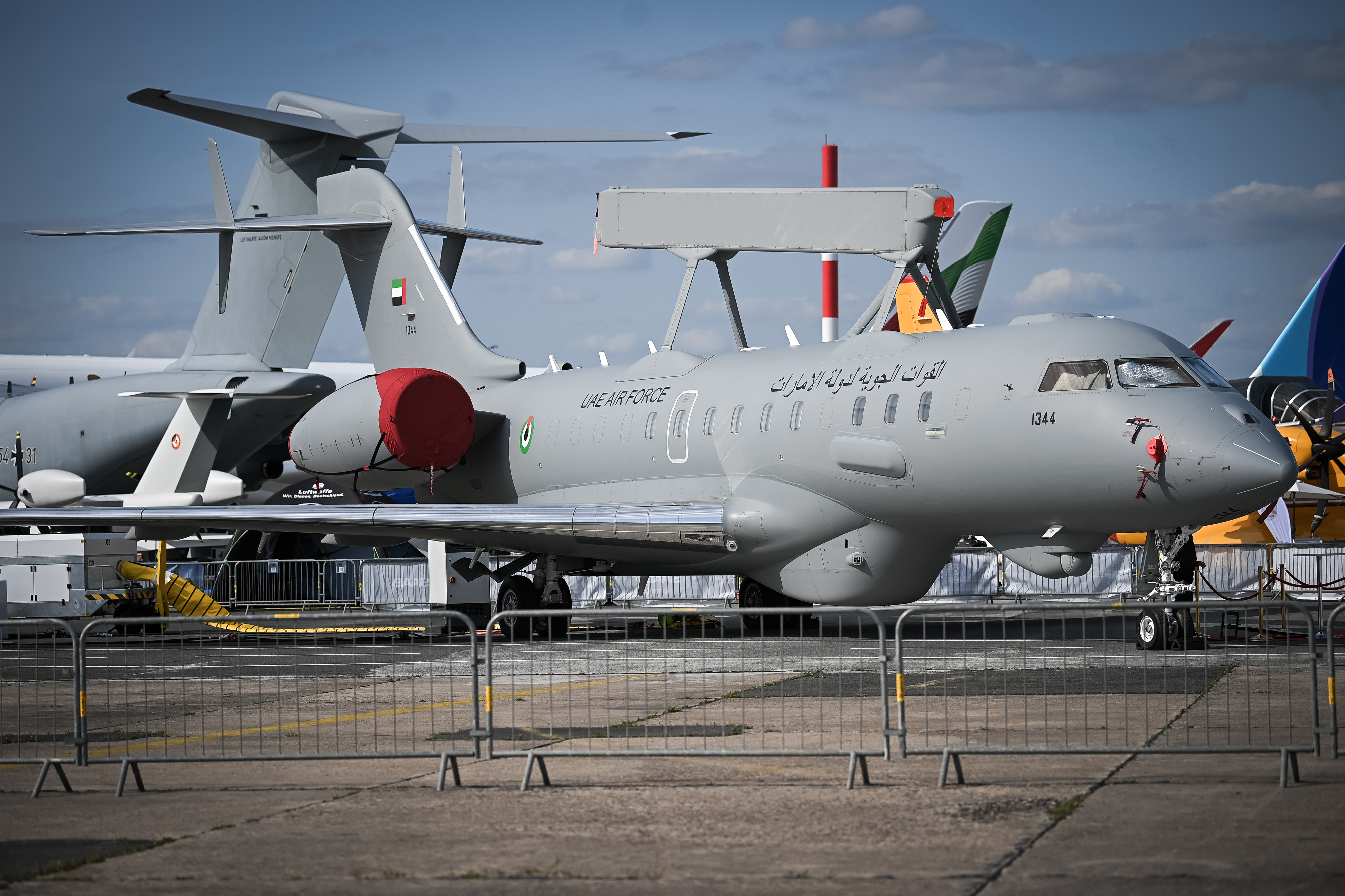
By contrast, the GlobalEye—built on the Bombardier Global 6000/6500 business jet with Saab’s Erieye ER AESA radar—offers 550+ km detection ranges across air, maritime, and ground domains with lower operating costs and a smaller logistical footprint. French acquisition of the platform in late 2025, combined with Polish and German interest, reflects a quiet realignment. This choice also cleverly threads the needle: while not purely European (given the Canadian airframe), it sidesteps direct U.S. supply-chain vulnerabilities at a time when Washington’s defense priorities are visibly shifting toward the Indo-Pacific.
What the original coverage missed is the intelligence dimension. AWACS assets are high-value targets in any Russia or China contingency; their emissions and size make them priority targets for long-range missiles. The GlobalEye’s smaller signature and rapid-deployment profile from dispersed European airfields may offer marginal tactical advantages the lumbering E-3 and even the E-7 struggle to match. Furthermore, this decision continues a pattern seen in the FCAS/GCAP fighter debates, the MGCS tank program, and European tanker procurements: progressive de-risking from sole reliance on U.S. primes. SIPRI’s 2025 arms transfer data shows European states increasing intra-European and non-U.S. NATO procurement by 31% since 2022, a trend driven by both strategic autonomy rhetoric and pragmatic fear of U.S. policy volatility.
Synthesizing the Defense News report with Reuters coverage of the USAF’s E-7 cancellation and a 2026 IISS Strategic Survey chapter on NATO’s ISR gaps reveals the original piece understated political momentum. Dutch State Secretary Gijs Tuinman’s explicit call for European industry investment was not mere rhetoric but a direct response to perceived American disengagement. The €5+ billion program, targeting 10–12 aircraft by 2031, will require significant infrastructure and training investment that could lock in European supply chains for decades.
This is not the death of transatlantic defense cooperation, but it does signal a new phase: selective diversification. Boeing’s difficulties have handed European industry a rare opening. In an environment where Russia’s war in Ukraine has exposed critical munitions and platform gaps, and China’s pacing threat demands resilient, non-monopolistic supply networks, NATO’s move toward the Swedish-Canadian solution is a rational if politically charged adaptation. The real test will be whether the GlobalEye fleet can achieve true interoperability with remaining U.S. assets and whether Washington views this as prudent risk management or the beginning of industrial decoupling.
SENTINEL: NATO's GlobalEye selection marks a calculated erosion of Boeing's monopoly on alliance ISTAR platforms, driven by repeated U.S. industrial shortfalls and the need for resilient supply chains against Russian and Chinese threats; expect this diversification trend to accelerate in future procurements, subtly weakening transatlantic industrial interdependence.
Sources (3)
- [1]NATO eyes Swedish-Canadian jet for AWACS role in shift away from Boeing(https://www.defensenews.com/global/europe/2026/04/24/nato-eyes-swedish-canadian-jet-for-awacs-role-in-shift-away-from-boeing/)
- [2]U.S. Air Force drops E-7 Wedgetail from FY2026 budget over costs and delays(https://www.reuters.com/business/aerospace-defense/us-air-force-removes-boeing-e-7-program-fiscal-2026-budget-2025-06-02/)
- [3]NATO ISR Capabilities and European Strategic Autonomy(https://www.iiss.org/publications/strategic-survey/2026/nato-isr-gaps-european-autonomy)