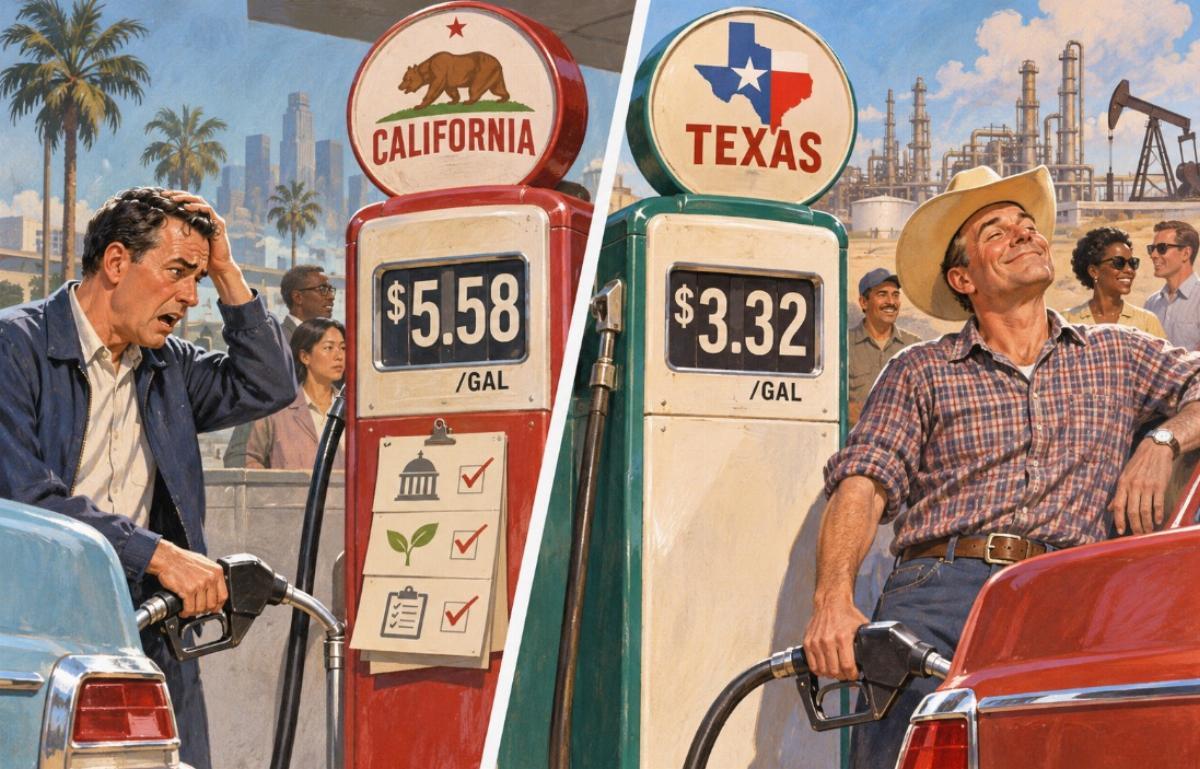
California regular gasoline is about 70% more expensive than Texas, a gap AAA data still shows above $2 a gallon
AAA data show California regular gasoline about $2.29 a gallon, or roughly 70%, above Texas. EIA attributes the long-running premium to taxes, clean-fuel rules, a special blend, and a isolated refining market now losing capacity — not to a verified partisan difference in recent price drops.
Documented: On November 16, 2026, AAA listed the national average for regular gasoline at $3.81 a gallon. California averaged $5.57 and Texas $3.28 — a difference of about $2.29 a gallon, or roughly 70% more in California than in Texas. Hawaii was slightly higher than California that day, at $5.62. The same AAA snapshot put Washington at $4.83, Oregon at $4.46, and Nevada at $4.90, while North Carolina was the cheapest state at $3.09. Newsweek, citing AAA the same morning, described a national decline from $4.01 a week earlier and $4.33 a month earlier, and attributed the drop to lower crude prices, the usual post-summer fall in demand, and the switch to cheaper winter-blend gasoline in much of the country.
That gap is large enough to show up in a household budget without any political overlay. At 12,000 miles a year and 25 miles per gallon, a driver buys about 480 gallons. The California–Texas price difference on the November 16 AAA figures is on the order of $1,100 a year for that driving pattern — before counting diesel, which AAA also listed far higher in California ($7.94) than in Texas ($5.41).
Claimed, and only partly checked here: An American Thinker piece republished by ZeroHedge said Californians were paying 68% more than Texans and that, over the 11 days after an election, states with long Democratic legislative control saw smaller percentage price drops than Republican-controlled states. The 68% figure is in the same range as the AAA gap documented above; the exact percentage moves with the day of the survey. The party-sorted ranking of post-election percentage drops was not independently reproduced in the sources reviewed here. Recent mainstream reporting on the national decline points to crude, seasonality, and winter blend, not to state party control.
Documented mechanisms for the West Coast premium, from the U.S. Energy Information Administration: California retail prices are consistently the highest in the continental United States, often more than a dollar above the national average. EIA’s May 2025 analysis listed the highest combined pump taxes in the country (about $0.90 a gallon including federal tax as of March 2025, of which the state excise alone was about $0.60), environmental compliance costs the California Energy Commission put as high as about $0.54 a gallon, and a unique cleaner-burning blend that few out-of-state refiners make. The state is also poorly connected by pipeline to Gulf Coast refineries, so it depends heavily on in-state plants and imports. A later EIA note said two announced closures — Phillips 66’s Wilmington refinery and Valero’s Benicia refinery — would remove about 17% of California refining capacity and raise the risk of price volatility on the West Coast, even if they are a small share of national capacity.
State fuel-tax tables compiled from EIA rates effective July 1, 2026, put California’s state gasoline tax near 74 cents a gallon and Texas at 20 cents. Taxes explain a large slice of the pump gap, not all of it. After subtracting published state and federal taxes, California’s estimated pre-tax price remains among the highest in the country. Hawaii is the clearest counterexample to a tax-only story: it has one of the lowest state gasoline taxes and, on the November 16 AAA survey, the highest pump price, consistent with isolation from mainland refining.
The party pattern in the original piece is a correlation, not a demonstrated cause. High prices cluster on the West Coast and in isolated markets; several higher-price states (including Utah, Idaho, and Arizona on recent AAA lists) are not uniformly Democratic, and several low-tax Republican states are also major refining regions. Speculated: that legislative party control, rather than refining geography, fuel specifications, and tax design, is the main reason the post-election percentage decline differed by state. That claim was not corroborated by the EIA or AAA reporting reviewed here.
Drivers in California pay roughly $2 more per gallon than drivers in Texas on current AAA averages, which can add on the order of a thousand dollars a year for a typical commute, on top of already high state fuel taxes and a shrinking in-state refining system.
Sources (5)
- [1]AAA State Gas Price Averages(https://gasprices.aaa.com/state-gas-price-averages/)
- [2]Newsweek: Map shows states with gas averages as prices fall(https://www.newsweek.com/map-shows-states-with-gas-average-below-4-as-prices-fall-12718984)
- [3]EIA: Why California usually pays more at the pump for gasoline(https://www.eia.gov/todayinenergy/detail.php?id=65184)
- [4]EIA: Refinery closures present risk for higher gasoline prices on the West Coast(https://www.eia.gov/todayinenergy/detail.php?id=65704)
- [5]Nebraska DOT compilation of EIA state motor-fuel taxes, rates effective July 1, 2026(https://dot.nebraska.gov/media/qh5pifiq/gas-tax.pdf)