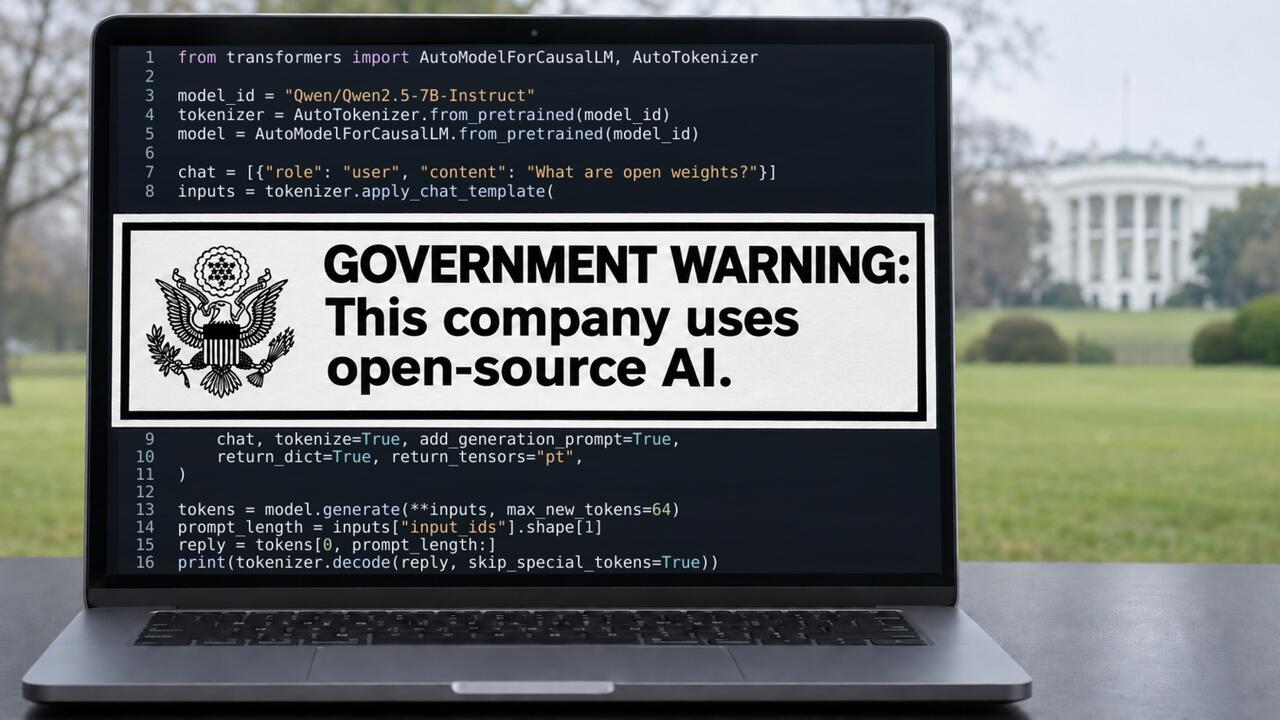
Trump officials have discussed requiring US firms to disclose use of Chinese AI models, Reuters reports
Treasury and White House science officials have discussed, but not adopted, a requirement that US companies publicly disclose use of Chinese AI models. Congress is already investigating Airbnb, Anysphere, and DoorDash over Chinese open-weight systems, while officials distinguish support for open source from alleged Chinese IP theft.
Documented: On November 18, 2026, Reuters reported that officials at the Treasury Department and the White House Office of Science and Technology Policy have discussed requiring US companies to publicly disclose their use of Chinese AI models, including by posting that information on company websites. Three people familiar with the discussions told Reuters the idea is meant to discourage reliance on Chinese systems without new restrictions that could anger industry or Beijing. Reuters described the approach as a “name and shame” campaign consistent with the administration’s broader anti-regulation stance on AI. Reuters also reported that it was not clear whether the idea was gaining traction or would enter formal rulemaking. The White House and Treasury did not respond to Reuters’ requests for comment. The idea has not been adopted as a rule.
The companies and models named in that reporting sit inside a longer, documented fight over Chinese open-weight systems. Reuters cited Airbnb’s use of Alibaba’s Qwen to power an AI customer-service agent. In May 2026, Airbnb CEO Brian Chesky told Bloomberg that lawmakers were “misunderstanding” the technology: Airbnb is not a customer of Alibaba, he said, and is not providing user data to Chinese companies. House Select Committee on China Chairman John Moolenaar and House Homeland Security Chairman Andrew Garbarino opened a joint investigation in April 2026 with letters to Airbnb and Anysphere, maker of the Cursor coding tool, and later wrote to DoorDash. On November 20, 2026, the chairmen released a joint investigation report arguing that US firms are adopting PRC open-weight models because they are inexpensive, customizable, and competitive, and that federal investigations have found major PRC developers used proxy networks and fraudulent accounts to harvest outputs from American frontier models. Moolenaar told Reuters that “disclosure is an important step in managing the potential risks posed by the diffusion of Chinese open-weight models.”
That congressional record is narrower than a general attack on open source. In their July 2026 letter to DoorDash, the chairmen wrote that US companies may deploy PRC open-weight models for cost, capability, customization, and as an alternative to a small set of proprietary providers, and that an effective federal approach should strengthen American open-weight alternatives while applying tailored safeguards in sensitive uses. Bessent has drawn a similar line in public. In July 2026 he said the administration supports open-source models but not IP theft, and that sanctions would be available if overseas models were found to be stealing from US companies. OSTP Director Michael Kratsios has separately accused Moonshot AI of distilling Anthropic’s Fable model; Moonshot has rejected the claim that its gains came from distillation. Those allegations remain contested claims by US officials, not court findings.
Claimed, not established: Commentary on the All-In podcast treated the disclosure idea as a step toward restricting, labeling, and ultimately controlling open-source AI as such. David Friedberg argued that curbing or labeling open source would limit prosperity and liberty and create what he called a path to tyranny and a regulated monopoly for closed-source products. Chamath Palihapitiya said a website disclosure would mean little in practice because markets reward capability and cost. Those are arguments about a policy that, on the public record, is still an internal discussion aimed at Chinese-origin models, not a published rule banning open weights or shaming users of open-source software in general.
Speculated: Whether website labels would change procurement, whether they would be enforced, and whether they would spill from Chinese open-weight models into a broader regime for open-source AI are not answered by the Reuters reporting. What is documented is a split inside the same administration’s public line: support for open source as a category, paired with investigations, IP-theft allegations, and a floated disclosure tool aimed at US companies that adopt Chinese models.
US companies that use Chinese open-weight models, including firms already questioned by Congress, could face a public disclosure duty if the idea becomes a rule. The documented proposal targets Chinese-origin models, not open-source software as a class, so the immediate stake is procurement risk and national-security scrutiny rather than a general ban on open weights.
Sources (8)
- [1]Trump administration weighs forcing US firms to disclose Chinese AI use(https://www.reuters.com/world/china/trump-administration-weighs-forcing-us-firms-disclose-chinese-ai-use-2026-11-18/)
- [2]Trump Administration Weighs Naming and Shaming US Firms Using Chinese AI(https://www.pymnts.com/news/artificial-intelligence/2026/trump-administration-weighs-naming-and-shaming-us-firms-using-chinese-ai/)
- [3]Joint Investigation Report: China is Trying to Get U.S. Companies Addicted to Chinese AI Models(http://chinaselectcommittee.house.gov/media/press-releases/joint-investigation-report-china-is-trying-to-get-us-companies-addicted-to-chinese-ai-models)
- [4]House Committees Investigate DoorDash’s Use of Chinese AI(http://chinaselectcommittee.house.gov/media/press-releases/house-committees-investigate-doordash-s-use-of-chinese-ai-a-recipe-for-risk)
- [5]Chairmen Moolenaar, Garbarino Announce Joint Investigation into Airbnb, Anysphere(http://chinaselectcommittee.house.gov/media/letters/chairmen-moolenaar-garbarino-announce-joint-investigation-into-airbnb-anysphere-and-the-national-security-risks-posed-by-chinese-ai-models)
- [6]Bessent Says US to Scrutinize Chinese AI Models for IP Theft(https://www.bloomberg.com/news/articles/2026-07-21/bessent-says-us-will-scrutinize-chinese-ai-models-for-ip-theft)
- [7]Treasury threatens sanctions after White House claims Moonshot distilled Anthropic’s Fable(https://techcrunch.com/2026/07/22/treasury-threatens-sanctions-after-white-house-claims-moonshot-distilled-anthropics-fable/)
- [8]Airbnb’s Chesky Says US ‘Misunderstanding’ Use of Chinese Open-Source AI Models(https://www.bloomberg.com/news/articles/2026-05-20/airbnb-s-chesky-says-us-misunderstanding-use-of-chinese-open-source-ai-models)