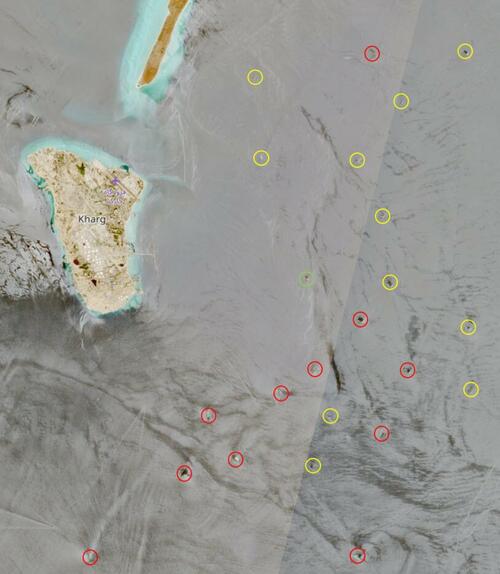
Iran's Oil Lifeline Choked: 10 Days of Zero Loadings at Kharg Island Exposes Limits of Counter-Blockade Strategy
Satellite data confirms 10+ days of zero tanker loadings at Iran's Kharg Island amid U.S. naval blockade, slashing export revenues, forcing storage buildup, and risking production damage. Shift to Jask offers limited relief; land routes insufficient. Broader war context since Feb 2026 connects to global oil tightening and potential diplomatic pressure points missed in limited mainstream reporting.
In a development with significant implications for global energy markets, Iran's primary oil export terminal at Kharg Island has recorded no loadings of large ocean-going tankers for at least ten consecutive days as of mid-May 2026. Satellite imagery analyzed by Bloomberg confirms empty berths since May 8, coinciding with the intensification of a U.S. naval blockade imposed in April. This shutdown is depriving Tehran of critical export revenues while forcing crude into onshore storage or floating tankers, potentially leading to production shut-ins that could damage reservoirs if prolonged.[1][2]
The situation reflects the effectiveness of the U.S. "counter-blockade" against Iran's earlier attempts to restrict tanker traffic through the Strait of Hormuz following the outbreak of conflict in late February 2026. Prior to the U.S. action, Iran had positioned itself as a dominant exporter by disrupting other nations' shipping. Now, U.S. Navy operations have redirected or disabled dozens of Iran-linked vessels, with Central Command reporting over 75 redirections and four disabled since mid-April. Activity has partially shifted to the Jask terminal outside the Strait but still within the blockade perimeter, where sanctioned tankers like the Vernon appear to be used primarily for storage rather than export.[3]
Deeper analysis reveals connections often missed in mainstream coverage: Iran's reliance on Kharg — which handles the vast majority of its seaborne crude — creates a single point of failure. With China as its primary customer (taking over 1.5 million barrels per day pre-blockade), the inability to move oil by sea has limited workaround options. Land routes via rail or pipelines offer minimal relief due to capacity constraints and higher costs, insufficient to offset seaborne losses estimated at $400-500 million daily. Prolonged storage risks not only economic strain but potential irreversible reservoir damage from pressure buildup during forced shut-ins, a factor rarely highlighted amid focus on immediate tanker counts.[4][5]
Corroborating data from maritime intelligence firms like Windward and TankerTrackers shows extended periods of empty terminals and accumulating "dark" tankers nearby, with some reports noting the first prolonged empty stretch since the war began. While isolated loadings have occurred (including one reported around May 14), the overall trend underscores a functional blockade squeezing Iran's economy. This aligns with U.S. statements from Treasury Secretary Scott Bessent and President Trump emphasizing the blockade's success in crashing Iran's oil revenues and broader economy. Global oil buffers are being drained at unprecedented rates, with potential price spikes if Iranian supply remains offline long-term.[6]
The minimal coverage outside specialized energy and defense feeds suggests possible narrative management around the escalating U.S.-Iran-Israel conflict, including prior U.S. strikes on Kharg infrastructure in March. Yet the satellite-verified reality at Kharg points to a tightening noose that could force Tehran toward concessions on its nuclear program and Hormuz access or risk systemic economic collapse. This episode highlights how control of maritime chokepoints remains decisive in modern hybrid warfare, with ripple effects on Asian importers and worldwide energy security.
LIMINAL: The sustained zero-loading period at Kharg is accelerating Iran's revenue collapse and reservoir risks faster than public reporting suggests, likely forcing either major concessions on Hormuz or risky escalation within weeks while quietly tightening global oil availability and benefiting alternative producers.
Sources (5)
- [1]Kharg Island Has No Tankers Loading in Sign Blockade Is Biting(https://www.bloomberg.com/news/articles/2026-05-18/kharg-island-has-no-tankers-loading-in-sign-blockade-is-biting)
- [2]US naval blockade squeezes Iran's oil exports, forces crude onto floating storage(https://www.reuters.com/business/energy/us-naval-blockade-squeezes-irans-oil-exports-forces-crude-onto-floating-storage-2026-04-30/)
- [3]First Oil Tanker Loads at Kharg Island Since May 7, Maritime Group Says(https://www.wsj.com/livecoverage/iran-us-china-news-2026/card/first-oil-tanker-loads-at-kharg-island-since-may-7-maritime-group-says-MWU81TpDHveRqQ6Wkt5f)
- [4]2026 United States naval blockade of Iran(https://en.wikipedia.org/wiki/2026_United_States_naval_blockade_of_Iran)
- [5]Iran Looks to the Region to Blunt the U.S. Blockade(https://thesoufancenter.org/intelbrief-2026-may-4/)