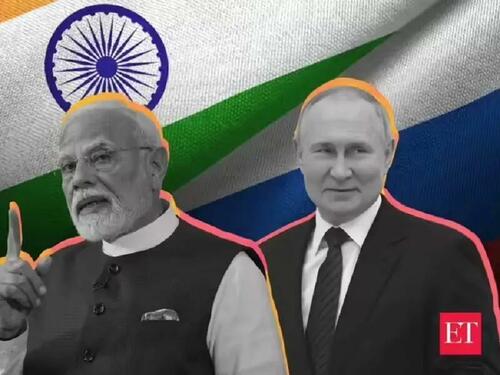
Russia-India Economic Rebalancing Plan Signals Shift in Global Trade Alliances Amid Western Sanctions
A joint report by Russian and Indian think tanks proposes a $100 billion trade target by 2030, focusing on SMEs, localization, and trade corridors to bypass Western sanctions. Beyond the original coverage, this article explores overlooked geopolitical implications, historical parallels, and risks in third-country ventures, labor shifts, and tech cooperation, framing the plan as part of a broader non-Western trade realignment.
A recent joint report by the Russian International Affairs Council (RIAC) and India’s Gateway House, titled 'Toward More Balanced Russia–India Economic Relations,' outlines a strategic plan to achieve $100 billion in bilateral trade by 2030, addressing sanctions, bureaucratic hurdles, and logistical challenges. While the original coverage by Andrew Korybko on ZeroHedge highlights key proposals like the role of Indian SMEs, localization of production, and optimization of trade corridors such as the North-South Transport Corridor, it misses deeper geopolitical implications and historical parallels that contextualize this partnership.
First, the report’s emphasis on SMEs as a workaround for US secondary sanctions reflects a broader trend of non-Western economies adapting to a fragmented global financial system. This mirrors strategies employed during the Cold War, when India and the Soviet Union used barter trade to bypass Western economic restrictions. Today, with Russia facing intensified sanctions post-2022 Ukraine conflict, the proposal to emulate China’s 'teapot' refinery model for Indian oil SMEs suggests a deliberate effort to decentralize economic exposure. However, the report and subsequent coverage underplay the risk of regulatory pushback from the US, which has previously targeted smaller entities under sanctions regimes, as seen in enforcement actions against Iranian oil traders in 2020.
Second, the plan to localize production and establish joint ventures in third countries like Afghanistan and Kenya introduces a geopolitical layer not fully explored in the original analysis. This move positions Russia and India as potential mediators in regional markets, challenging the dominance of Western-led trade frameworks. For instance, cooperation in Afghanistan could intersect with India’s historical interest in Central Asian connectivity via the Chabahar Port project, which also counters China’s Belt and Road Initiative. Yet, the report glosses over security risks in volatile regions, a critical oversight given recent instability in Afghanistan post-2021 US withdrawal.
Third, the labor cooperation proposal—replacing Central Asian workers with Indian labor in Russia—signals a demographic and strategic pivot. While Korybko notes this as a 'work in progress,' he misses its alignment with Russia’s broader demographic crisis (a shrinking working-age population, down 6% since 2010 per World Bank data) and India’s surplus labor pool. This could reshape migration patterns in Eurasia, potentially straining Russia’s domestic social policies, which have historically favored Slavic labor over South Asian inflows.
Finally, the report’s skepticism about technological cooperation, particularly in AI, underestimates the strategic necessity of such partnerships in a multipolar tech race. While global competition is a valid barrier, both nations have incentives to counterbalance US and Chinese tech dominance, as evidenced by India’s push for data sovereignty under its 2022 Digital Personal Data Protection Act and Russia’s 'sovereign internet' policies since 2019. This missed opportunity for deeper analysis suggests the report prioritizes immediate trade gains over long-term strategic alignment.
In the broader context, this Russia-India economic rebalancing plan is not merely a bilateral initiative but a signal of emerging non-Western alliances reshaping global trade amid Western sanctions. It parallels efforts within the BRICS framework, where both nations advocate for de-dollarization, as seen in their increased use of local currencies for trade (up to 60% of Russia-India transactions in 2023 per RBI data). However, achieving the $100 billion trade target by 2030 remains uncertain, not only due to logistical and bureaucratic challenges but also due to unpredictable geopolitical shocks, such as potential escalations in the Middle East affecting energy markets, as Korybko briefly notes with reference to a 'Third Gulf War.'
This plan, while ambitious, reveals a critical pattern: sanctioned states like Russia are increasingly leveraging partnerships with neutral powers like India to build economic resilience. Yet, the feasibility of these proposals hinges on navigating external pressures and internal constraints, elements insufficiently addressed in the original coverage.
MERIDIAN: The Russia-India economic plan could accelerate non-Western trade alliances, but its success depends on navigating US sanctions and regional instability, which may delay the $100 billion trade goal beyond 2030.
Sources (3)
- [1]Toward More Balanced Russia–India Economic Relations (RIAC & Gateway House Report)(https://russiancouncil.ru/en/analytics-and-comments/analytics/toward-more-balanced-russia-india-economic-relations/)
- [2]World Bank Data on Russia’s Demographic Trends(https://data.worldbank.org/country/russian-federation)
- [3]Reserve Bank of India Report on Local Currency Trade Settlements(https://www.rbi.org.in/Scripts/BS_PressReleaseDisplay.aspx?prid=55247)