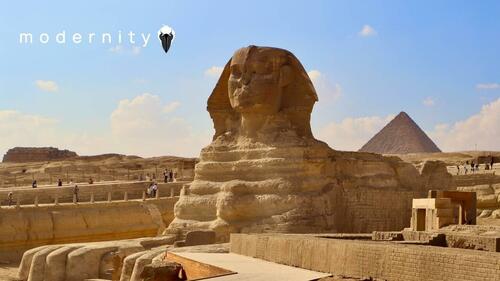
CIA's 1952 'Temple Under Sphinx' Notation and 2025 Radar Claims: Echoes of Suppressed Atlantean Archives?
A 1952 CIA photo inventory explicitly noting a 'Temple under Sphinx' has revived Edgar Cayce's Hall of Records prophecy, intersecting with controversial 2025 SAR claims of vast deep chambers beneath Giza. While the document is mundane, its language and timing fuel theories of suppressed pre-dynastic knowledge and institutional cover-ups of humanity's deeper past.
A routine declassified CIA photographic inventory from 1952, cataloging 1950 images taken near Giza, lists an entry that has ignited fresh speculation: 'Temple under Sphinx; July '50.' While the document itself is an unclassified submission form for graphic materials rather than an intelligence assessment, the specific phrasing stands out amid otherwise mundane listings like 'Sphinx,' 'Tourist at Pyramids,' and 'Ruins near Sphinx.' This has been interpreted by alternative researchers as potential indirect confirmation of structures beyond the known Sphinx Temple at ground level, tying into longstanding fringe narratives of a Hall of Records.[1][2]
The Hall of Records concept originates primarily with Edgar Cayce, the early 20th-century psychic who described an underground repository near the Sphinx's right paw, built by Atlantean refugees to preserve advanced knowledge of science, history, and spirituality before a cataclysm. Cayce predicted its discovery would coincide with humanity's readiness for a new epoch of understanding. Mainstream Egyptology has consistently found no evidence for such a chamber despite decades of excavations, seismic surveys, and projects like ScanPyramids, which have detected only minor voids elsewhere on the plateau. Yet the CIA reference—public in the agency's Reading Room since declassification in 1999—functions as a Rorschach test for those suspecting institutional gatekeeping of deep history.[3][4]
This archival anomaly gains traction when linked to 2025 claims by Italian researcher Corrado Malanga (University of Pisa) and Scottish engineer Filippo Biondi (University of Strathclyde). Using Synthetic Aperture Radar (SAR) tomography on satellite data, they reported a sprawling underground complex beneath the Giza pyramids and Sphinx vicinity: eight deep vertical shafts descending over 2,000 feet, multi-level chambers, and geometric connections potentially linking the three main pyramids. Spokesperson Nicole Ciccolo framed the findings as possibly corresponding to the legendary 'Halls of Amenti,' suggesting a pre-dynastic or even older origin that could upend sacred topography narratives. However, the work remains non-peer-reviewed in major journals, has drawn sharp criticism for methodological limits on deep penetration, and faces accusations of exaggeration tied to Malanga's prior interest in ufology and alternative Egyptology. Skeptics argue the anomalies may be natural geology, urging physical verification that Egyptian authorities have not endorsed.[5][6]
Viewed through the lens of suppressed history, these intersections suggest more than coincidence. The CIA's early Cold War-era documentation of Egyptian sites occurred against a backdrop of shifting geopolitics in the Nile Valley, just before the 1952 revolution. Intelligence agencies have historically shown interest in archaeological mysticism—evident in declassified remote viewing programs and psychic research during the same era. The persistent 'under Sphinx' descriptor, even if possibly a shorthand for the known lower temple or a misfiled caption, fits larger patterns where bureaucratic language inadvertently validates heterodox claims. Mainstream dismissal often relies on appeals to authority rather than exhaustive transparent scanning, fueling distrust. If the 2025 radar signatures hold under scrutiny, they could connect to global megalithic underground traditions, implying a shared forgotten technological or cultural layer predating accepted timelines. Absent excavation or independent verification, the story underscores how declassified fragments and contested remote sensing keep alive questions of what governments or academic gatekeepers might prefer remains buried—both literally and figuratively.
Liminal Observer: Renewed public scrutiny of Giza's subsurface via independent tech could erode official narratives on human origins within 5-10 years, pressuring disclosures that blend fringe prophecy with emerging geophysical data.
Sources (4)
- [1]CIA Reading Room - Presentation Form for Graphic Material(https://www.cia.gov/readingroom/document/cia-rdp83-00423r000100200001-7)
- [2]Uncovering Secrets of the Sphinx(https://www.smithsonianmag.com/history/uncovering-secrets-of-the-sphinx-5053442/)
- [3]Researchers say they used SAR to find vast city beneath pyramids(https://www.jpost.com/archaeology/archaeology-around-the-world/article-847207)
- [4]The Controversial Case of Giza's “Underground City”(https://answersingenesis.org/archaeology/ancient-egypt/controversy-giza-underground-city/)