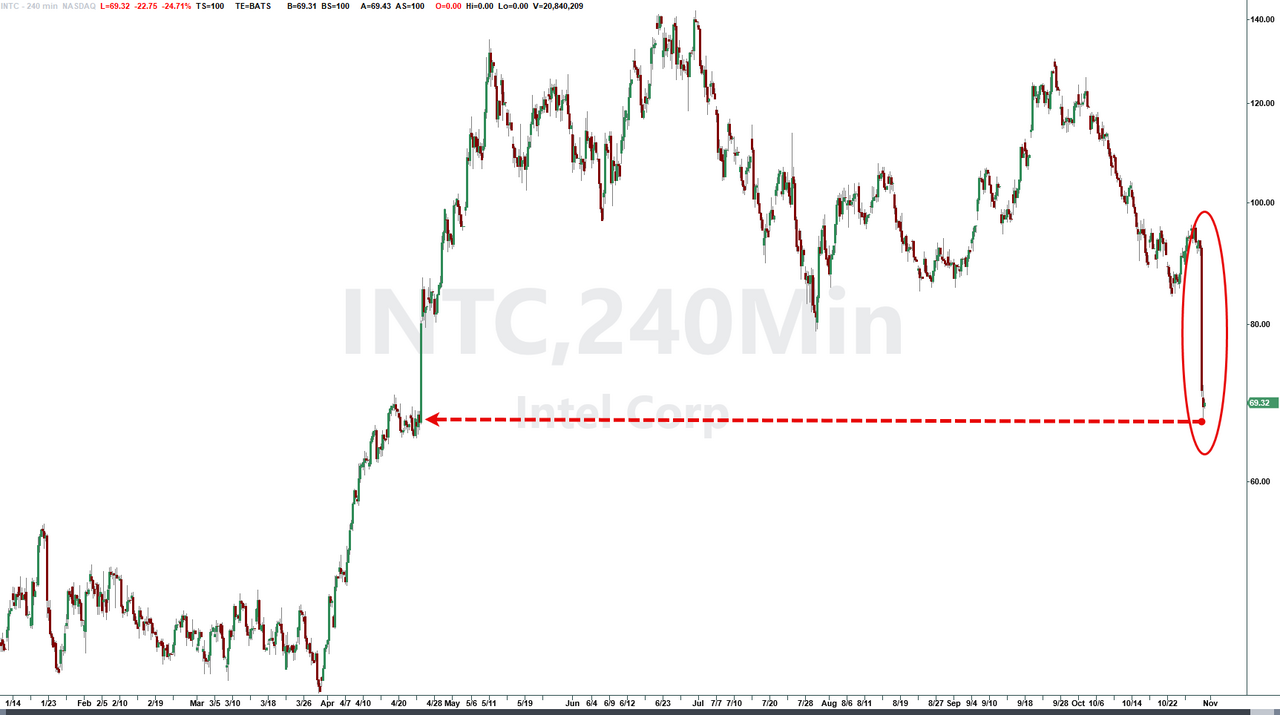
Intel Stock Plunges 25% on PC Weakness Amid AI-Driven Memory Shortages
Intel's Q3 2026 earnings revealed robust AI/data center growth overshadowed by PC market weakness from AI-induced memory shortages, triggering a historic stock plunge with broad market and employment implications.
Intel shares cratered nearly 25-29% in premarket and early trading on October 30, 2026, marking one of the company's steepest single-day declines on record, after the chipmaker reported Q3 results that highlighted a stark divergence between its AI-fueled data center growth and a sharp slowdown in its traditional PC business.
Third-quarter revenue rose 21% year-over-year to $16.51 billion, with data center and AI revenue surging 78% to $7.32 billion. However, client computing sales fell 5% to $8.1 billion, and the company guided Q4 revenue to $15-16 billion—well below analyst estimates of around $17 billion—along with adjusted EPS of $0.25 versus expectations of $0.43. Gross margins were also projected lower at 38%.
Executives and analysts attributed the weakness to a 'surprisingly severe PC correction,' exacerbated by surging memory chip prices driven by AI data center demand, which has created supply shortages and higher costs for PC makers. Intel expects global PC shipments to decline about 12% in 2026 and another 10% in 2027, with the slowdown persisting through at least the first half of next year. An accident at its Israel fab added further pressure, contributing roughly $300 million in lost revenue.
The selloff erased over $100 billion in market value and triggered broader chip sector declines, including drops in AMD, TSMC, and ASML shares. While Intel's long-term foundry and AI ambitions remain intact, the results underscore how AI infrastructure demand is indirectly cannibalizing legacy PC revenues that still comprise a major portion of the company's top line.
This event directly ripples into jobs: lower valuations pressure R&D budgets, hiring, and supplier ecosystems in the semiconductor and PC industries, amplifying volatility for tech workers amid shifting market dynamics.
Market Analyst: The PC-AI supply chain tension could prolong semiconductor sector volatility, pressuring Intel's valuation and indirectly affecting thousands of jobs in tech manufacturing and related industries through reduced investment and hiring.
Sources (5)
- [1]Intel plunges more than 25% amid surging memory costs and PC weakness(https://www.businessinsider.com/intel-shares-plunge-revenue-drop-warning-ai-led-supply-shortages-2026-10)
- [2]PC chip plunge wipes out a quarter of Intel’s value(https://www.theregister.com/systems/2026/10/30/pc-chip-plunge-wipes-out-a-quarter-of-intels-value/5306531)
- [3]Intel warning sparks chip rout as PC weakness clouds turnaround(https://www.theglobeandmail.com/investing/article-intel-warning-sparks-chip-rout-as-pc-weakness-clouds-turnaround/)
- [4]Why Intel's stock is sinking toward its worst day in two years - and a $128 billion wipeout(https://www.morningstar.com/news/marketwatch/2026103091/why-intels-stock-is-sinking-toward-its-worst-day-in-two-years-and-a-128-billion-wipeout)
- [5]Intel shares fall 22% as weak sales outlook dents turnaround(https://www.ft.com/content/d7540e89-08db-43d3-92e0-3c15dd3a60cb)