The Rare Earth Disconnect: Elevated Prices and Supply Constraints Clash with Depressed Mining Stocks
Rare earth supplies remain tight with high ex-China prices due to Chinese export controls, yet mining stocks and REMX have plummeted; analysts flag a fundamental disconnect with potential investment implications ahead of key November 2026 deadlines.
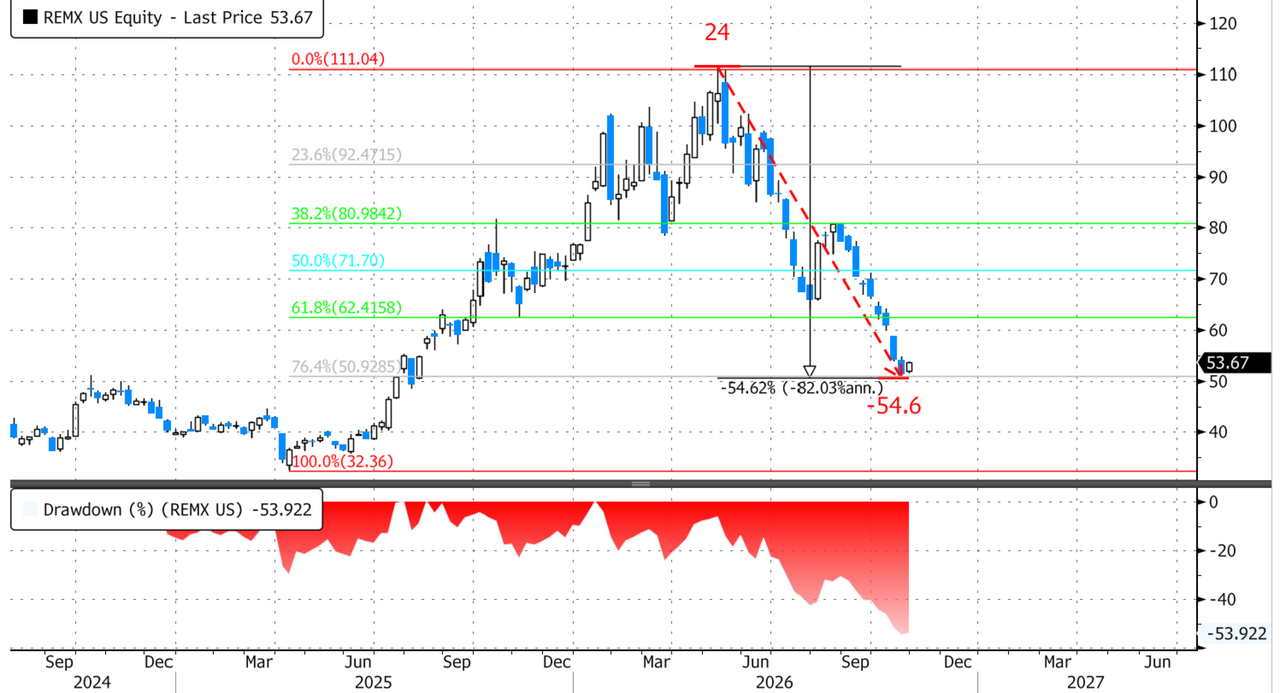
In late October 2026, critical minerals analysts at Canaccord Genuity highlighted a stark divergence in rare earth markets: tight global supplies and sharply elevated spot prices outside China, driven by Beijing's export licensing regime and resource nationalism, alongside a prolonged bear market in mining equities. This 'great rare earth disconnect' has left the VanEck Rare Earth/Strategic Metals ETF (REMX) down roughly 55% from its spring 2026 peak near $111, trading around $54 amid a broader selloff that began in early summer.
China's April 2025 export controls on heavy rare earths (including dysprosium, terbium, and yttrium) and related magnets have created significant price premiums ex-China. Dysprosium oxide trades at approximately $1,074/kg in Rotterdam versus $227/kg domestically in China; terbium shows similar gaps, while yttrium oxide has reached extreme differentials. Overall rare earth exports from China remain well below pre-control levels despite some monthly fluctuations, with September 2026 data showing shipments still constrained. The one-year suspension of expanded October 2025 controls is set to expire November 10, 2026, adding urgency.
Analysts from William Blair and Canaccord have challenged market assumptions that Chinese supply constraints would ease, describing such views as incorrect amid persistent quasi-monopoly control—China accounts for ~90% of global refining and even higher shares for heavy rare earth separation. Non-Chinese producers and developers covered by Canaccord have fallen 28% and 17% respectively year-to-date, trading at steep discounts to net asset value despite favorable long-term supply-demand dynamics (projected 7%+ annual demand growth from EVs, renewables, defense, and tech).
The REMX rebound of ~4% in recent sessions may reflect technical factors or reassessment of geopolitical risks, but the underlying tension persists: Western efforts to diversify face refining bottlenecks, with full alternative capacity years away. This misalignment carries implications for tech supply chains, green energy transitions, and defense procurement as the November deadline approaches.
[LIMINAL]: Persistent Chinese controls on heavy rare earths could sustain price premiums and force accelerated Western diversification, creating asymmetric upside for non-Chinese miners if stocks re-rate to reflect supply realities rather than macro sentiment.
Sources (5)
- [1]China Squeezed Rare Earth Supply. Why Are The Miners Still Down 28%?(https://wallstreetlogic.com/metals-and-mining/china-squeezed-rare-earth-supply-why-are-the-miners-still-down-28/)
- [2]Report: China’s rare earth exports still ‘well below’ historical levels(https://insidetrade.com/critical-minerals-news/report-china-s-rare-earth-exports-still-well-below-historical-levels)
- [3]Riding the rare earths rollercoaster: Outlook strong despite volatility(https://stockhead.com.au/resources/riding-the-rare-earths-rollercoaster-outlook-strong-despite-volatility/)
- [4]Rare Earth Export Pause: 10 Nov Deadline and Key Outcomes(https://rare-earth-mining.com/rare-earth-export-pause-expiry-november-2026/)
- [5]VanEck Rare Earth and Strategic Metals ETF Performance Data(https://ycharts.com/companies/REMX)