Ironic Entanglements: China's Record US Ethane Imports Expose Fragile Supply Chains Amid Iran Conflict
China's pivot to record US ethane imports amid Hormuz disruptions from the Iran conflict reveals ironic US-China energy interdependence, exposing Asia's petrochemical vulnerabilities and the underreported global economic ripples of Middle East instability on plastics and manufacturing supply chains.
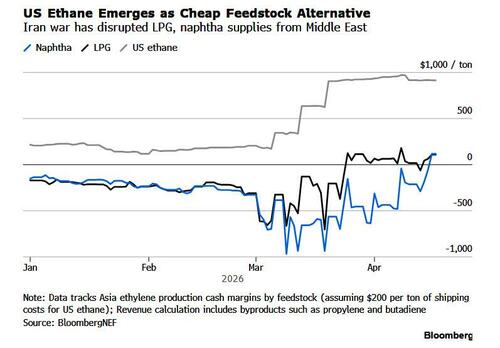
As the Strait of Hormuz remains contested amid the ongoing US-Iran-Israel conflict, China is projected to import a record 800,000 tons of US ethane in April — approximately 60% above monthly averages — to sustain its petrochemical sector. This surge, driven by the effective blockage of naphtha and LPG shipments from Persian Gulf producers, highlights not only immediate feedstock shortages but deeper, underreported interconnections between Middle East geopolitics and global manufacturing. According to multiple analysts, over 50% of China's pre-conflict naphtha imports and 40% of its LPG came from the region; with no strategic stockpiles for these specific inputs despite vast oil reserves, its ethylene crackers — which rely on naphtha for 57% of capacity versus just 16% from ethane — face acute pressure. Ethane, primarily sourced from US shale gas, has emerged as a viable and highly profitable substitute, with margins reportedly ten times higher than naphtha-based production as of mid-April. New downstream capacity from players like Wanhua Chemical and Sinopec Ineos has further amplified demand. This development carries profound ironies. Just over a year ago, US-China trade tensions saw debates over leveraging American ethane exports against Chinese rare earth dominance. A brief detente pushed the issue aside, yet the current crisis has quietly deepened China's reliance on US energy liquids at a moment when broader economic decoupling remains a stated goal for hawks in both capitals. The mutual vulnerabilities — US leverage via ethane and China's via rare earths and processing — create a form of economic MAD (mutually assured disruption) that receives scant sustained coverage compared to kinetic military updates. The International Energy Agency has noted petrochemical feedstocks are experiencing the war's most immediate global effects, with Asian supply chains thrown into disarray; Japan has turned to US and African naphtha sources, while broader ripple effects threaten plastics, packaging, automotive components, and consumer goods worldwide. Higher input costs are already flowing through, potentially contributing to downstream inflation in everything from electronics to textiles at a time when global growth remains uneven. This episode underscores how regional conflicts in energy chokepoints like Hormuz cascade far beyond oil prices into specialized chemical markets that underpin modern industry. It also reveals the limits of diversification efforts to date: Asia's petrochemical heartland was built atop Middle Eastern feedstock concentration, a single-point failure now laid bare. Long-term, expect accelerated investment in flexible crackers, African or domestic alternatives, and renewed scrutiny of strategic reserves beyond crude. In the near term, with President Trump's planned mid-May Beijing visit, US energy exports are likely to feature prominently — potentially tempering tariff or export control escalations despite the rivalry. The episode serves as a reminder that in an interconnected world, Middle East wars are rarely contained; their economic aftershocks reshape rivalries in unexpected ways, often binding adversaries tighter through necessity even as political rhetoric suggests otherwise.
Geopolitical Economist: This crisis may accelerate pragmatic US-China energy deals despite rivalry, while forcing both nations and Asia to invest heavily in feedstock diversification — ultimately raising long-term costs for global consumers as the hidden price of concentrated Middle East dependencies becomes visible.
Sources (5)
- [1]Iran war deepens China's dependence on US for niche gas(https://www.bloomberg.com/news/articles/2026-04-20/iran-war-deepens-china-s-dependence-on-the-us-for-niche-gas)
- [2]Middle East conflict impact: China's dependence on US ethane deepens; set to import record volume(https://timesofindia.indiatimes.com/business/international-business/middle-east-conflict-impact-chinas-dependence-on-us-ethane-deepens-set-to-import-record-volume/articleshow/130385112.cms)
- [3]China's April Ethane Imports From the U.S. Set to Hit All-Time High(https://oilprice.com/Latest-Energy-News/World-News/Chinas-April-Ethane-Imports-From-the-US-Set-to-Hit-All-Time-High.html)
- [4]How China is plugging energy supply gaps left by US-Iran conflict(https://www.reuters.com/markets/commodities/how-china-is-plugging-energy-supply-gaps-left-by-us-iran-conflict-2026-04-14/)
- [5]2026 Strait of Hormuz crisis(https://en.wikipedia.org/wiki/2026_Strait_of_Hormuz_crisis)