Asia's Surveillance Surge: Indian Cities Lead Global CCTV Density, Foretelling Pan-Asian Techno-Authoritarian Governance
Data from Comparitech and Visual Capitalist shows Asian cities, led by Indian metropolises like Hyderabad, dominate global surveillance rankings with eight of the top ten most surveilled urban areas. This reflects a broader regional shift toward techno-authoritarian governance via smart city programs, AI-integrated CCTV, and private-public camera networks—extending beyond China-focused narratives to reveal converging privacy risks and social control mechanisms across democracies and hybrids.
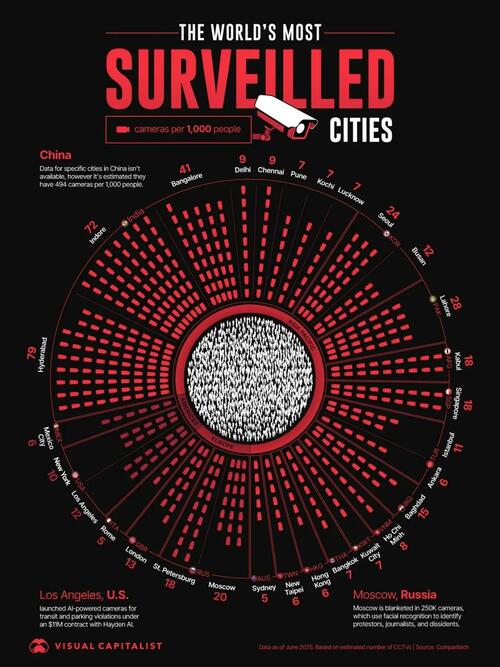
New data confirms that eight of the world's ten most surveilled cities are in Asia, extending well beyond the well-documented Chinese surveillance state. According to Comparitech's updated 2025 analysis, Hyderabad, India ranks first among non-Chinese cities with approximately 79 cameras per 1,000 residents (900,000 cameras for a population of over 11 million), followed closely by Indore, India (72 per 1,000) and Bangalore, India (41 per 1,000). Lahore, Pakistan; Seoul, South Korea; Singapore; and Afghan and Russian cities round out the top tier. China itself maintains an estimated 700 million cameras nationwide, equating to 494 per 1,000 people—nearly one camera for every two citizens—though city-level breakdowns remain opaque due to state control. Visual Capitalist visualizations of this data underscore the regional dominance, with Indian smart city initiatives driving rapid deployment through geo-tagging of hundreds of thousands of public and private cameras for police integration.
This trend reveals a deeper convergence toward techno-authoritarian governance across Asia. While Western coverage frequently isolates criticism to China's Skynet project and facial recognition-enabled social control, parallel developments in democratic and hybrid regimes are under-contextualized. India's Smart Cities Mission has integrated massive CCTV networks with AI for traffic enforcement, crime prediction, and real-time monitoring, often linking private business and resident cameras directly to law enforcement feeds. In Bangalore, over 535,000 cameras have been mapped as "eyes and ears" for authorities. Lahore has mapped 400,000 private cameras as part of a larger Punjab surveillance push. Singapore's "Smart Nation" initiative deploys pervasive sensors and analytics under the guise of efficiency and safety, raising alarms about normalized mass monitoring. South Korea similarly employs dense urban camera systems.
Human Rights Watch has documented how China's techno-authoritarian model—merging surveillance, AI, and social scoring—is being exported and adapted globally, inspiring similar architectures elsewhere. Academic analyses of Indian smart cities highlight risks including mass surveillance, caste and gender-based over-policing, chilling effects on speech, and insufficient privacy safeguards despite the fundamental right to privacy recognized by the Indian Supreme Court. There is limited correlation between camera density and actual crime reduction, suggesting these systems primarily expand state and municipal control over populations rather than purely addressing security.
Private cameras are increasingly federated into public networks worldwide, but Asia's scale and speed stand out. This infrastructure enables not just retrospective footage requests but live feeds, facial recognition, and predictive analytics—building blocks of governance that prioritize compliance and data extraction. Western cities like London (13.4 per 1,000) and New York (around 10 per 1,000) lag significantly, yet even there, camera registries and police integration are expanding. The Asian model signals a future where pervasive surveillance becomes default urban infrastructure, blending authoritarian efficiency with "smart" developmental rhetoric. As these systems mature and interconnect, they risk entrenching power through constant visibility, a pattern that transcends any single nation and merits broader scrutiny.
LIMINAL: Asia is rapidly prototyping a scalable techno-authoritarian governance template where ubiquitous cameras, data integration, and AI analytics normalize constant monitoring as the foundation of urban order, a model poised to influence global cities prioritizing control and efficiency over privacy.
Sources (4)
- [1]Surveillance Camera Statistics: Which City has the Most CCTV?(https://www.comparitech.com/vpn-privacy/the-worlds-most-surveilled-cities/)
- [2]Ranked: The World's Most Surveilled Cities(https://www.visualcapitalist.com/ranked-the-worlds-most-surveilled-cities-by-camera-density/)
- [3]China’s Techno-Authoritarianism Has Gone Global(https://www.hrw.org/news/2021/04/08/chinas-techno-authoritarianism-has-gone-global)
- [4]Smart city initiatives, practices and technologies: surveillance in breach of fundamental human rights(https://www.sciencedirect.com/science/article/pii/S0736585326000274)