Completed CDAA at Bejucal: CSIS Satellite Imagery Confirms Expansion of Suspected Chinese-Linked SIGINT Site in Cuba
CSIS geospatial analysis corroborates completion of an advanced listening post in Cuba potentially enhancing adversarial surveillance near U.S. shores, consistent with multi-year patterns of suspected Sino-Cuban intelligence cooperation.
Recent satellite imagery analyzed by the Center for Strategic and International Studies (CSIS) shows that construction of a large circularly disposed antenna array (CDAA) at the Bejucal signals intelligence (SIGINT) facility near Havana, Cuba, has been completed. The 32-antenna array—comprising 19 outer and 13 inner elements—is larger than prior Cuban CDAAs observed by CSIS and appears operational as of mid-2026.
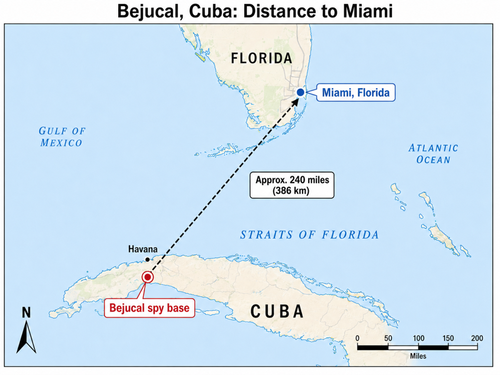
CDAAs enable high-frequency direction finding, allowing operators to intercept and geolocate radio transmissions over wide areas, potentially monitoring U.S. military, naval, and air activity across the Caribbean, Gulf of Mexico, and southeastern United States—just 145 km from Florida. CSIS notes the site's conversion from a linear antenna grid to the CDAA over two years, with cable-laying groundwork documented in April 2025 imagery now finished.
This builds on earlier CSIS reporting from July 2024 identifying four suspected Chinese-linked SIGINT sites in Cuba (Bejucal, Wajay, Calabazar, and El Salao near Santiago de Cuba). U.S. officials have previously acknowledged China's access to Cuban intelligence facilities since at least 2019, though CSIS emphasizes no direct unclassified "smoking gun" linking Beijing to specific equipment while noting historical suspicions dating to 2005 congressional testimony on Chinese operations in Bejucal.
The developments align with broader concerns over China's intelligence footprint in the Western Hemisphere, including dual-use space facilities elsewhere in Latin America. Congressional scrutiny, including 2025 House Homeland Security testimony, has highlighted the sites' potential to support PLA warfighting capabilities through signals collection.
[CSIS Analyst]: Ongoing upgrades at Bejucal and related sites indicate sustained investment in regional signals collection, likely increasing granularity of monitoring U.S. operations and complicating Western Hemisphere policy responses amid shifting alliances.
Sources (5)
- [1]New Activity at Possible Chinese Intelligence Facilities in Cuba(https://www.csis.org/analysis/new-activity-possible-chinese-intelligence-facilities-cuba)
- [2]At the Doorstep: A Snapshot of New Activity at Cuban Spy Sites(https://features.csis.org/hiddenreach/snapshots/cuba-china-cdaa-base/)
- [3]Satellite Images of Cuba Show Expansion of Suspected Chinese Spy Bases(https://www.wsj.com/politics/national-security/china-cuba-suspected-spy-bases-da1d6ec9)
- [4]Satellite Images From Cuba Spy Site Raise China Fears(https://www.newsweek.com/satellite-images-cuba-spy-site-raise-china-fears-2070325)
- [5]China's Intelligence Footprint in Cuba(https://www.csis.org/analysis/chinas-intelligence-footprint-cuba-new-evidence-and-implications-us-security)