Jane Street's $9.4 Billion Payouts Highlight Quant Trading Boom and Deepening Market Inequalities
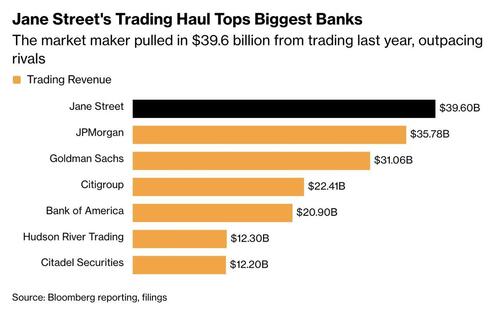
Jane Street’s $9.4 billion employee payouts in 2025, averaging $2.7 million per person, reflect the quant trading sector’s profitability with $39.6 billion in revenue. Beyond the numbers, this signals a shift in market power from banks to HFT firms, raises wealth inequality concerns, and highlights regulatory gaps amid global scrutiny and tech investment pivots.
Jane Street Group, a quantitative trading powerhouse, disbursed a staggering $9.4 billion in employee compensation in 2025, averaging $2.7 million per employee, following a record-breaking $39.6 billion in trading revenue. This payout, reported by Bloomberg and detailed in ZeroHedge, doubled the previous year’s distribution and underscores the firm’s dominance in the high-frequency trading (HFT) and market-making sectors. Beyond the headline numbers, this development signals broader shifts in global finance, including the growing influence of quant-driven firms over traditional banks, the concentration of wealth in niche sectors, and the potential for regulatory backlash amid market volatility.
Jane Street’s ascent—built on a $45 billion internal capital base and strategic investments in tech firms like Anthropic and CoreWeave—reflects a structural shift in market dynamics. Unlike traditional Wall Street banks such as Goldman Sachs or JPMorgan, which rely on diversified revenue streams, Jane Street’s profits are heavily tied to automated trading systems that exploit micro-inefficiencies during volatile periods. Primary financial disclosures cited by Bloomberg indicate that the firm’s adjusted EBITDA reached $31.2 billion, a figure that outstrips even the largest global investment banks on a per-employee basis. This efficiency is driven by a workforce of 3,500, composed largely of mathematicians and engineers, operating without a conventional CEO structure—a model that prioritizes algorithmic precision over hierarchical decision-making.
What original coverage often misses is the broader competitive landscape and systemic risks. Jane Street’s outperformance of rivals like Citadel Securities, as noted in the ZeroHedge report, coincides with a decade-long trend where quant firms have captured market share from traditional banks constrained by post-2008 regulations like Dodd-Frank. A 2023 Federal Reserve report on financial stability highlights that HFT firms now account for over 50% of U.S. equity market volume, raising concerns about liquidity provision during crises. Jane Street’s war chest allows it to weather such storms, but its dominance could exacerbate market fragility if algorithmic strategies amplify downturns—a risk underexplored in initial reports.
Moreover, the $9.4 billion payout intensifies debates on wealth inequality within finance. While Goldman Sachs partners might earn comparable sums, Jane Street’s per-employee compensation dwarfs industry norms, concentrating extraordinary wealth among a small, elite cohort. This mirrors patterns seen in tech, where firms like Google or Meta reward specialized talent disproportionately, but in finance, the societal impact is more direct: trading profits often come at the expense of less sophisticated market participants. A 2024 IMF working paper on financial inequality notes that HFT-driven profits contribute to a ‘winner-takes-all’ dynamic, potentially fueling populist backlash against Wall Street, even as firms like Jane Street maintain low public profiles.
Regulatory scrutiny, briefly mentioned in the original coverage, deserves deeper examination. Jane Street faces allegations of market manipulation in India and insider trading tied to the Terraform Labs collapse. While the firm denies these claims and seeks dismissal of lawsuits, as reported by Reuters in February 2025, these incidents highlight a gap in global oversight of quant trading. Unlike banks, which face stringent Basel III capital requirements, HFT firms operate in a regulatory gray zone, often exploiting cross-border arbitrage. This could prompt coordinated international action, especially as Jane Street expands in hubs like London.
Finally, Jane Street’s pivot to long-term tech investments signals a hybrid strategy that diverges from pure trading. Its stakes in Anthropic and CoreWeave, as cited in Bloomberg, suggest a bet on AI and cloud computing as future drivers of trading algorithms—a trend other quant firms may follow. This diversification, while a hedge against market saturation, introduces new risks tied to illiquid private valuations, a factor overlooked in initial reports that could impact future profitability if tech bubbles burst.
In synthesizing these perspectives, it’s clear Jane Street’s success is both a triumph of innovation and a harbinger of systemic challenges. The quant trading boom reshapes market competition, but at the cost of heightened inequality and regulatory blind spots. As this sector evolves, the balance between technological edge and market stability will remain a critical fault line.
MERIDIAN: Jane Street’s dominance in quant trading will likely spur tighter global regulations on HFT firms within the next 2-3 years as concerns over market stability grow. Tech investments may also face scrutiny if private valuations falter.
Sources (3)
- [1]Jane Street Paid Employees $9.4 Billion - Bloomberg via ZeroHedge(https://www.zerohedge.com/markets/jane-street-paid-employees-94-billion-twice-what-it-paid-last-year-after-record-results)
- [2]Federal Reserve Financial Stability Report 2023(https://www.federalreserve.gov/publications/2023-november-financial-stability-report.htm)
- [3]IMF Working Paper on Financial Inequality 2024(https://www.imf.org/en/Publications/WP/Issues/2024/03/15/Financial-Inequality-and-Market-Dynamics-546789)