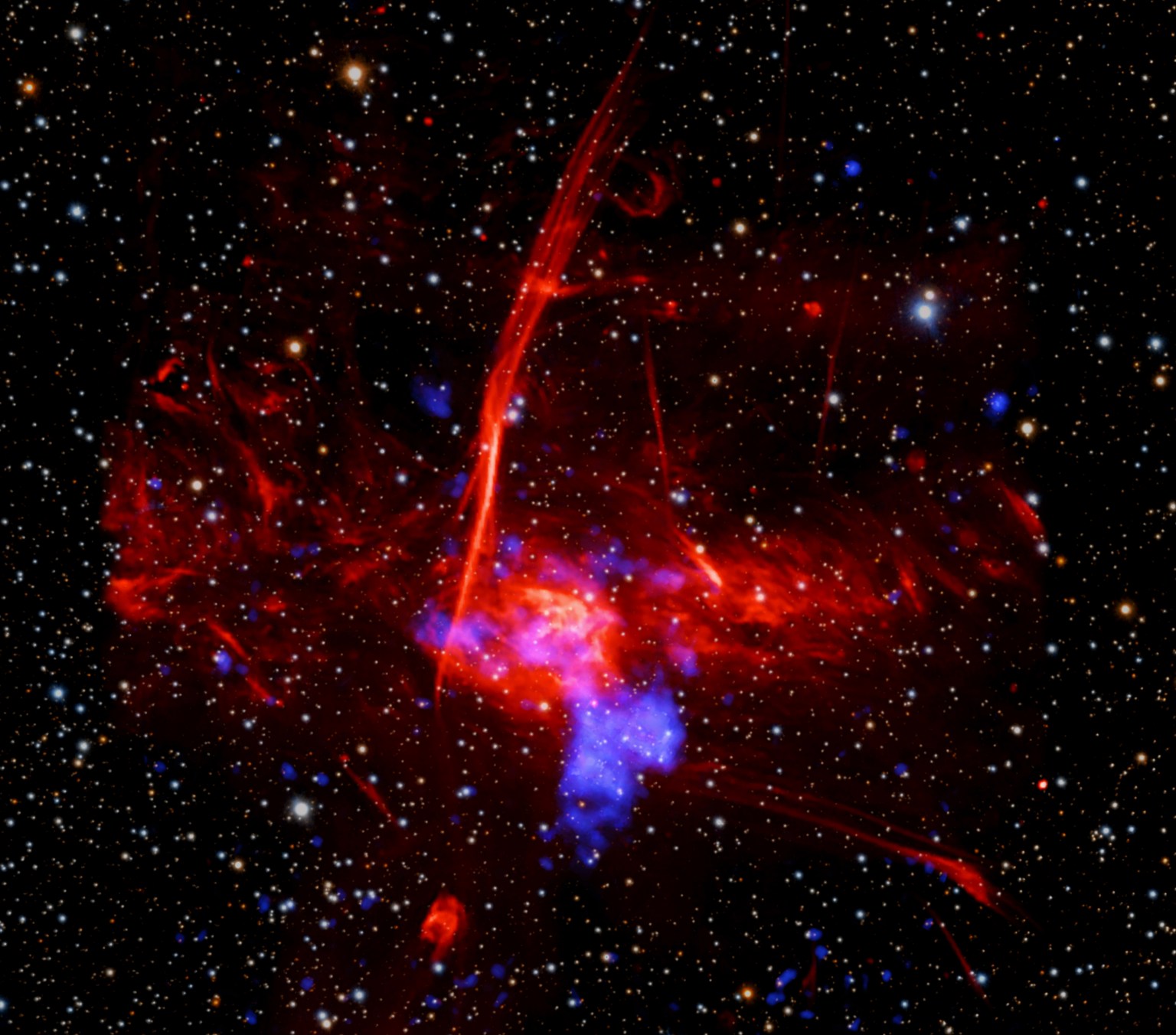
UCLA Team Reports Chandra X-ray Blob as Candidate Supernova Remnant 1,700 Years Old Near Sagittarius C
Chandra and XMM-Newton data reveal an X-ray excess inside Sagittarius C whose luminosity and morphology favor a young supernova remnant over stellar-wind emission. The candidate lies in a high-density, magnetized environment close to Sgr A* and shows no clear elemental enrichment. Confirmation requires abundance or kinematic follow-up that existing observations cannot yet provide.
The authors combined Chandra ACIS and XMM-Newton EPIC data with MeerKAT 1.28 GHz radio maps to isolate a compact X-ray feature whose surface brightness exceeds known stellar clusters by more than a factor of ten. No abundance enhancement of Si, S or Fe was detected, consistent with rapid mixing into the surrounding 10^4 K ionized gas previously mapped by SOFIA. The remnant sits inside a radio bubble whose expansion had already hinted at a recent energetic event. This location only 26,000 light-years from Earth places the explosion within the sphere of influence of Sgr A*, where tidal forces and magnetic filaments could alter remnant evolution. The absence of a pulsar or compact object in the current data leaves open the possibility that the X-rays arise from colliding winds rather than a single supernova. Deeper Chandra or XRISM spectroscopy targeting the 6.7 keV Fe line would distinguish the two scenarios within one observing cycle.
Zhu: XRISM 6.7 keV line mapping will show velocity-broadened emission above 3-sigma within 18 months if the feature is a remnant.
Sources (2)
- [1]Primary Source(https://iopscience.iop.org/article/10.3847/1538-4357/ad5f8e)
- [2]Supporting Source(https://science.nasa.gov/missions/chandra/nasas-chandra-discovers-possible-supernova-remnant-in-galactic-center/)