Druckenmiller’s WSJ Critique: Treasury Bond Buybacks Risk Eroding Market Credibility as Fiscal Signal
Druckenmiller’s op-ed critiques Treasury buybacks as misguided price management that weakens the bond market’s fiscal warning role, backed by market reaction and historical parallels; AI drafting and political timing added secondary headlines.
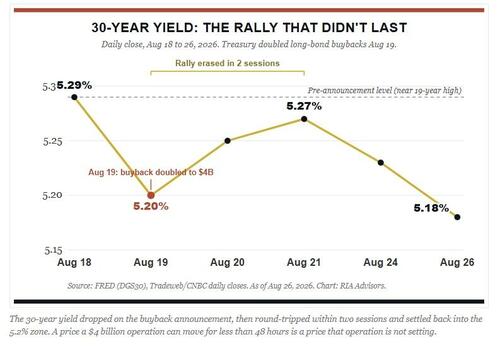
Stanley Druckenmiller’s August 24, 2026, Wall Street Journal op-ed, 'Let the Bond Market Speak,' delivered a pointed structural critique of the U.S. Treasury’s decision to double long-dated bond buyback operations to at least $4 billion per auction starting September 9. The move, announced August 19 shortly after 30-year yields touched a 19-year high near 5.335%, was framed by officials as liquidity support but interpreted by the market—and Druckenmiller—as price management.
Yields initially fell on the announcement but reversed within a day, with the long bond hovering around 5.2% thereafter, underscoring the market’s verdict that no genuine dysfunction (failed auctions, liquidity seizure) justified intervention. Druckenmiller emphasized that strong investor sponsorship in the sector already signaled a functioning market, rendering the action unnecessary and counterproductive.
The legendary investor, mentor to Treasury Secretary Scott Bessent, argued that artificially suppressing the long bond yield—the 'only fiscal disciplinarian the U.S. has left'—subsidizes procrastination on deficits running near 6% of GDP at full employment (4.1% unemployment), with national debt surpassing $40 trillion and net interest costs exceeding $1.1 trillion annually. He described elevated yields not as a crisis but an 'invoice' reflecting economic reality, warning that yield suppression historically evolves from technical operations into entrenched policy, citing the 1942–1951 Fed cap on long Treasuries that outlasted wartime needs.
Follow-up coverage highlighted that the op-ed was drafted with AI assistance, a detail Druckenmiller embraced without embarrassment, comparing it to using a calculator. Media reaction focused on the mentor-protégé dynamic and AI angle, often overshadowing the core argument about preserving Treasury market credibility ahead of midterms.
Corroborating analyses from Reuters, Bloomberg, and the Atlantic Council echo concerns that such interventions risk escalating into larger commitments, blurring the line between debt management and price controls, and diminishing the bond market’s role in enforcing fiscal restraint. The episode illustrates broader tensions in integrating policy tools with market signals amid high debt levels.
Druckenmiller: Expanded buybacks may temporarily dampen yields but will likely prompt larger interventions or credibility erosion unless paired with primary deficit reduction, amplifying long-term borrowing costs.
Sources (6)
- [1]Let the Bond Market Speak(https://www.wsj.com/opinion/let-the-bond-market-speak-81529d74)
- [2]Druckenmiller’s Surprising Critique of Bessent Was Delivered With the Help of AI(https://www.wsj.com/tech/ai/druckenmillers-surprising-critique-of-bessent-was-delivered-with-the-help-of-ai-9dd0a4fd)
- [3]US Treasury buybacks a 'mistake' costing credibility, says Druckenmiller(https://www.reuters.com/legal/transactional/us-treasury-buybacks-mistake-costing-credibility-says-druckenmiller-2026-08-25/)
- [4]Stanley Druckenmiller Calls Bessent’s Bond Buyback Plan a Mistake(https://www.bloomberg.com/news/articles/2026-08-25/druckenmiller-bessent-s-early-mentor-calls-bond-buys-a-mistake)
- [5]The danger of hitting mute on US bond markets(https://www.atlanticcouncil.org/content-series/inflection-points/the-danger-of-hitting-mute-on-us-bond-markets/)
- [6]Druckenmiller Warning: The Bond Market Already Priced It(https://seekingalpha.com/article/4941560-druckenmiller-warning-bond-market-already-priced-it)